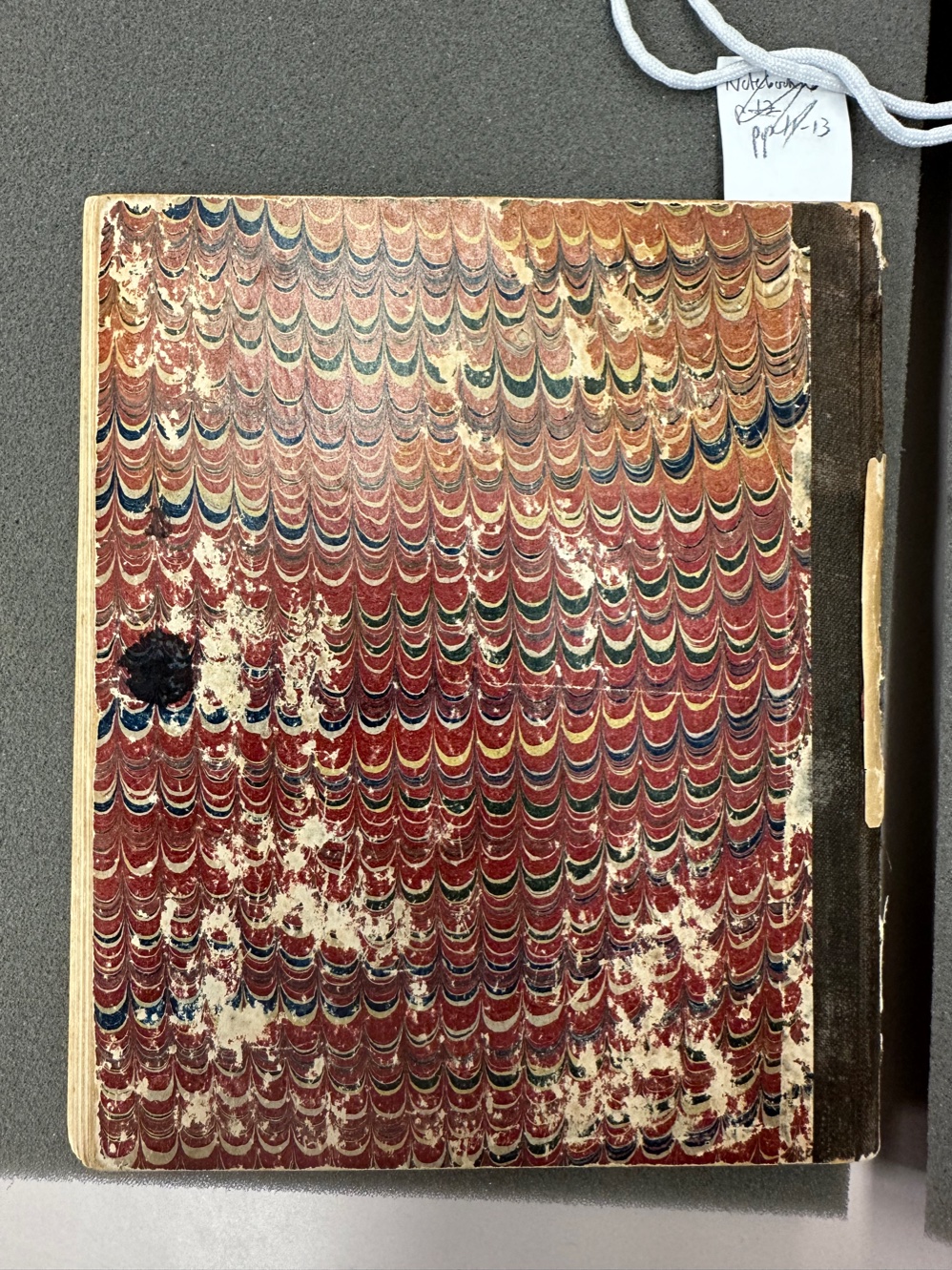
V_0111
Outside of front cover.
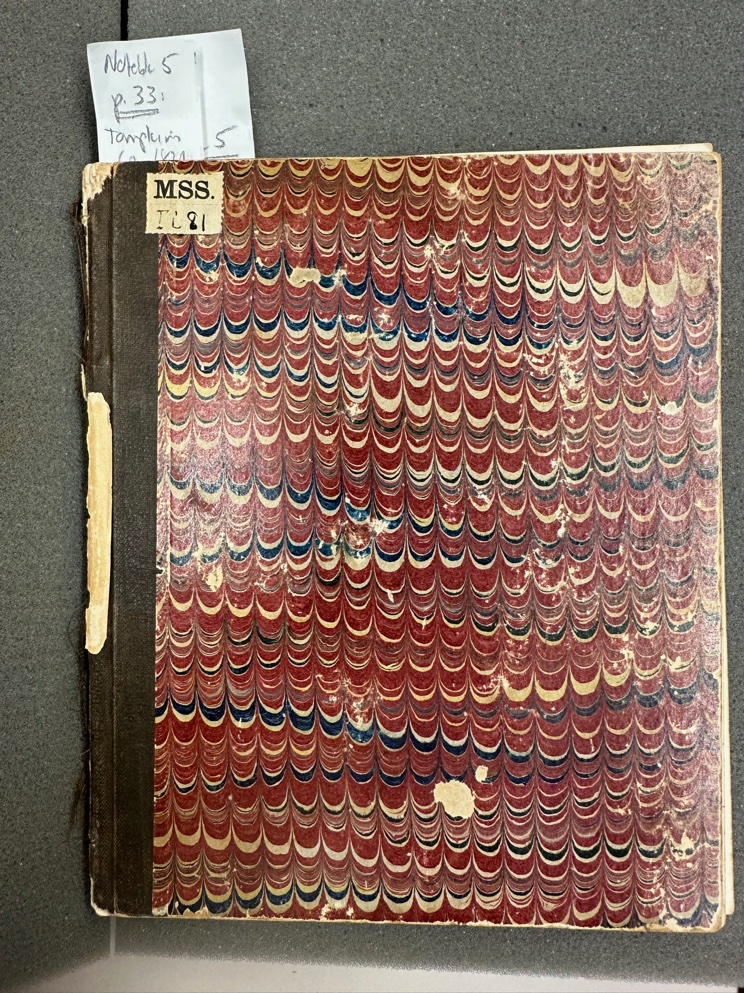
V_0111B
View of damaged spine showing signatures.
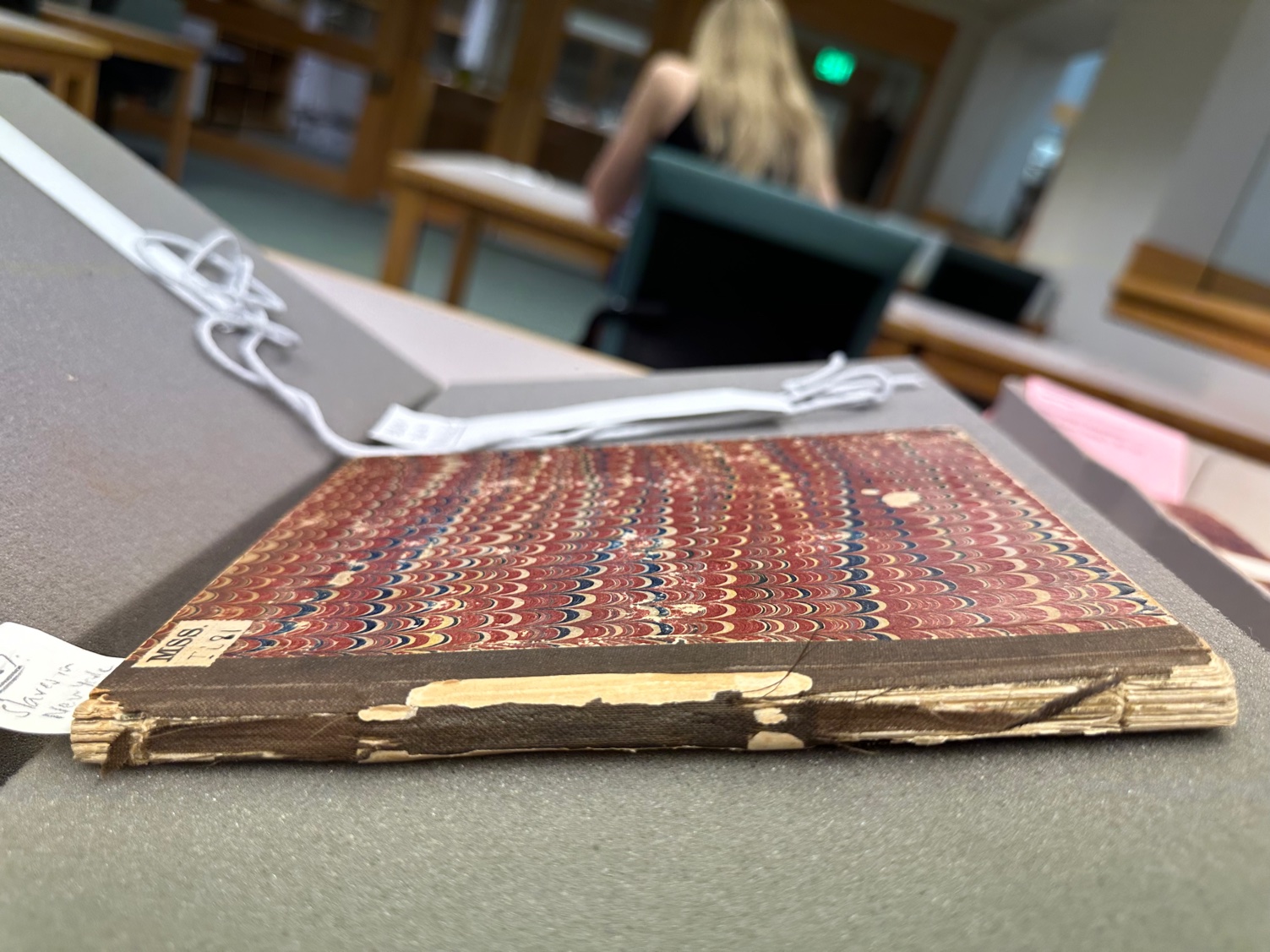
V_0112
Howards metalic hair brush
Inside of front cover showing accession codes and CU book plate.
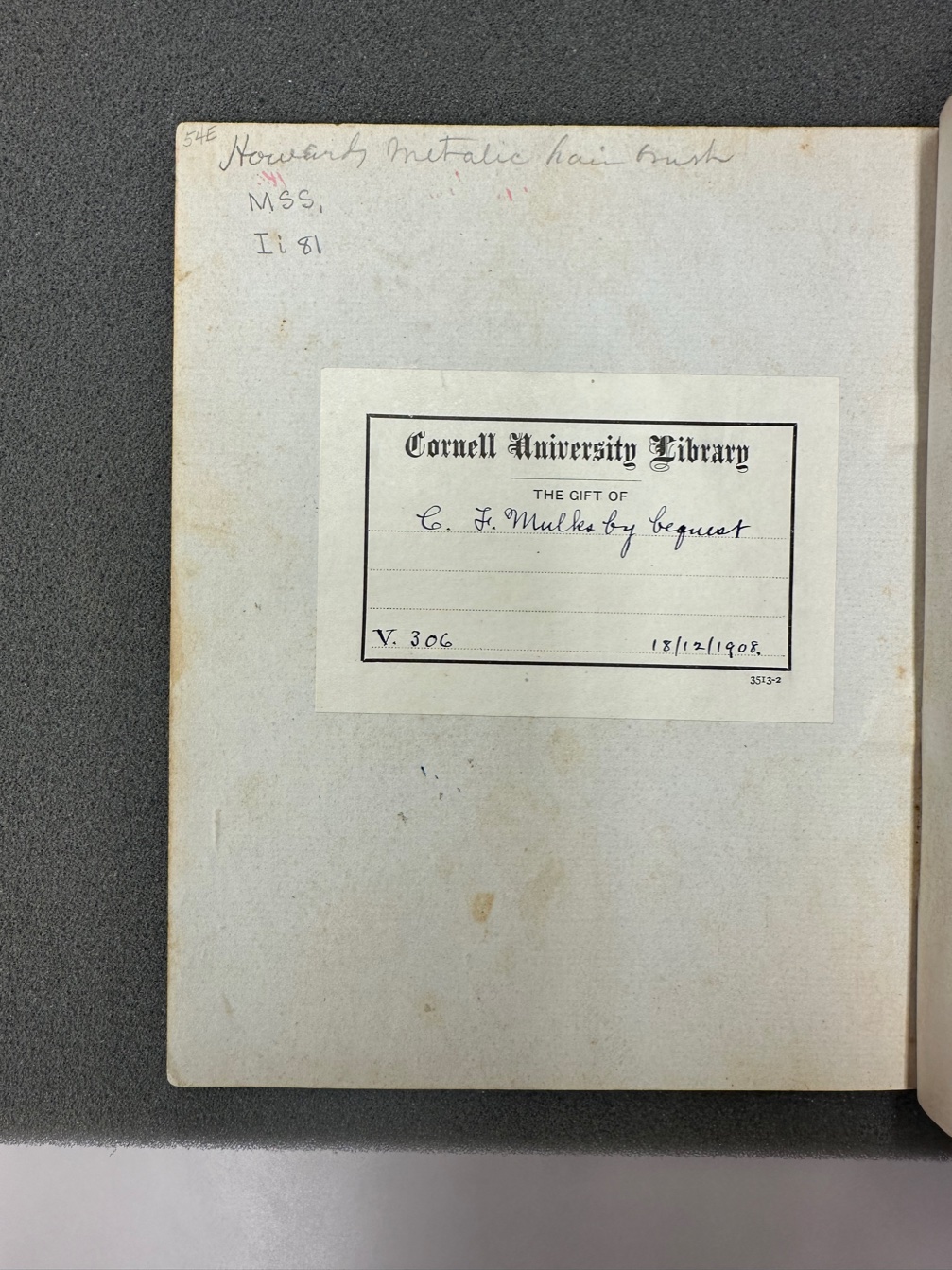
V_0113
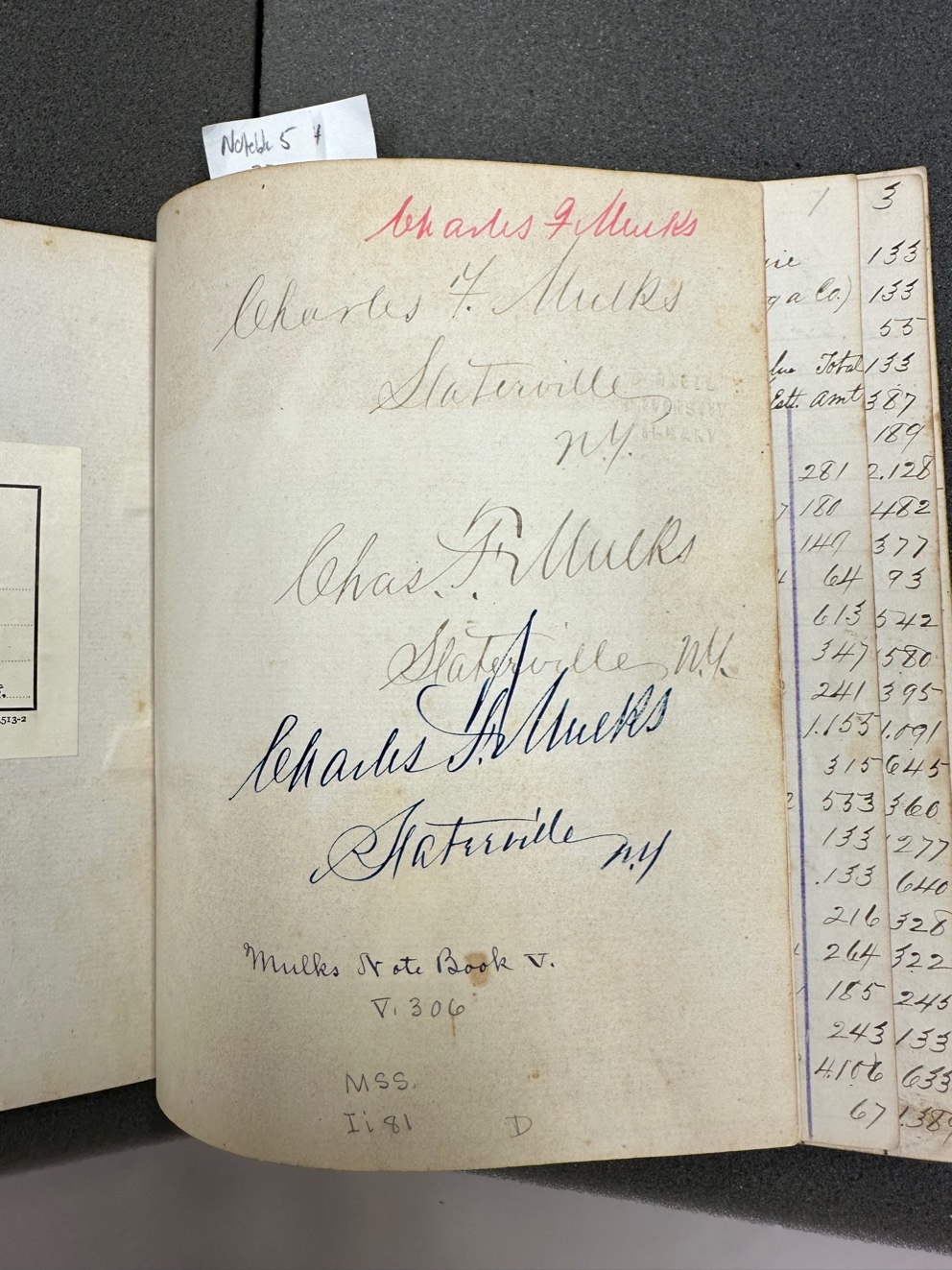
Pen practice? Accession marks.
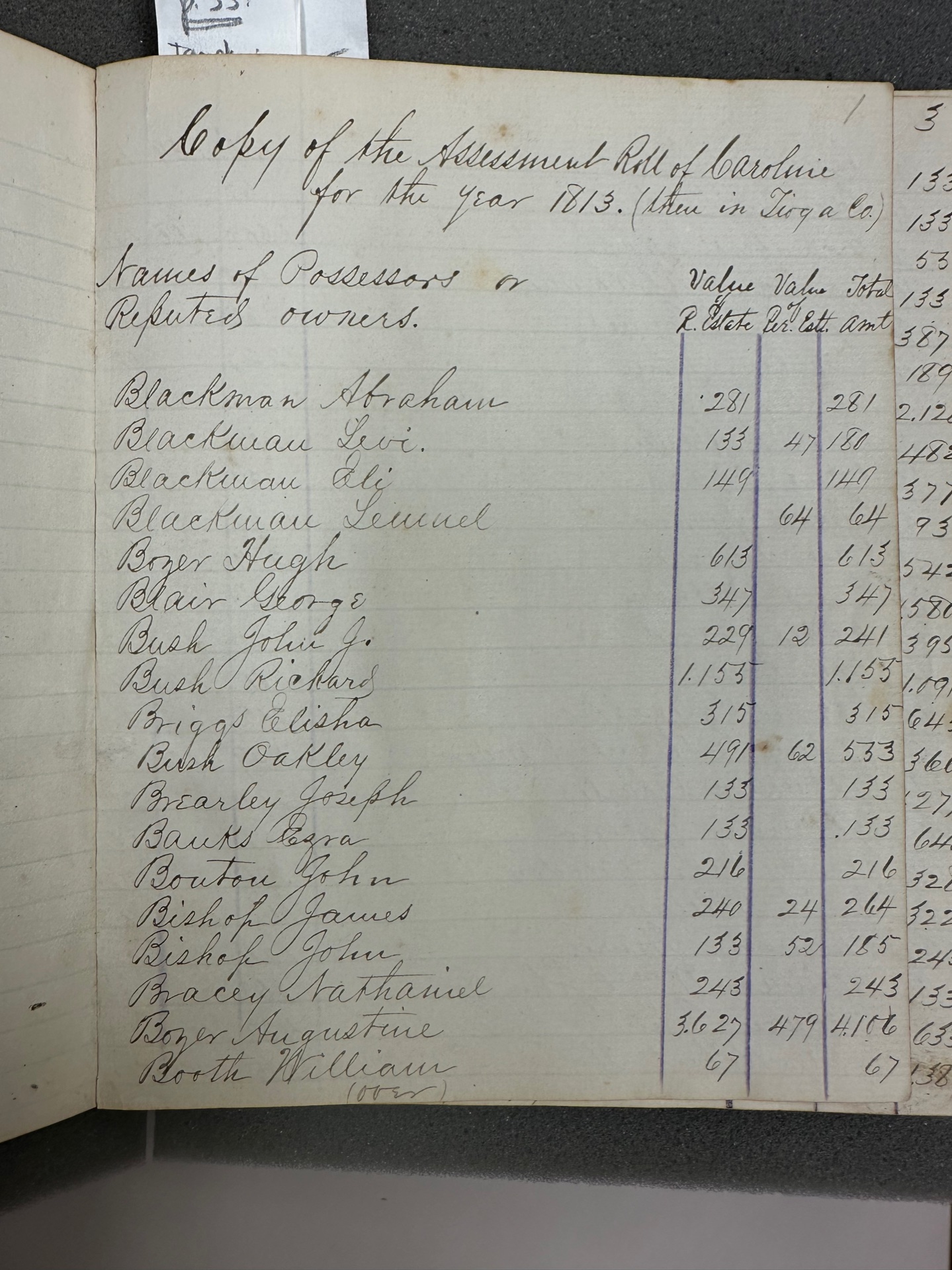
V_0114
1
| Names of Possessors or Reputed owners. | Value of R. estate | Value of Per. Est | Total Amt |
|---|---|---|---|
| Blackman Abraham | 281 | 281 | |
| Blackman Levi | 133 | 47 | 180 |
| Blackman Eli | 149 | 149 | |
| Blackman Samuel | 64 | 64 | |
| Boyer Hugh | 613 | 613 | |
| Blair George | 347 | 347 | |
| Bush John J | 229 | 12 | 241 |
| Bush Richard | 1155 | 1155 | |
| Briggs Elisha | 315 | 315 | |
| Bush Oakley | 491 | 62 | 553 |
| Brearley Joseph | 133 | 133 | |
| Banks Ezra | 133 | 133 | |
| Bouton John | 216 | 216 | |
| Bishop James | 240 | 24 | 264 |
| Bishop John | 133 | 52 | 185 |
| Bracey Nathaniel | 243 | 243 | |
| Boyer Augustine | 3627 | 479 | 4106 |
| Booth William | 67 | 67 |
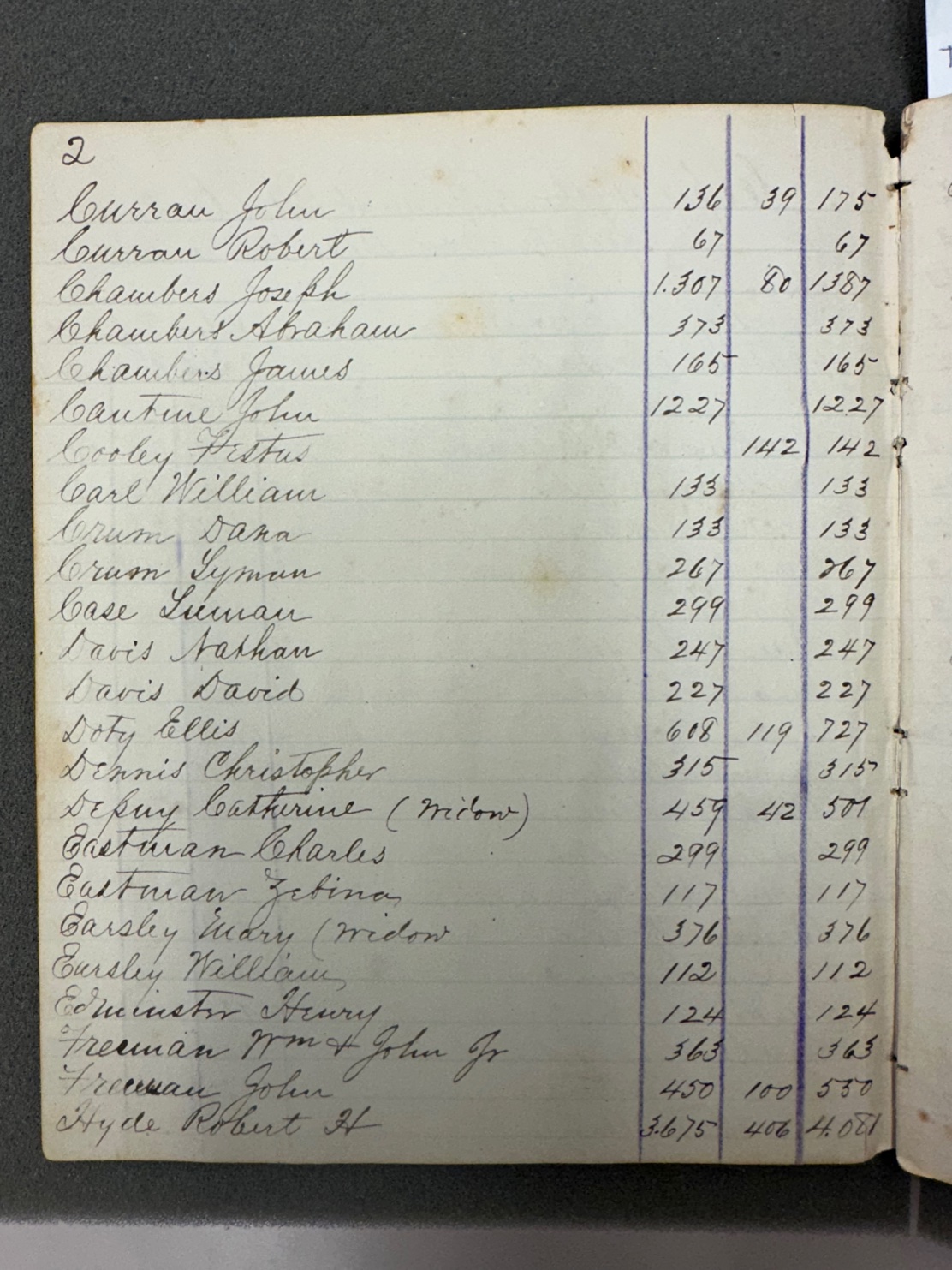
V_0115
2
| Curran John | 136 | 39 | 175 |
| Curran Robert | 67 | 67 | |
| Chambers Joseph | 1307 | 80 | 1387 |
| Chambers Abraham | 373 | 373 | |
| Chambers James | 165 | 165 | |
| Cantine John | 1227 | 1227 | |
| Cooley Festus | 142 | 142 | |
| Carl William | 133 | 133 | |
| Crum Dana | 133 | 133 | |
| Crum Lyman | 267 | 267 | |
| Case Luman | 299 | 299 | |
| Davis Nathan | 247 | 247 | |
| Davis David | 227 | 227 | |
| Doty Ellis | 608 | 119 | 727 |
| Dennis Christopher | 315 | 315 | |
| Depuy Catherine (widow) | 459 | 42 | 501 |
| Eastman Charles | 299 | 299 | |
| Eastman Zebina | 117 | 117 | |
| Earsley Mary (widow | 376 | 376 | |
| Earsley William | 112 | 112 | |
| Edminster Henry | 124 | 124 | |
| Freeman Wm + John Jr | 363 | 363 | |
| Freeman John | 450 | 100 | 550 |
| Hyde Robert H | 3675 | 406 | 4081 |
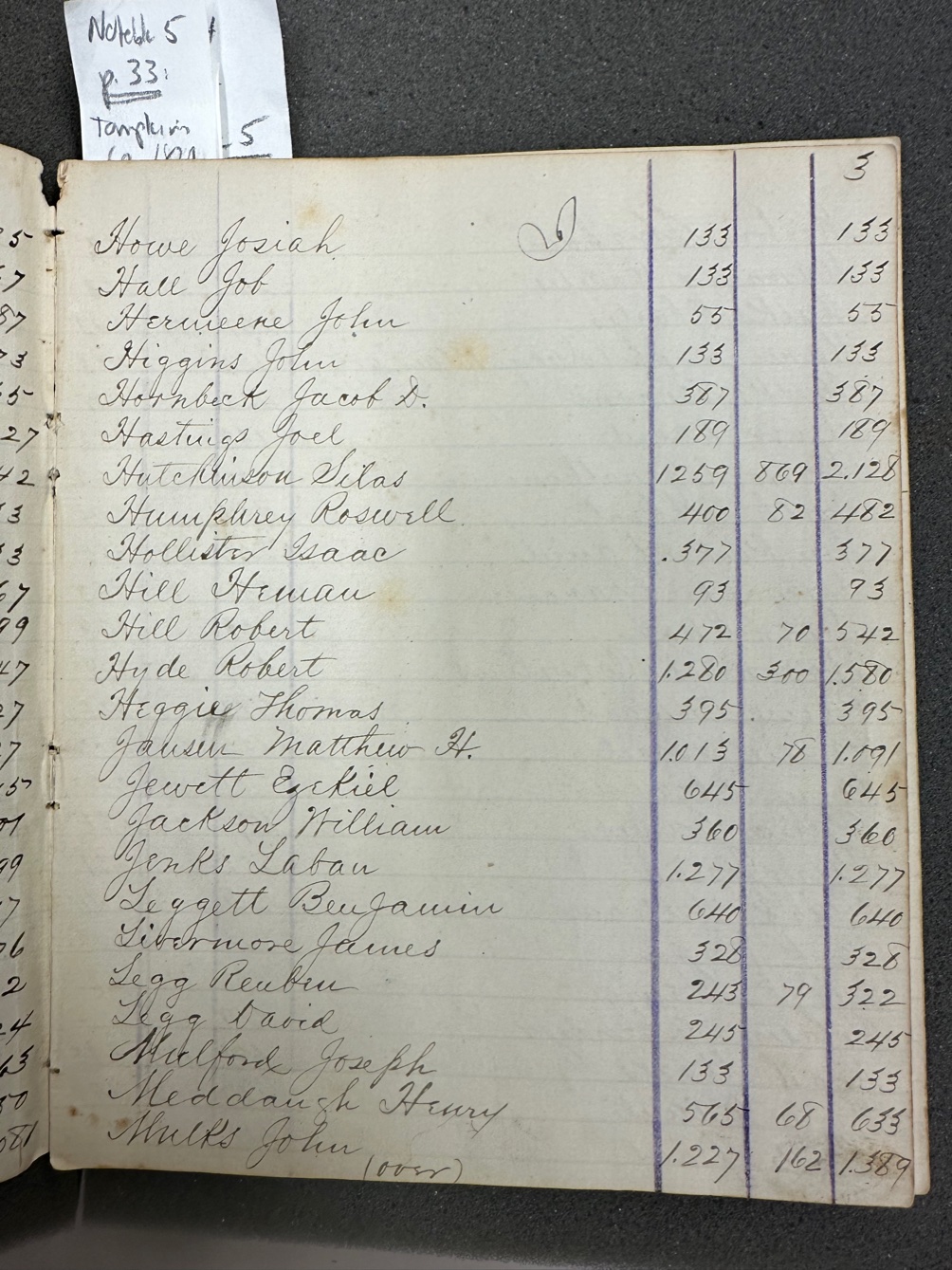
V_0116
3
| Howe Josiah | 133 | 133 | |
| Hall Job | 133 | 133 | |
| Hermeene John | 55 | 55 | |
| Higgins John | 133 | 133 | |
| Hornbeck Jacob D. | 387 | 387 | |
| Hastings Joel | 189 | 189 | |
| Hutchinson Silas | 1259 | 869 | 2128 |
| Humphrey Roswell | 400 | 82 | 482 |
| Hollister Isaac | 377 | 377 | |
| Hill Heman | 93 | 93 | |
| Hill Robert | 472 | 70 | 542 |
| Hyde Robert | 1280 | 300 | 1580 |
| Heggie Thomas | 395 | 395 | |
| Jansen Matthew H. | 1013 | 78 | 1091 |
| Jewett Ezekiel | 645 | 645 | |
| Jackson William | 360 | 360 | |
| Jenks Laban | 1277 | 1277 | |
| Leggett Benjamin | 640 | 640 | |
| Livermore James | 328 | 328 | |
| Legg Reuben | 243 | 79 | 322 |
| Legg David | 245 | 245 | |
| Mulford Joseph | 133 | 133 | |
| Meddaugh Henry | 564 | 68 | 632 |
| Mulks John | 1227 | 162 | 1389 |
V_0117
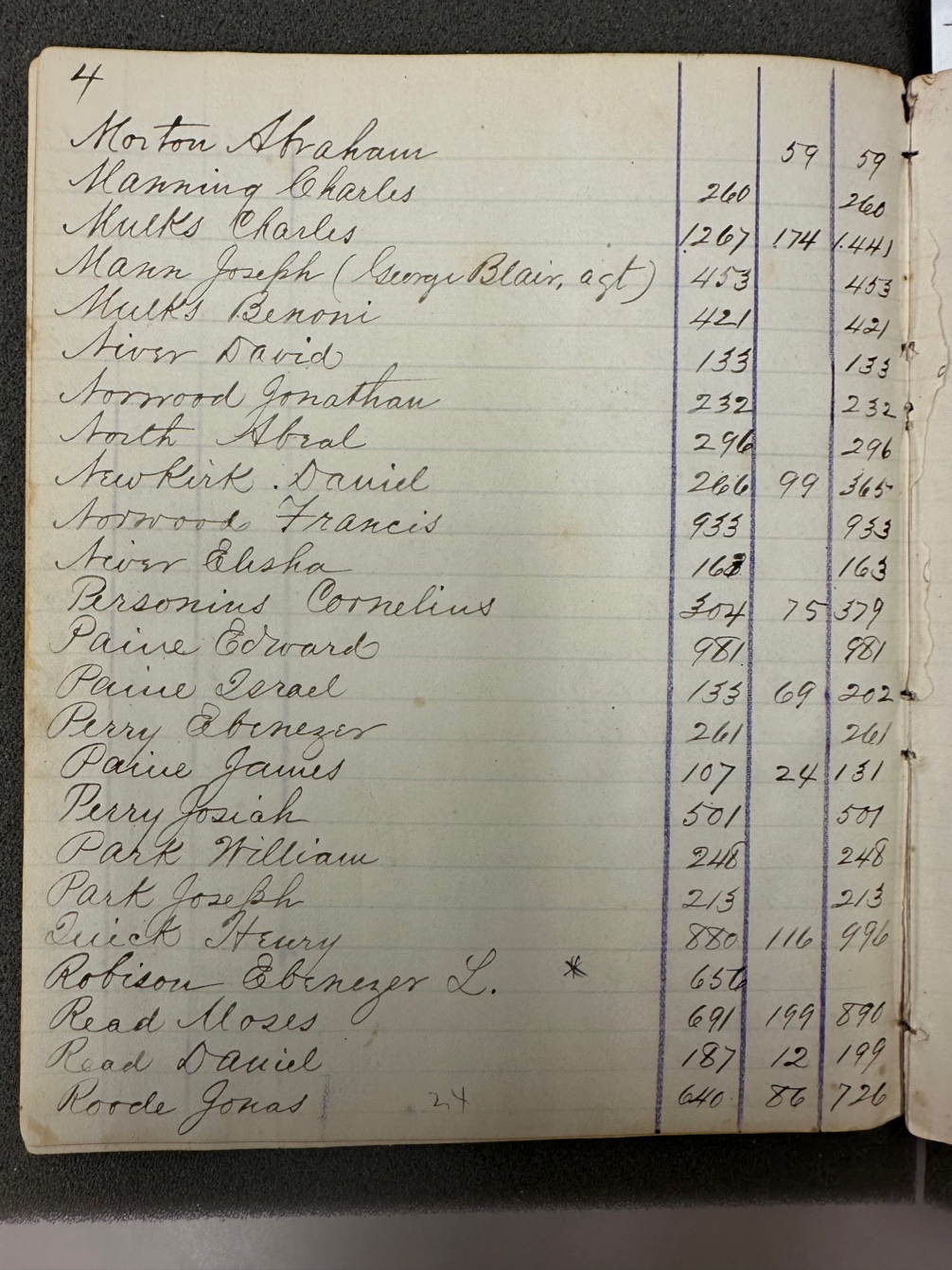
4
| Morton Abraham | 59 | 59 | |
| Manning Charles | 260 | 260 | |
| Mulks Charles | 1267 | 174 | 1441 |
| Mann Joseph (George Blair, agt) | 453 | 453 | |
| Mulks Benoni | 421 | 421 | |
| Niver David | 133 | 133 | |
| Norwood Jonathan | 232 | 232 | |
| North Abeal | 296 | 296 | |
| Newkirk David | 266 | 99 | 365 |
| Norwood Francis | 933 | 933 | |
| Niver Elisha | 163 | 163 | |
| Personius Cornelius | 304 | 75 | 379 |
| Paine Edward | 981 | 981 | |
| Paine Israel | 133 | 69 | 202 |
| Perry Ebenezer | 261 | 261 | |
| Paine James | 107 | 24 | 131 |
| Perry Josiah | 501 | 501 | |
| Park William | 248 | 248 | |
| Park Joseph | 213 | 213 | |
| Quick Henry | 880 | 116 | 996 |
| Robison Ebenezer L. | 650 | ||
| Read Moses | 691 | 199 | 890 |
| Read Daniel | 187 | 12 | 199 |
| Roode Jonas | 640 | 86 | 726 |
V_0118
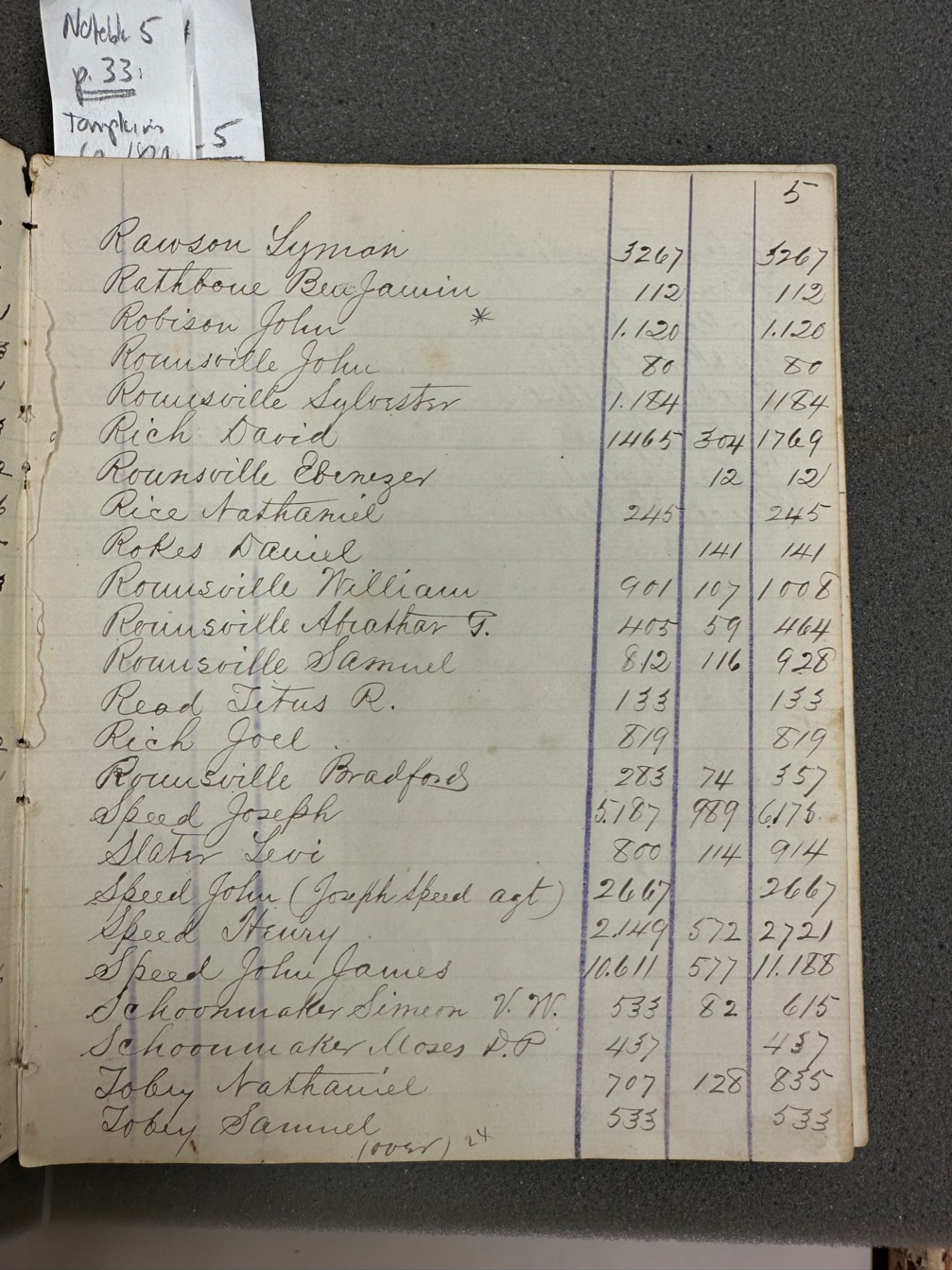
5
| Rawson Lyman | 3267 | 3267 | |
| Rathbone Benjamin | 112 | 112 | |
| Robison John | 1120 | 1120 | |
| Rounsville John | 80 | 80 | |
| Rounsville Sylvester | 1184 | 1184 | |
| Rich David | 1465 | 304 | 1769 |
| Rounsville Ebenezer | 12 | 12 | |
| Rice Nathaniel | 245 | 245 | |
| Rokes Daniel | 141 | 141 | |
| Rounsvile William | 901 | 107 | 1008 |
| Rounsville Abrathar G. | 405 | 59 | 464 |
| Rounsville Samuel | 812 | 116 | 928 |
| Read Titus R. | 133 | 133 | |
| Rich Joel | 819 | 819 | |
| Rounsville Bradford | 283 | 74 | 357 |
| Speed Joseph | 5187 | 989 | 6176 |
| Slater Levi | 800 | 114 | 914 |
| Speed John (Joseph Speed agt) | 2667 | 2667 | |
| Speed Henry | 2149 | 572 | 2721 |
| Speed John James | 10611 | 577 | 11188 |
| Schoonmaker Simeon V.W. | 533 | 82 | 615 |
| Schoonmaker Moses D.P | 437 | 437 | |
| Tobey Nathaniel | 707 | 128 | 835 |
| Tobey Samuel | 533 | 533 |
V_0119
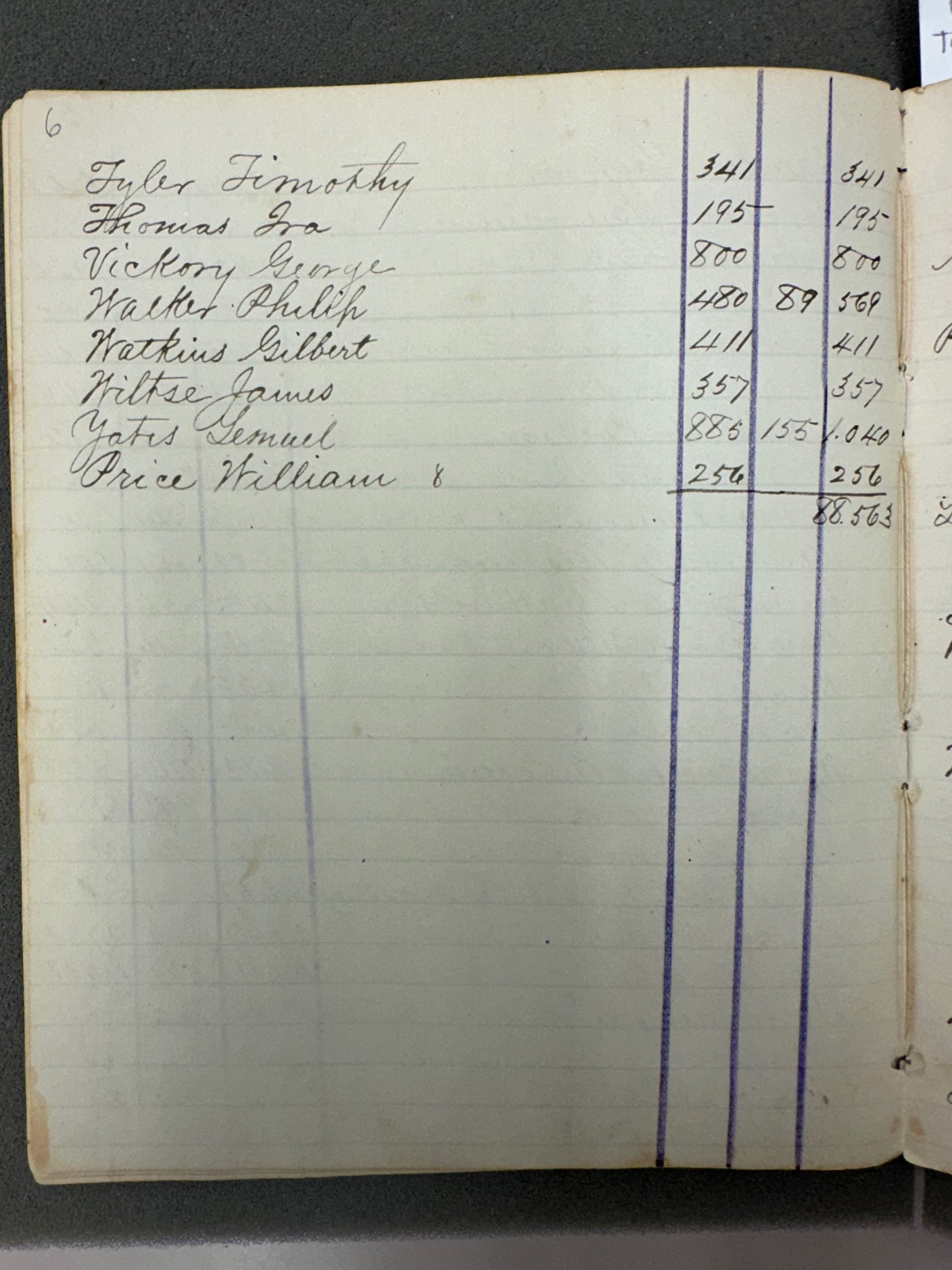
6
| Tyler Timothy | 341 | 341 | |
| Thomas Ira | 195 | 195 | |
| Vickory George | 800 | 800 | |
| Walker Philip | 480 | 89 | 569 |
| Watkins Gilbert | 411 | 411 | |
| Wiltse James | 357 | 357 | |
| Yates Lemuel | 885 | 155 | 1040 |
| Price William | 256 | 256 | |
| 88563 | |||
The correct total is 88168.
V_0120
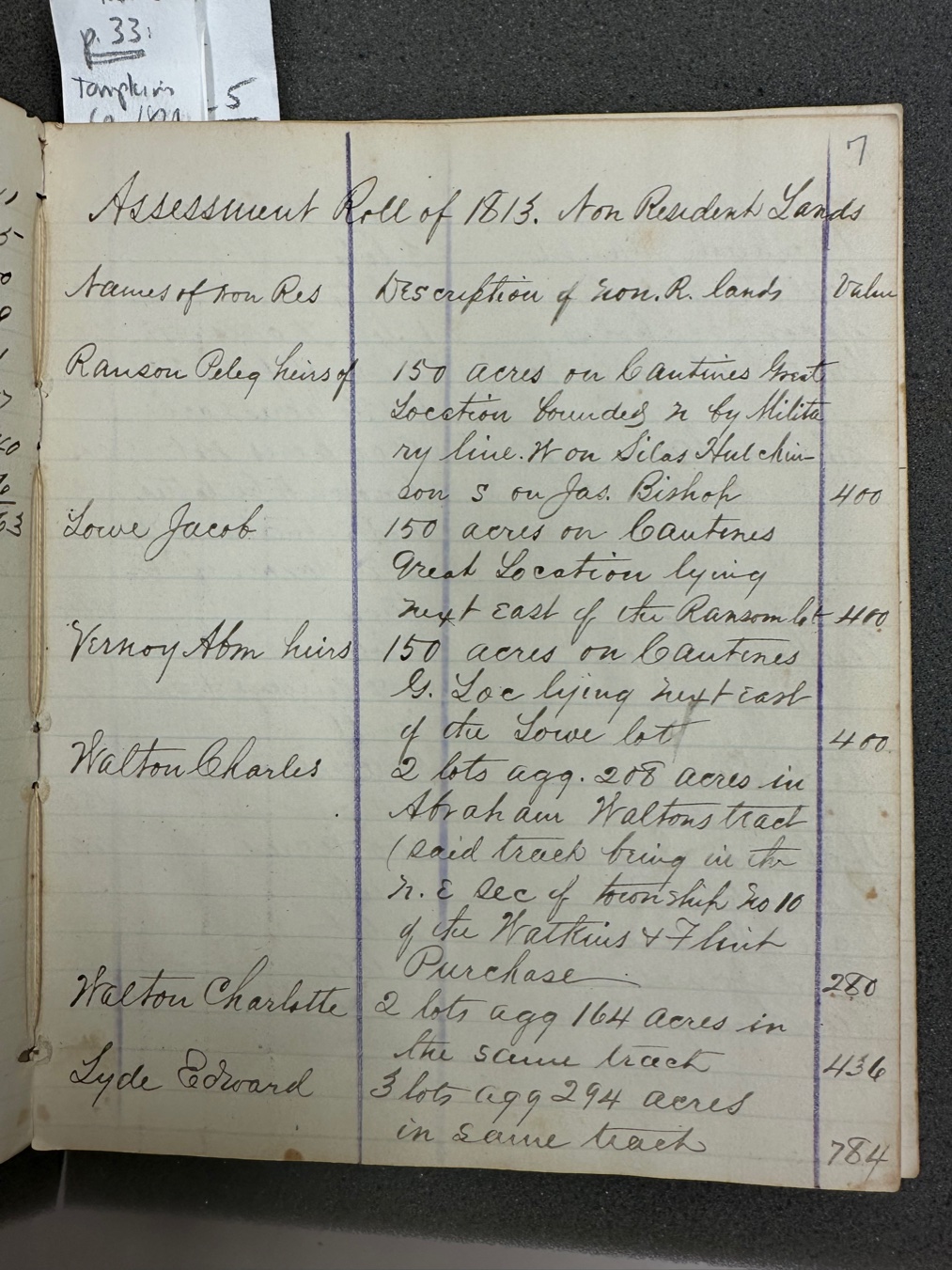
7
| Names of Non Res | Description of non.R. lands | Value |
|---|---|---|
| Ranson Peleg heirs of | 150 acres on Cantine's Great Location bounding N by Military line. W on Silas Hutchinson S on Jas. Bishop | 400 |
| Lowe Jacob | 150 acres on Cantines Great Location lying next east of the Ransom lot | 400 |
| Vernoy Abm heirs | 150 acres on Cantines G. Loc lying next east of the Lowe lot | 400 |
| Walton Charles | 2 lots agg. 208 acres in Abraham Waltons tract (said tract being in the N.E sec of township no 10 of the Watkins + Flint Purchase | 280 |
| Walton Charlotte | 2 lots agg 164 acres in the same tract | 436 |
| Lyde Edward | 3 lots agg 294 acres in same tract | 784 |
V_0121
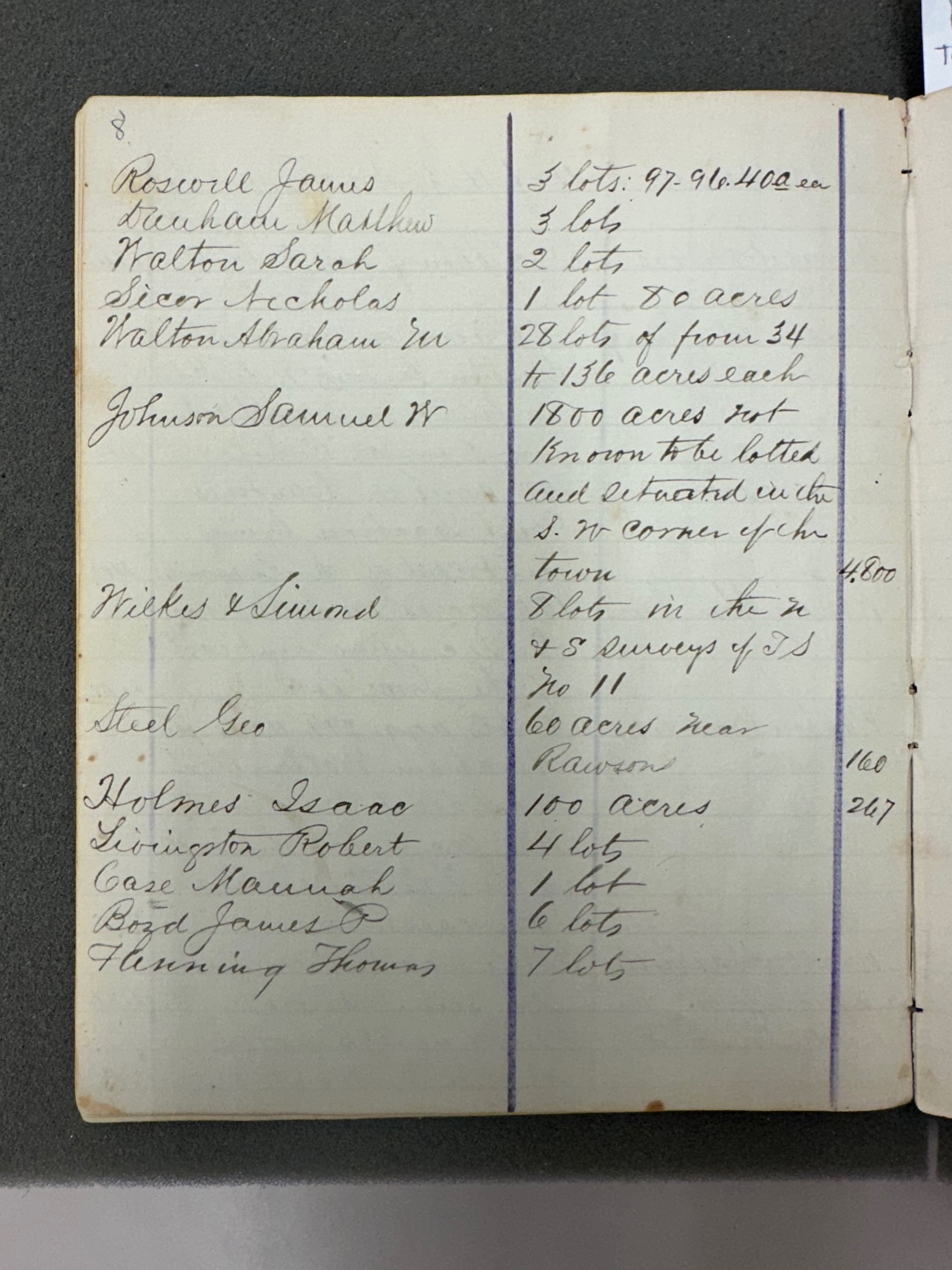
8
| Roswell James | 3 lots: 97–96. 40a ea | |
| Dunham Matthew | 3 lots | |
| Walton Sarah | 2 lots | |
| Sicor Nicholas | 1 lot 80 acres | |
| Walton Abraham M | 28 lots of from 34 to 136 acres each> | |
| Johnson Samuel W | 1800 acres not known to be lotted and situated in the S. W corner of the town | 4800 |
| Wilkes [?] Simond | 8 lots in the N + S surveys of TS No 11 | |
| Steel Geo | 60 acres near Rawson | 160 |
| Holmes Isaac | 100 acres | 267 |
| Livingston Robert | 4 lots | |
| Case Mannah | 1 lot | |
| Boyd James P | 6 lots | |
| Fanning Thomas | 7 lots |
V_0121B
9
Page is blank.
V_0121C
10
Page is blank.

V_0122
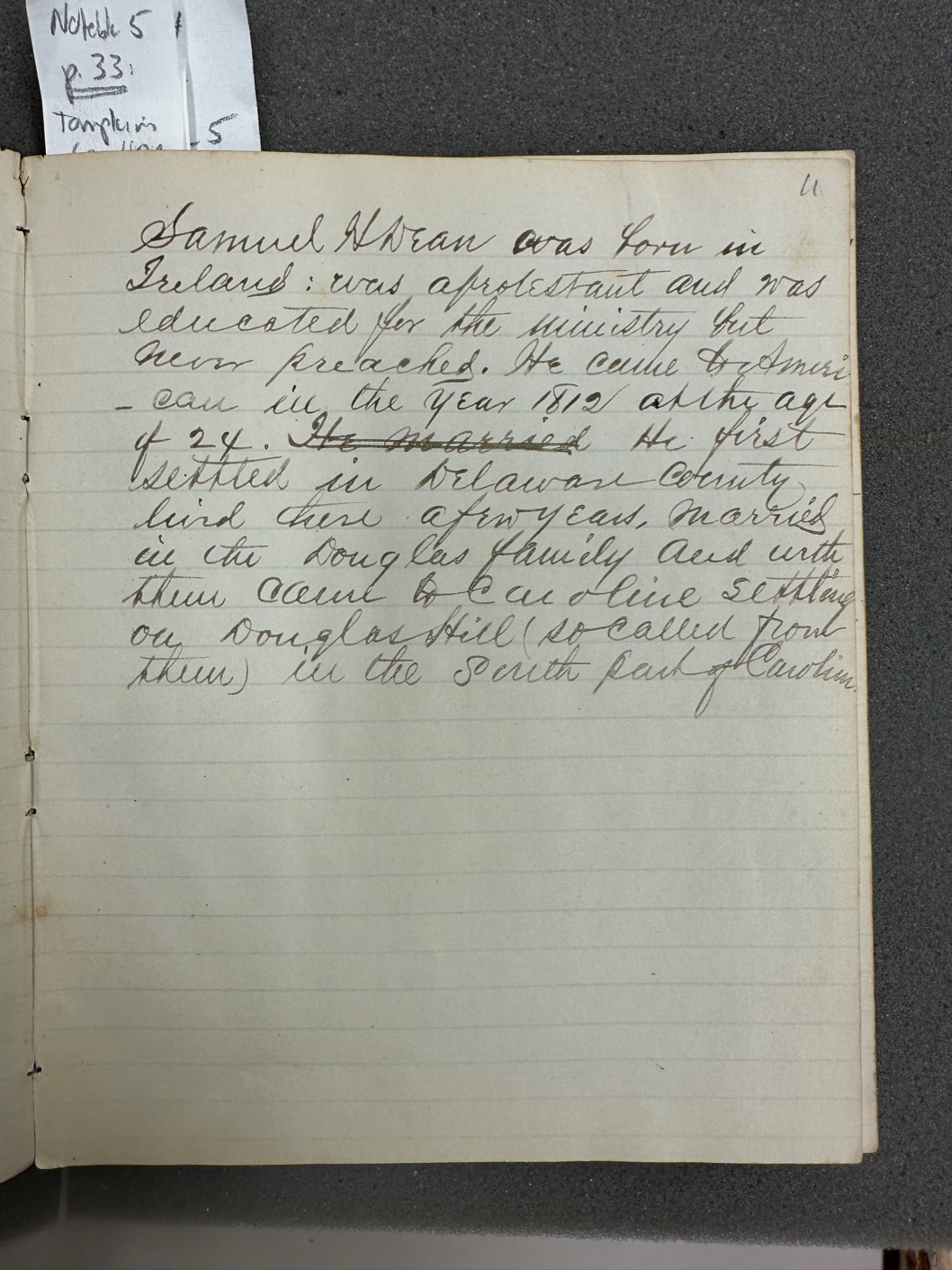
11
Samuel H Dean was born in Ireland: was a Protestant and was educated for the ministry but never preached. He came to America in the year 1812 at the age of 24. He married He first settled in Delaware County lived there a few years. Married in the Douglas family and with them came to Caroline settling on Douglas Hill (so-called from them) in the south part of Caroline.
V_0123
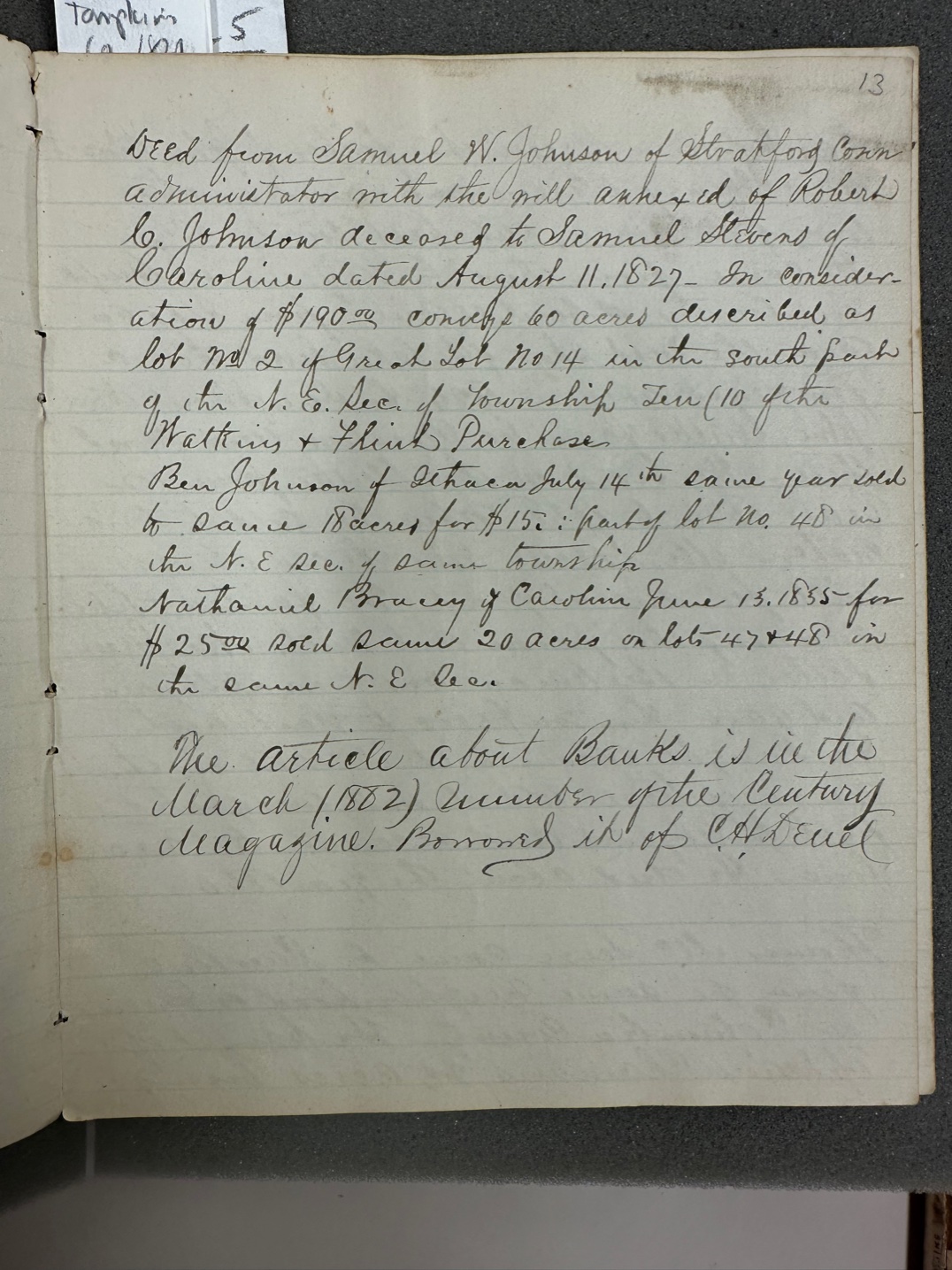
13
Deed from Samuel W. Johnson of Stratford, Conn administrator with the will annexed of Robert C. Johnson deceased to Samuel Stephens of Caroline dated August 11, 1827. In consideration of $190.00 conveys 60 acres described as lot No. 2 of Great Lot No 14 in the south part of the N.E. Sec. of Township Ten (10) of the Watkins + Flint purchase. Ben Johnson of Ithaca July 14 same year sold to the same 18 acres for $15: part of lot No. 48 in the N.E. sec of same township. Nathaniel Bracey of Caroline June 13, 1855 for $25.00 sold same 20 acres on lots 47 + 48 in the same N.E. Sec.
The article about Banks is in the March (1882) number of the Century Magazine. Borrowed it of C.H. Deuel.
BROKEN BANKS AND LAX DIRECTORS begins
V_0124
14
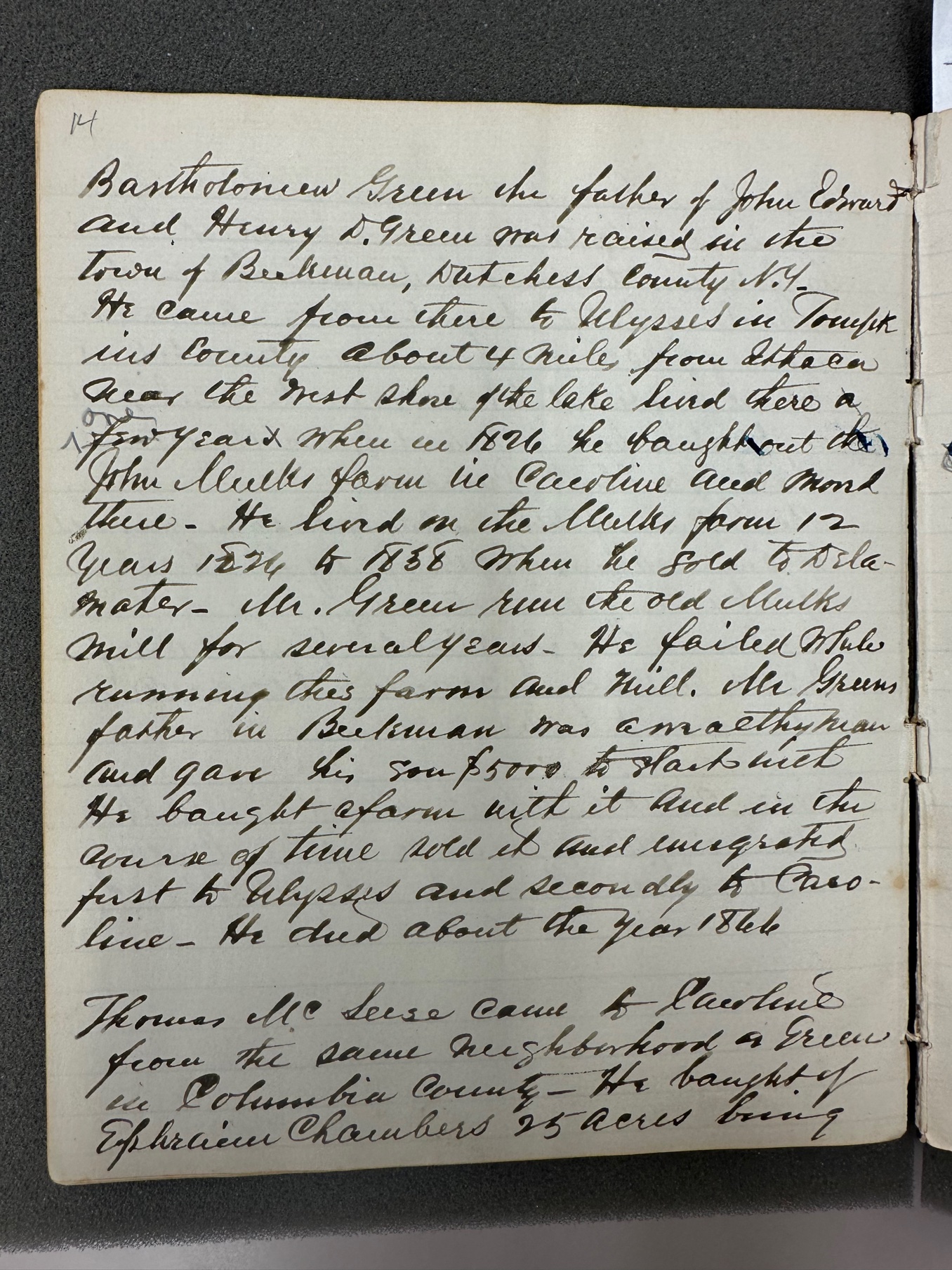
Bartholomew Green the father of John Edward and Harry D. Green was raised in the town of Beekman, Duchess County N.Y. He came from there to Ulysses in Tompkins County about 4 miles from Ithaca near the west shore of the lake lived there one year when in 1826 he bought out the John Mulks farm in Caroline and moved there. He lived on the Mulks farm 12 years 1826 to 1838 when he sold to Delamater. Mr. Green ran the old Mulks mill for several years. He failed while running this farm and mill. Mr. Greens father in Beekman was a wealthy man and gave his son $5000 to start with. He bought a farm with it and in course of time sold it and migrated first to Ulysses and secondly to Caroline. He died about the year 1866.
Thomas McSeese came to Caroline from the same neighborhood as Green in Columbia County. He bought of Ephraim Chambers 25 acres being
V_0125
15
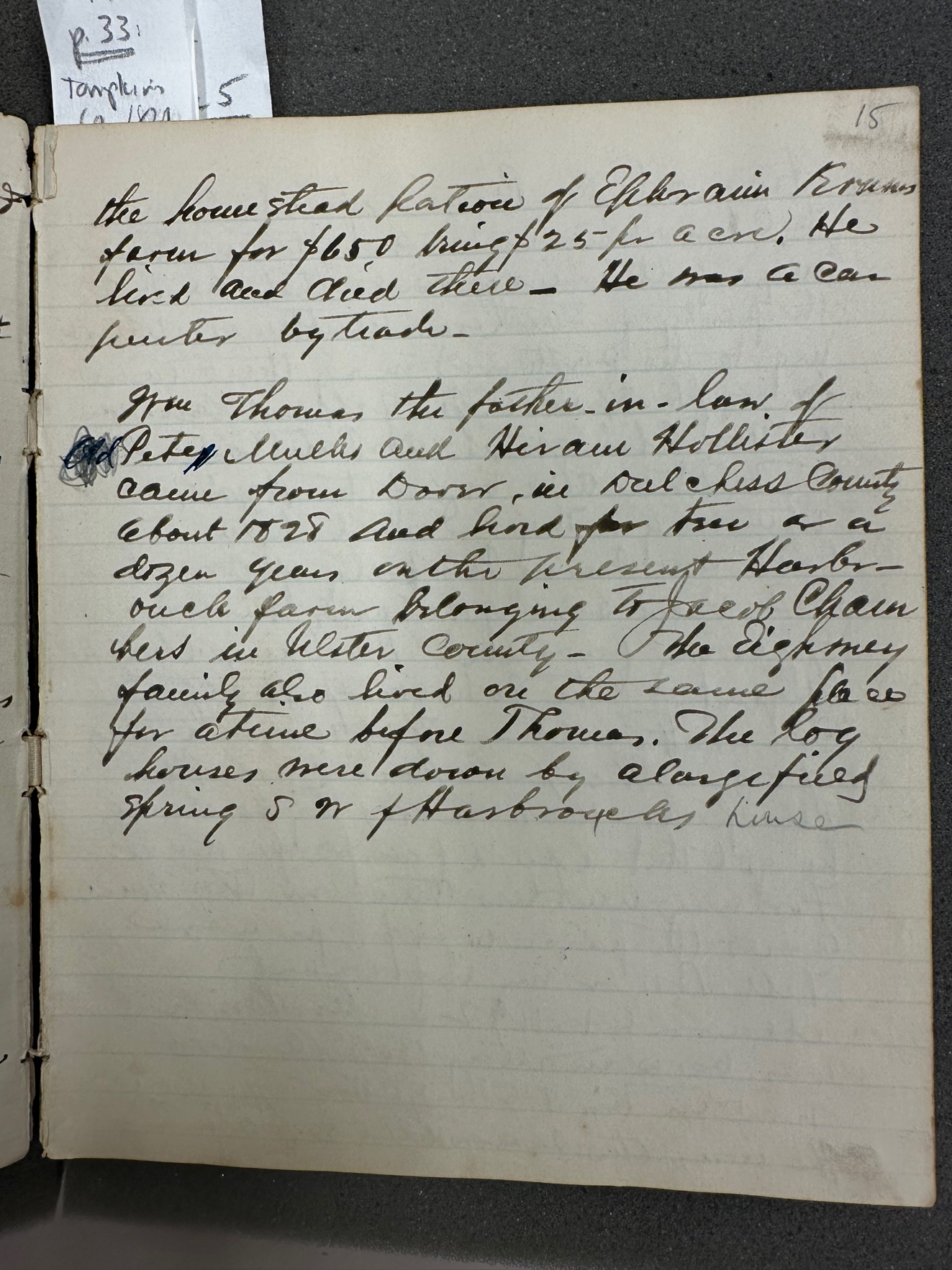
the homestead portion of Ephraim Krums farm for $650 being $25 per acre. He lived and died there. He was a carpenter by trade.
William Thomas the father-in-law of Peter Mulks and Hiram Hollister came from Dover in Duchess County about 1828 and lived for ten or a dozen years on the present Harbrouch farm belonging to Jacob Chambers in Ulster County. The Eighmey family also lived on the same place for a time before Thomas. The log houses were down by a large field spring SW of Harbrouchs house
V_0126
16
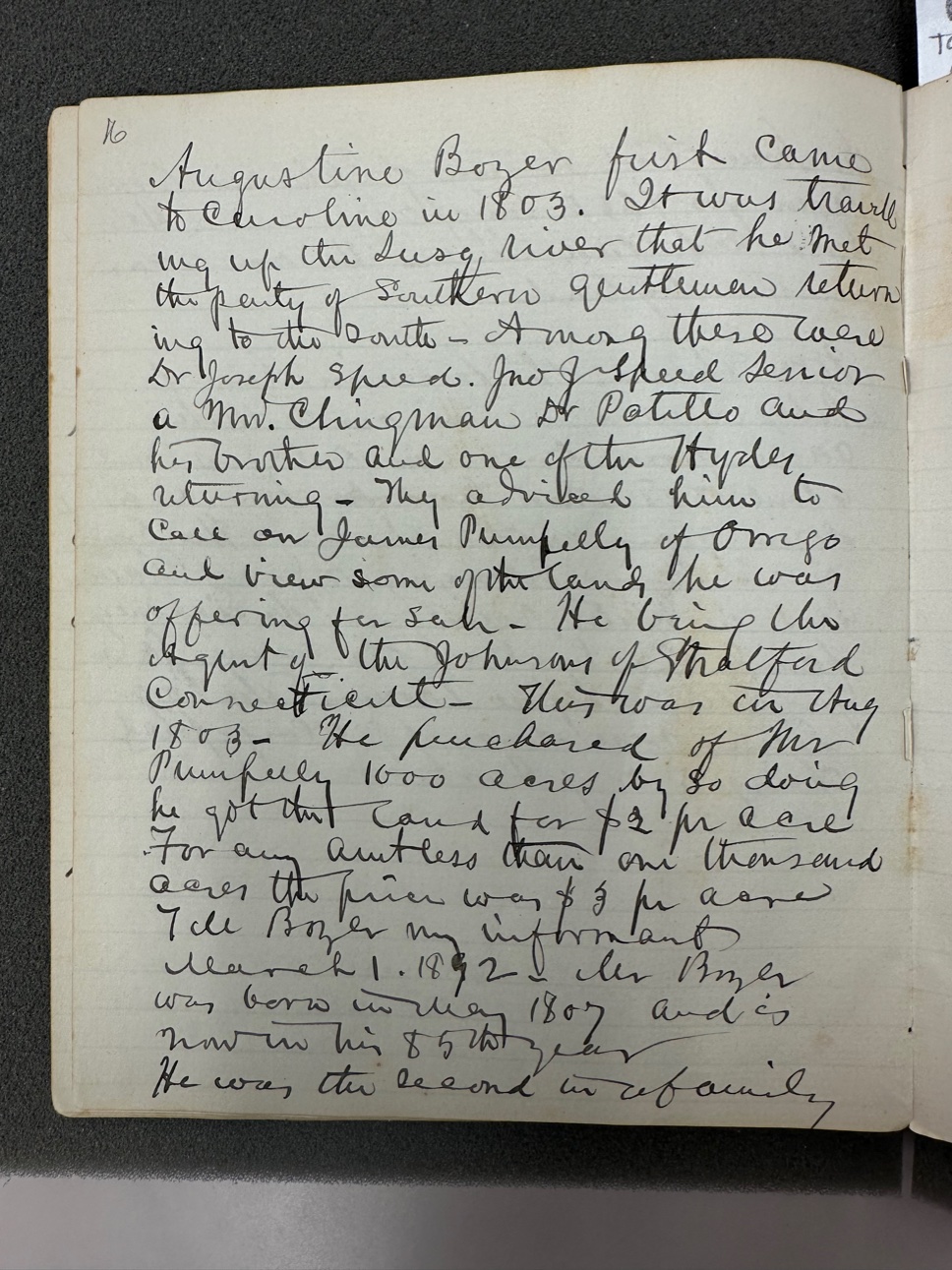
Augustine Boyer first came to Caroline in 1803. It was traveling up the Susq River that he met the party of Southern gentlemen returning to the South. Among these were Dr. Joseph Speed, John J. Speed Sr. a Mr. Clingman Dr. Patrillo and his brother and one of the Hydes returning. They advised him to call on James Pumpelly of Owego and view some of the lands he was offering for sale. He being the agent of the Johnson of Stratford Connecticut. This was in Aug 1803. He purchased of Mr. Pumpelly one thousand acres by so doing he got the land for $2 per acre[.] For any amounts less than one thousand acres the price was $3 per acre. T[homas] M[ontgomery] Boyer my informant March 1, 1892. Mr. Boyer was born in May 1807 and is now in his 85th year. He was the second in the family
V_0126B
17
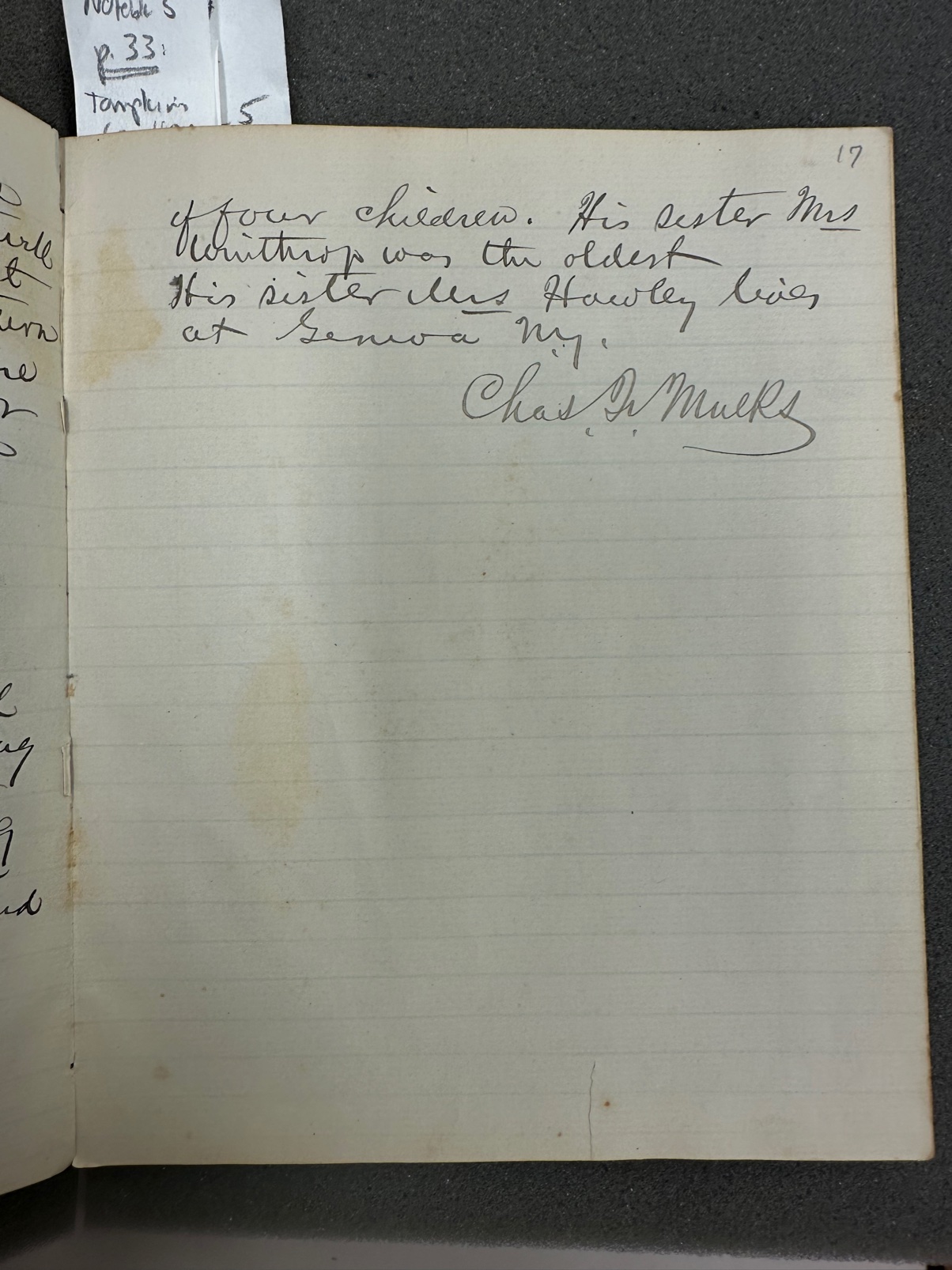
of four children. His sister Mrs. Winthrop was the oldest. His sister, Mrs. Hawley lives at Geneva, N.Y.
V_0127
18
Page is blank.

V_0128
19
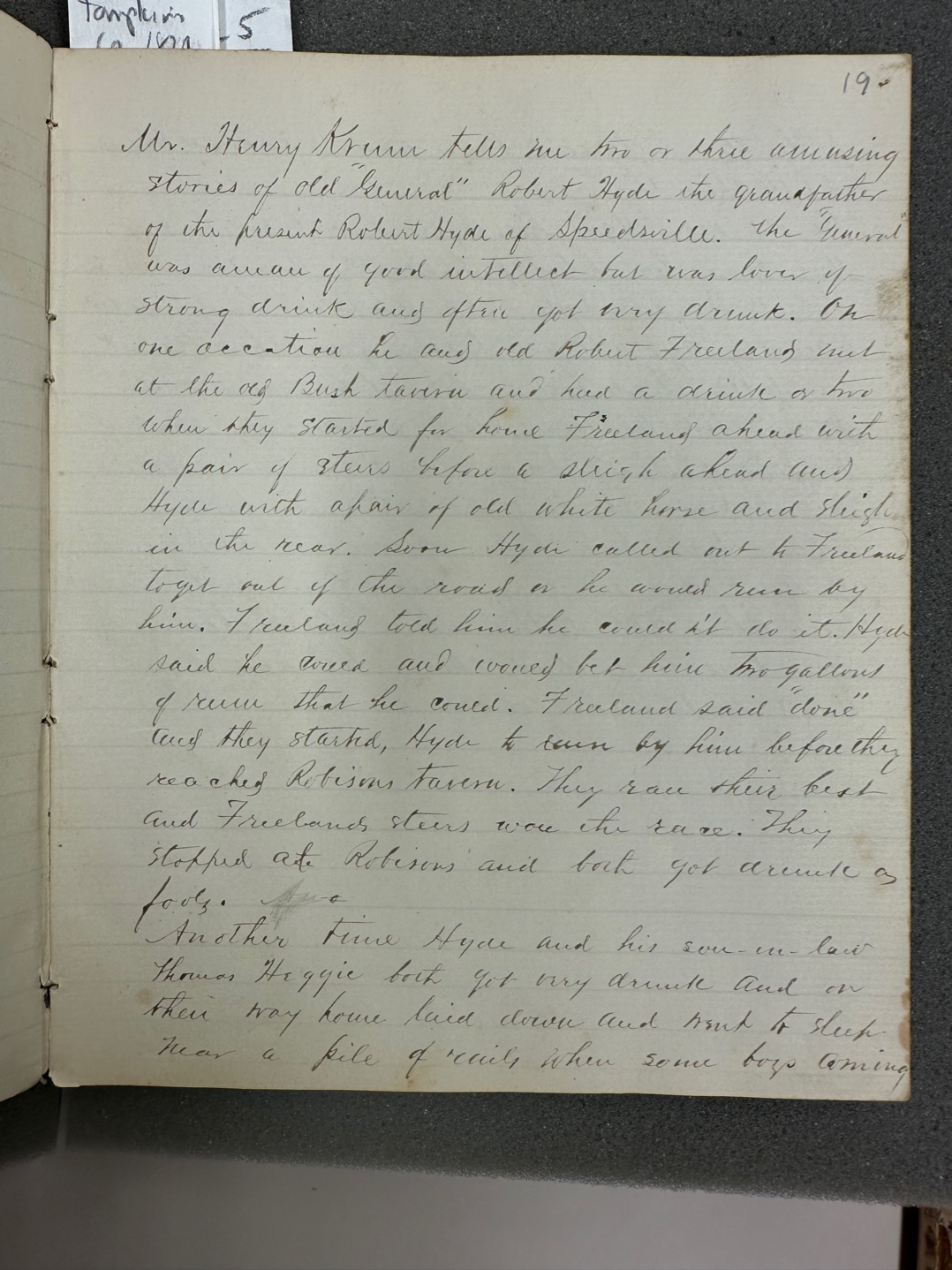
Mr. Henry Krum tells me two or three amusing stories about old “General” Robert Hyde the grandfather of the present Robert Hyde of Speedsville. The “General” was a man of good intellect but was a lover of strong drink and often got very drunk. On one occasion he and old Robert Freeland met at the old Bush Tavern and had a drink or two. When they started for home Freeland ahead with a pair of steers before a sleigh ahead and Hyde with a pair of old white horses and sleigh in the rear. Soon Hyde called out to Freeland to get out of the road as he would run by him. Freeland told him he couldn't do it. Hyde said he could and would bet him two gallons of rum that he could. Freeland said, “done” and they started, Hyde to run by him before they reached Robison's Tavern. They ran their best and Freeland's steers won the race. They stopped at Robison's and both got drunk as fools. Another time Hyde and his son-in-law Thomas Heggie both got very drunk and on their way home laid down and went to sleep near a pile of rails when some boys coming
V_0129
20
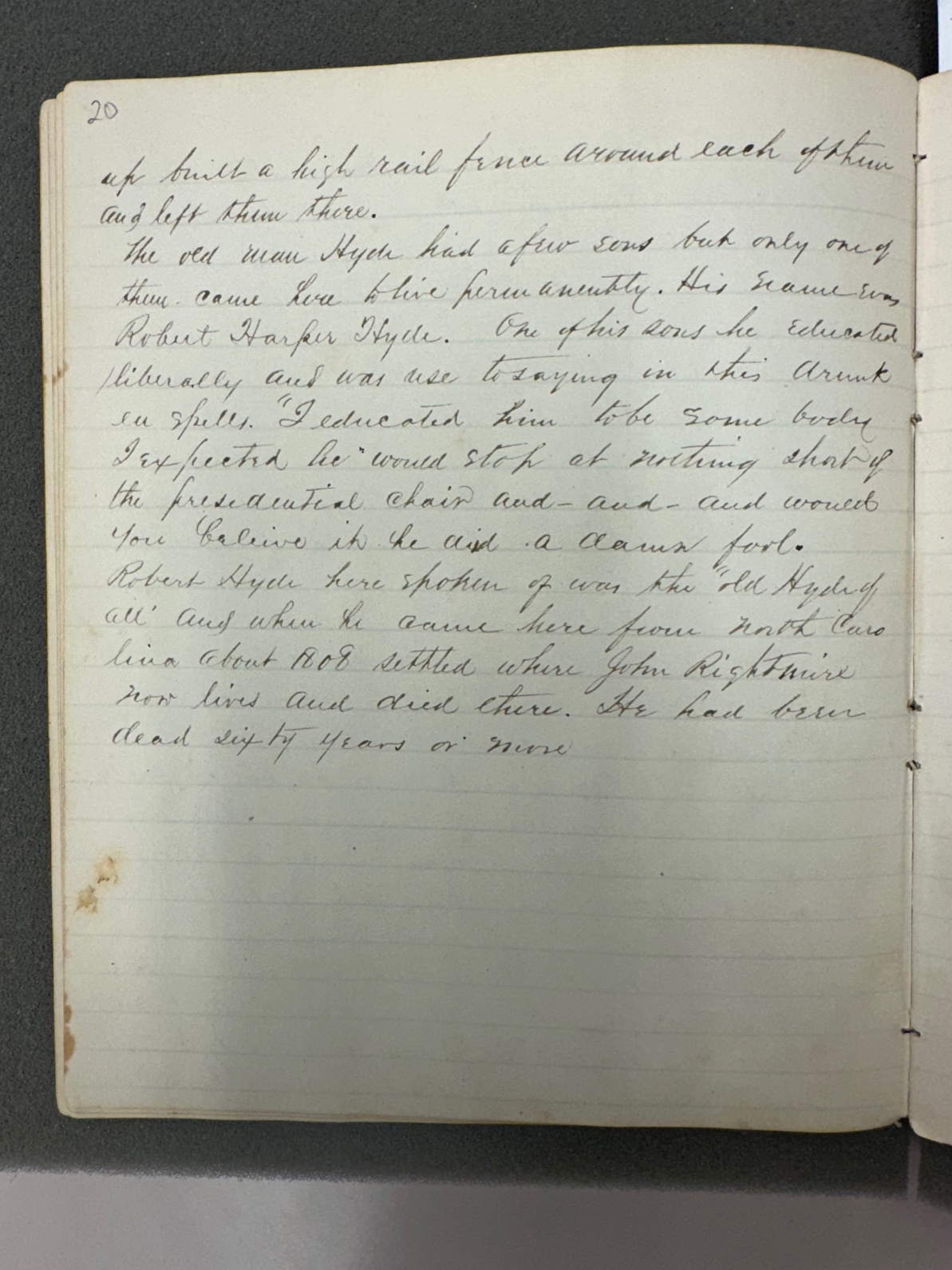
up, built a high rail fence around each of them and left them there. The old man Hyde had a few sons but only one of them came here to live permanently. His name was Robert Harper Hyde. One of his sons he educated liberally and was used to saying in his drunken spells, “I educated him to be somebody. I expected he would stop at nothing short of the presidential chair, and— and— and would you believe it? He died a damn fool. Robert Hyde here spoken of was the “old Hyde of all” and when he came here from North Carolina about 1808 settled where John Rightmeyer now lives and died there. He had been dead about sixty years or more.
V_0130
21
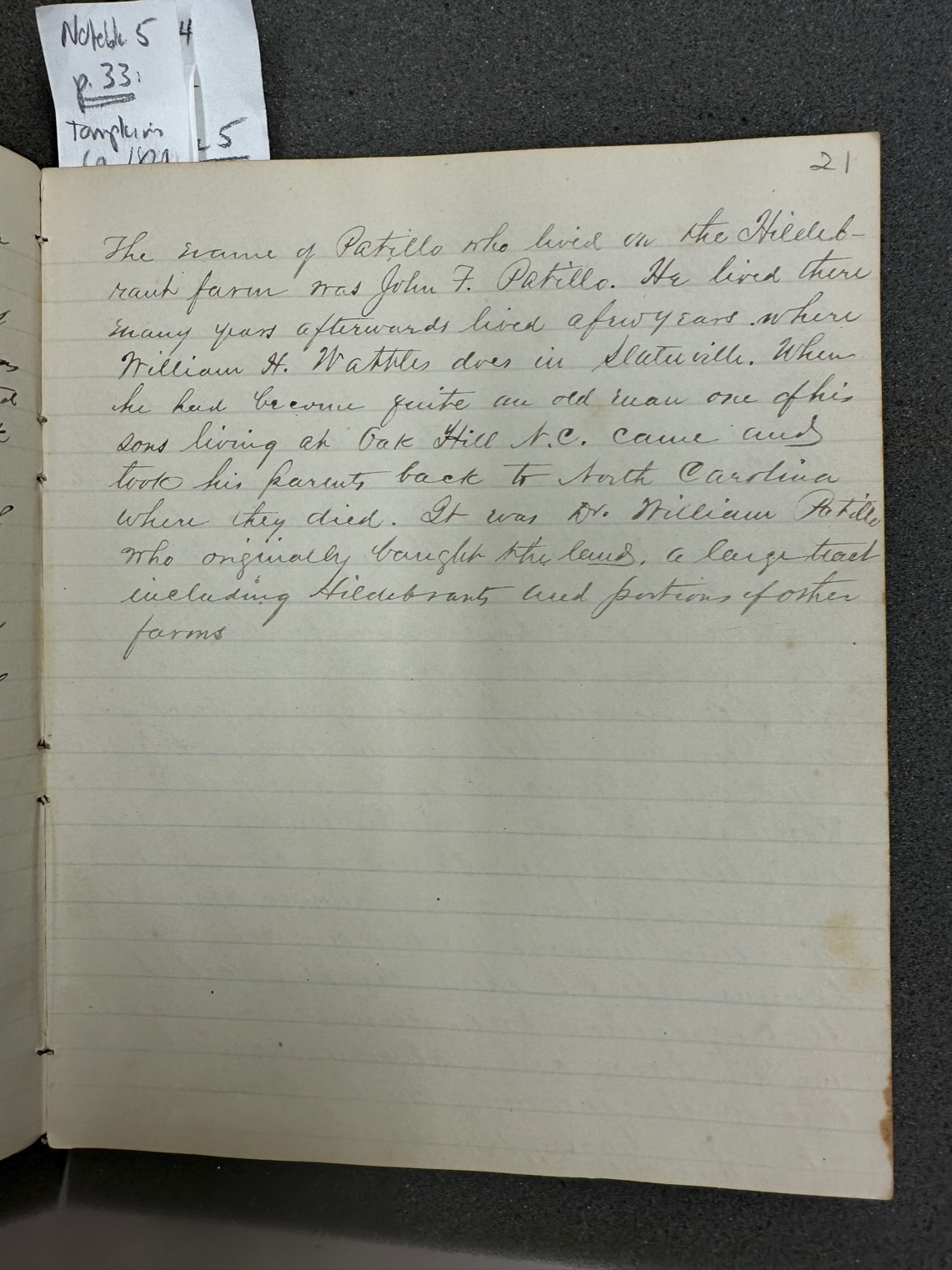
The name of Patrillo who lived on the Hildebrandt farm was John F. Patrillo. He lived there many years afterwards lived a few years where William H. Wattles does in Slaterville. When he had become quite an old man one of his sons living at Oak Hill N.C. came and took his parents back to North Carolina where they died. It was Dr. William Patrillo who originally bought the land and a large tract including Hildebrandt's and portions of other farms.
V_0131
22
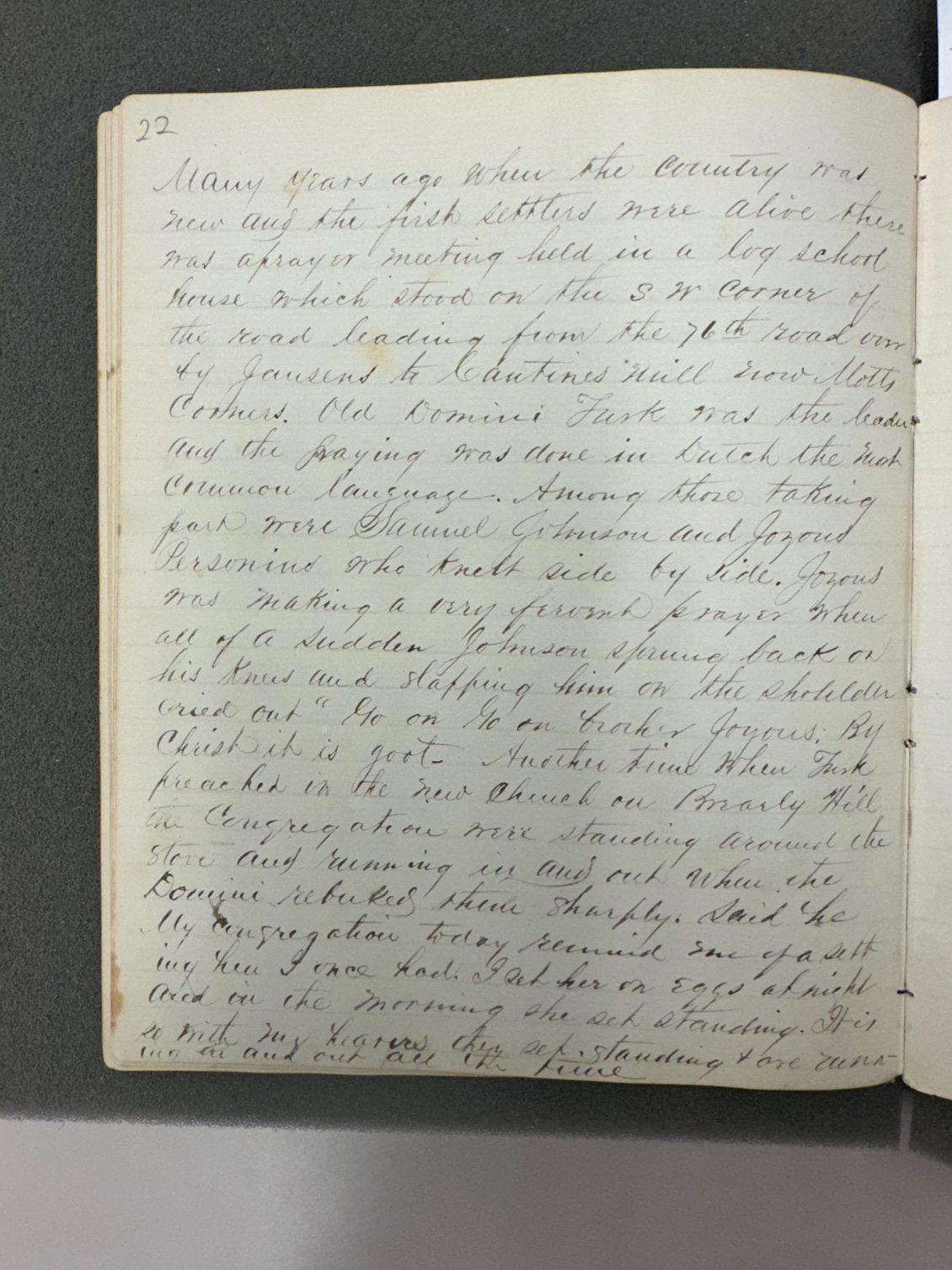
Many years ago when the country was new and the first settlers were alive there was a prayer meeting held in the log school house, which stood on the SW corner of the road leading from the 76th road over by Jansens to the Cantines Mill now Mott's Corner. Old Domini Tusk was the leader and the praying was done in Dutch the most common language. Among those taking part were Samuel Johnson and Joyous Personius who knelt side by side. Joyous was making a very personal prayer when all of a sudden Johnson sprung back on his knees and slapping him on the shoulder cried out “Go on, go on, brother Joyous by Christ, it is goot.” Another time, when Tusk preached in the new church on Brearley Hill the congregation were standing around the stove and running in and out When the Domini rebuked them sharply Said he My congregation today reminds me of a setting hen I once had. I set her on eggs at night and in the morning she set standing. This is so with my hearers they set standing and are wandering in and out all the time
V_0132
23
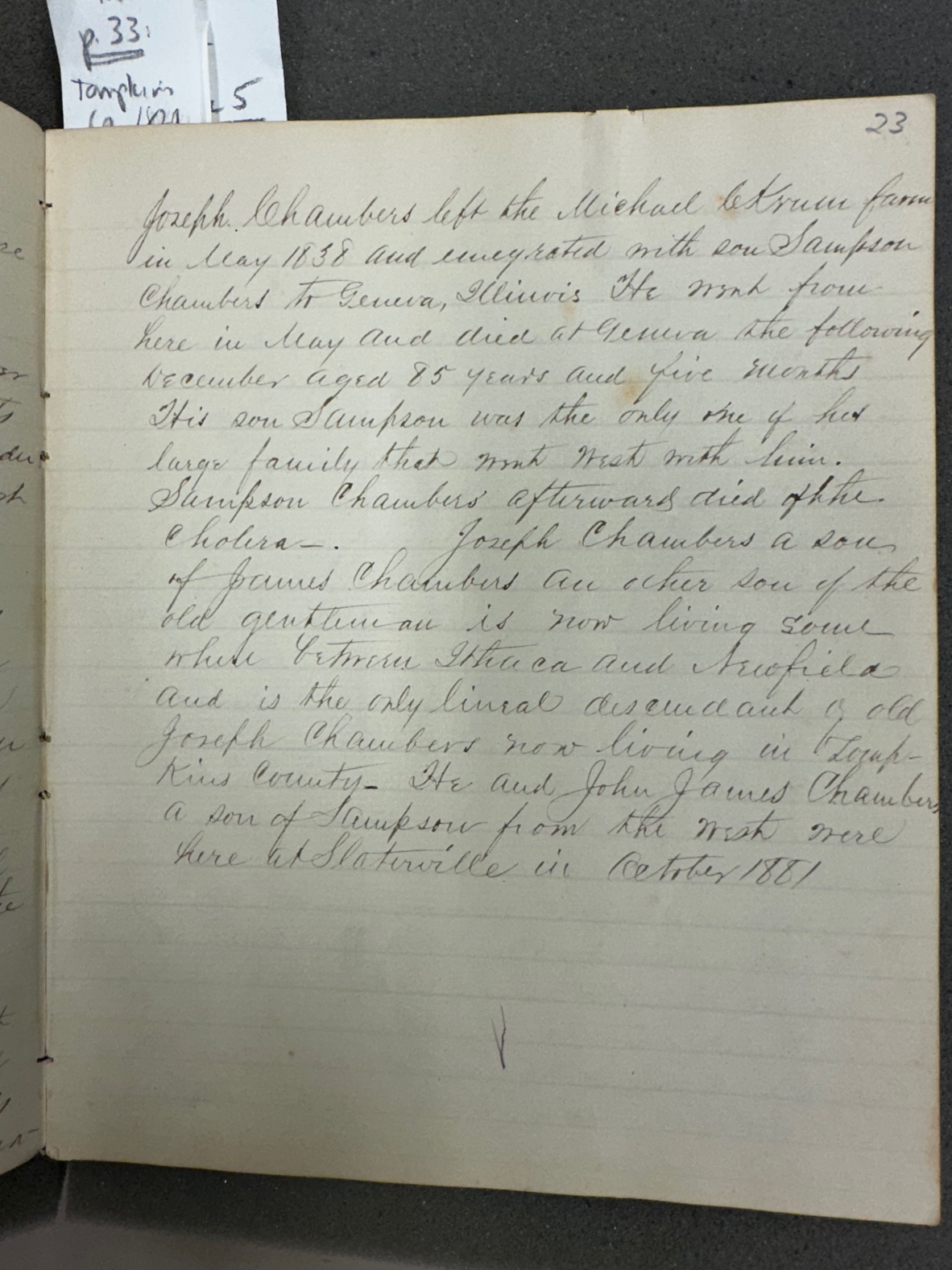
Joseph Chambers left the Michael C Krum farm in May 1838 and emigrated with son Sampson Chambers to Geneva, Illinois. He went from here in May and died in Geneva the following December aged 85 years and five months. His son Sampson was the only one of his large family that went west with him. Sampson Chambers afterwards died of the cholera. Joseph Chambers a son of James Chambers an other son of the old gentleman is now living somewhere between Ithaca and Newfield and is the only lineal descendent of old Joseph Chambers now living in Tompkins County. He and John James Chambers a son of Sampson from the west were here at Slaterville in October 1881.
V_0132B
24
Page is blank.
V_0133
25
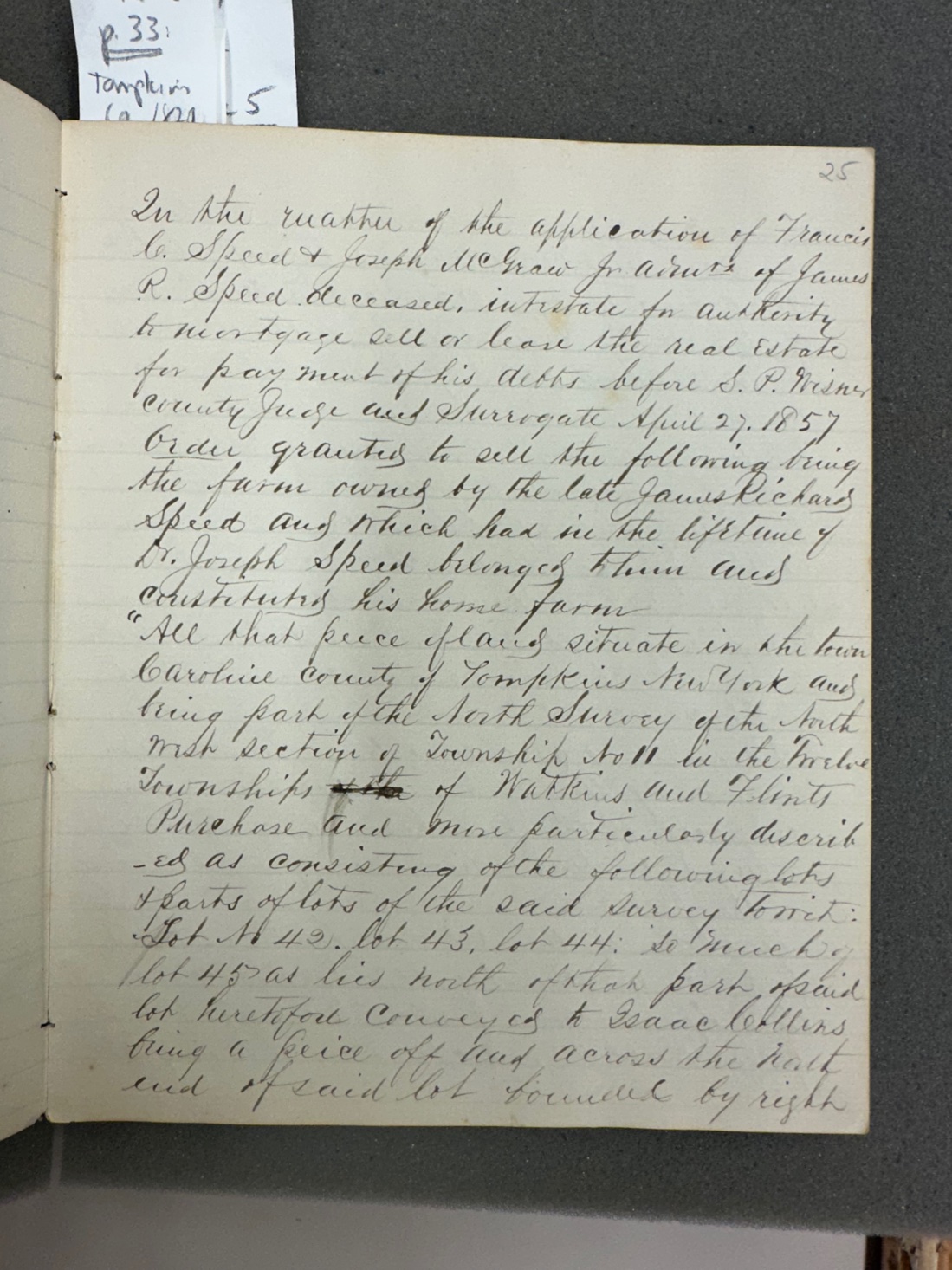
In the matter of the application of Frances C Speed and Joseph McGraw Junior administrators of James R Speed deceased intestate for authority to mortgage sell or lease the real estate in payment of his debts before S.P. Wiser County Judge and Surrogate April 27, 1857 Order granted to sell the following being the farm owned by the late James Richard Speed and which had in the lifetime of Dr. Joseph belonged to him and constituted his home farm “All that piece of land situate in the Town of Caroline county of Tompkins New York and being part of the North Survey of the North West section of Township No. 11 in the Twelve Townships of Watkins and Flint Purchase and more particularly described as consisting of the following lots and parts of lots of the said survey to wit: lot No. 42 Lot 43, Lot 44 so much of Lot 45 as lies north of that part of said lot heretofore conveyed to Isaac Collins being a piece of and across the north end of said lot bounded by right
V_0134
26
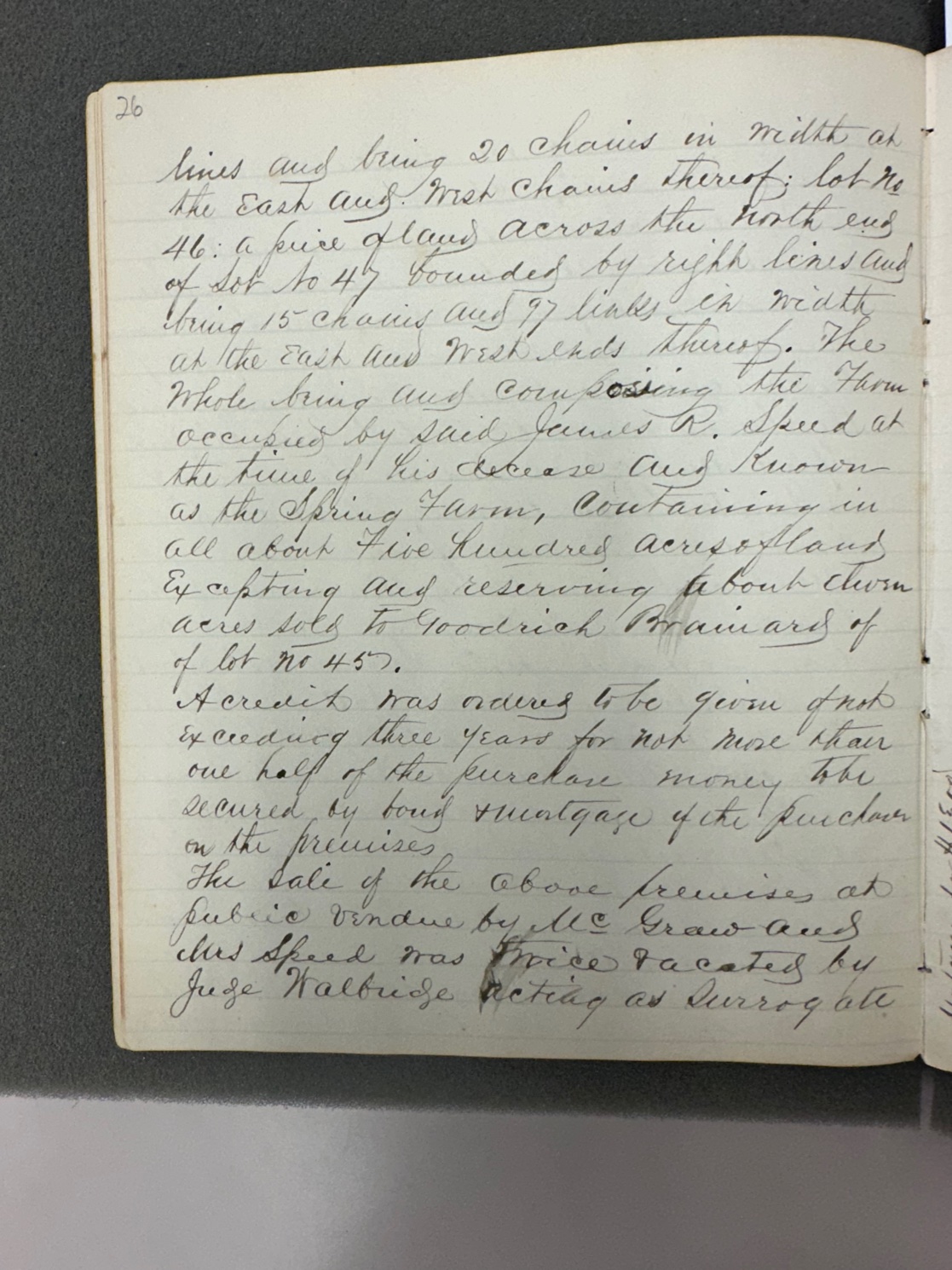
lines and being 20 chains in width at the east and west chains thereof: lot No. 46 a piece of land across the north end of Lot No. 47 bounded by right lines and being 15 chains and 97 links in width at the east and west ends thereof. The whole being and composing the farm occupied by said Joseph R Speed at the time of his decease and known as the Spring Farm containing in all about 500 acres of land excepting and reserving about 11 acres sold to Goodrich Brainard of lot No. 45. A credit was ordered to be given of not exceeding three years for not more than one half of the purchase money to be secured by bond mortgage of the purchaser on the premises The sale of the above premises at public vendue by McGraw and Mrs. Speed was twice vacated by Judge Wallbridge acting as Surrogate
V_0135
27
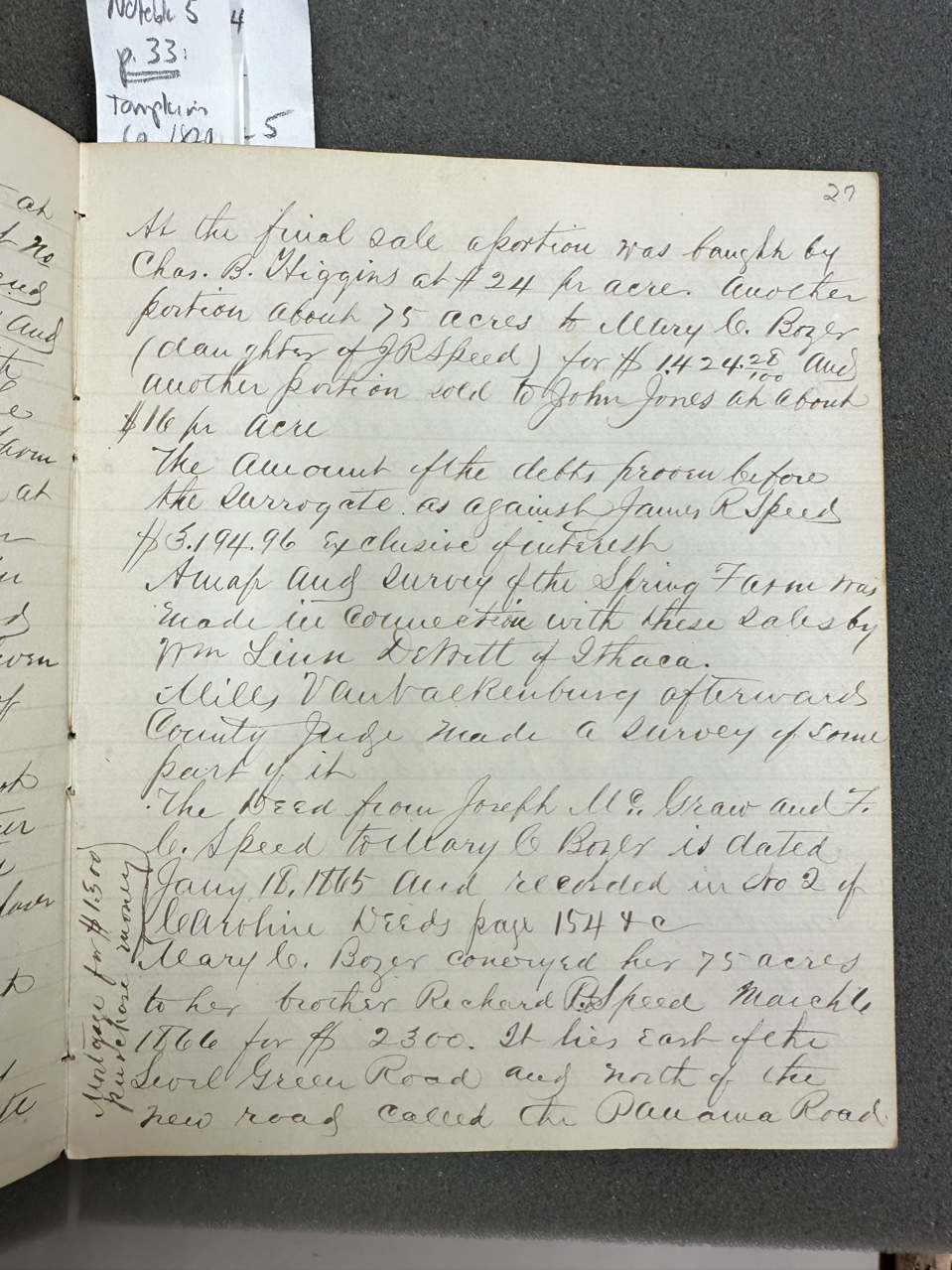
V_0136
28
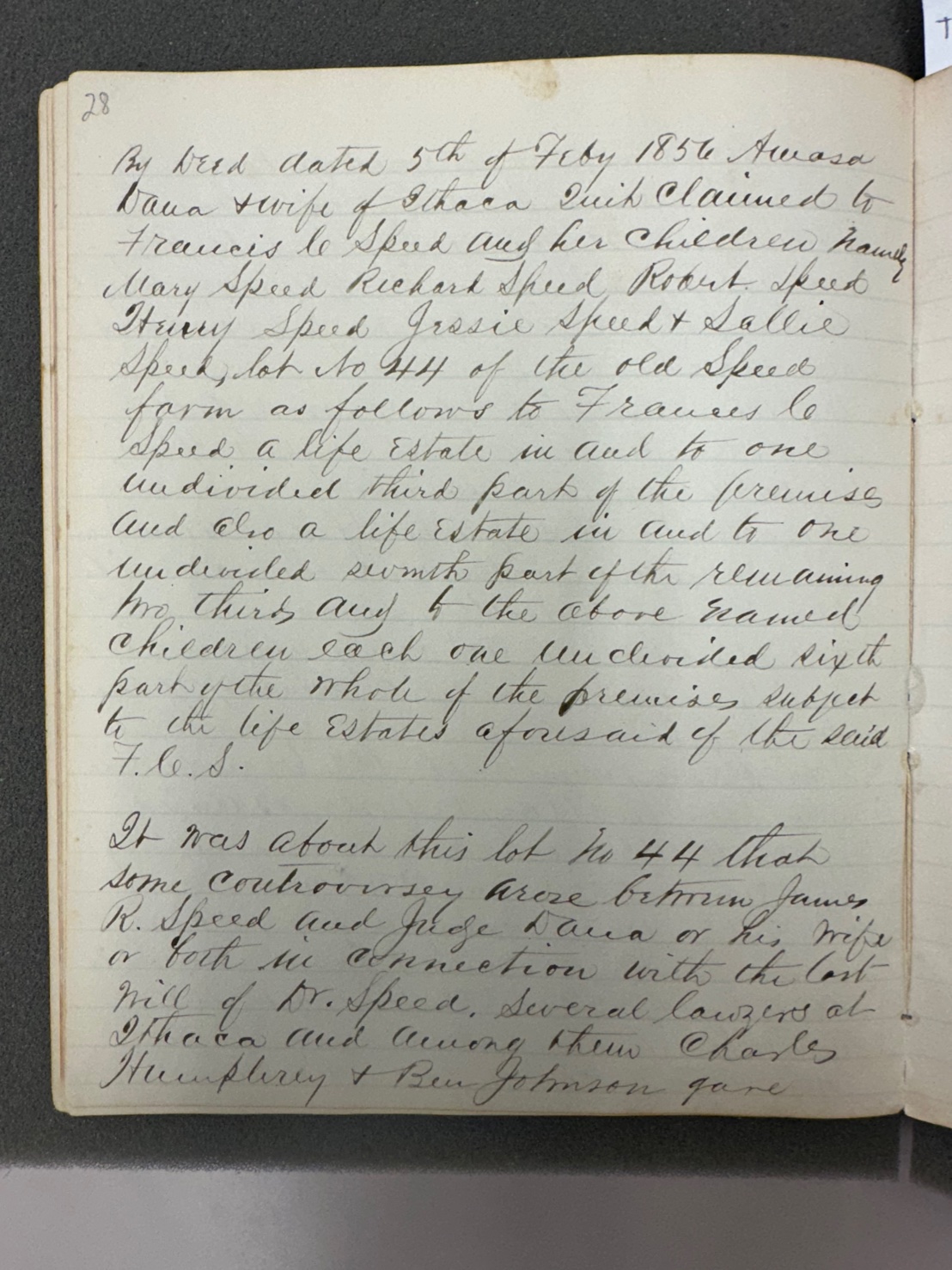
By Deed dated 5th of Feby 1856 Awasa Dana + wife of Ithaca Quit Claimed to Francis C Speed and her children namely Mary Speed Richard Speed Robert Speed Henry Speed Jessie Speed + Sallie Speed, lot No 44 of the old Speed farm as follows to Francis C Speed a life estate in and to one undivided third part of the premises and also a life estate in and to one undivided seventh part of the remaining two thirds and to the above named children each one undivided sixth part of the whole of the premises subject to the life estates aforesaid of the said F.C.S.
It was about this lot No 44 that some controversey arose between James R. Speed and Judge Dana or his wife or both in connection with the last will of Dr. Speed. Several Lawyers at Ithaca and among them Charles Humpherey + Ben Johnson gave
V_0137
29
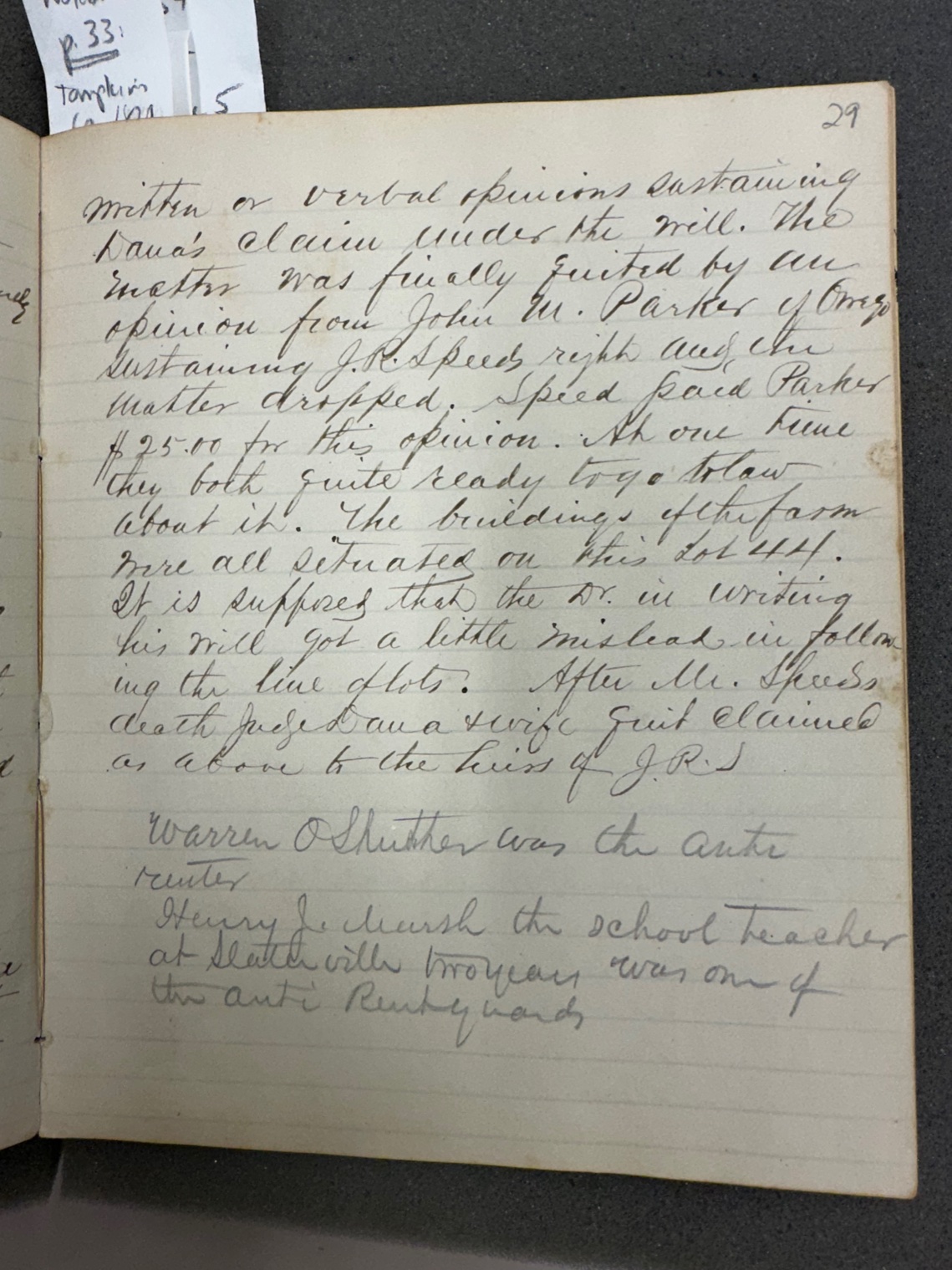
written or verbal opinions sustaining Dana's claim under the will. The matter was finally quited by an opinion from John M. Parker of Owego sustaining J.R.Speeds right and the matter dropped. Speed paid Parker $25.00 for this opinion. At one time they both quite ready to go to law about it. The buildings of the farm were all situated on this Lot 44. It is supposed that the Dr. in writing his will got a little mislead in following the line of lots. After Mr. Speeds death the Judge Dana + wife quit claimed as above to the heirs of J.R.
V_0138
30
Page is blank.
V_0139
31
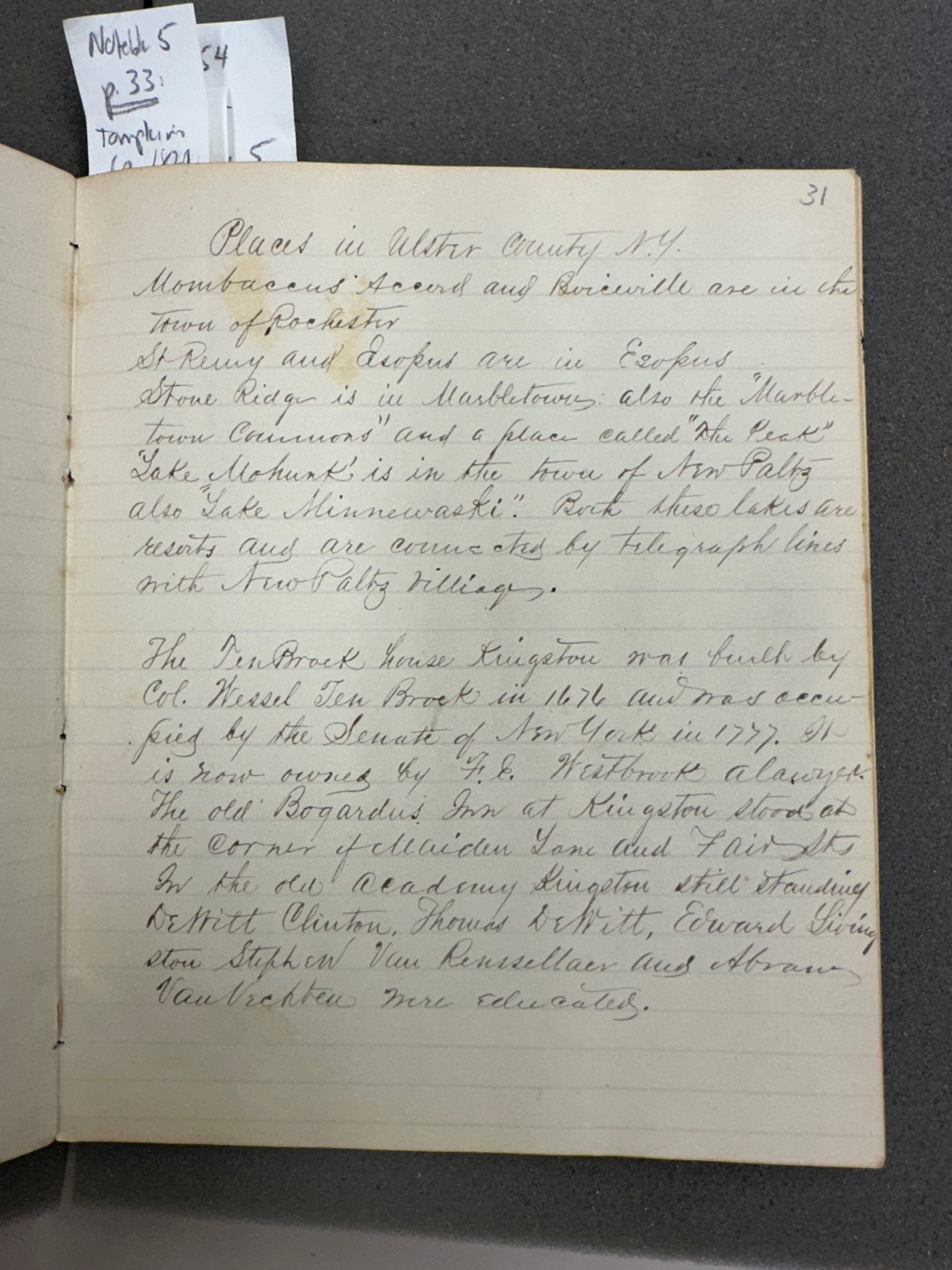
Mombaccus Accord and Boiceville are in the Town of Rochester. St Remy and Esopus are in Esopus Stone Ridge is in Marbletown: also the “Marbletown Commons” and a place called “The Peak”. Lake Mohunk is in the town of New Paltz—also “Lake Minnewaski”. Both these lakes are resorts and are connected by telegraph lines with New Paltz villiage[sic].
The TenBrock house Kingston was built by Col. Wessel Ten Brock in 1676 and was occupied by the Senate of New York in 1777. It is now owned by F.E. Westbrook a lawyer. The old Bogardus Inn at Kingston stood at the corner of Maiden Lane and Fair Sts. In the old academy Kingston still standing DeWitt Clinton, Thomas DeWitt, Edward Livingston Stephen Van Rensselaer and Abram VanVichten were educated.
V_0140
32
Page is blank.
V_0141
33
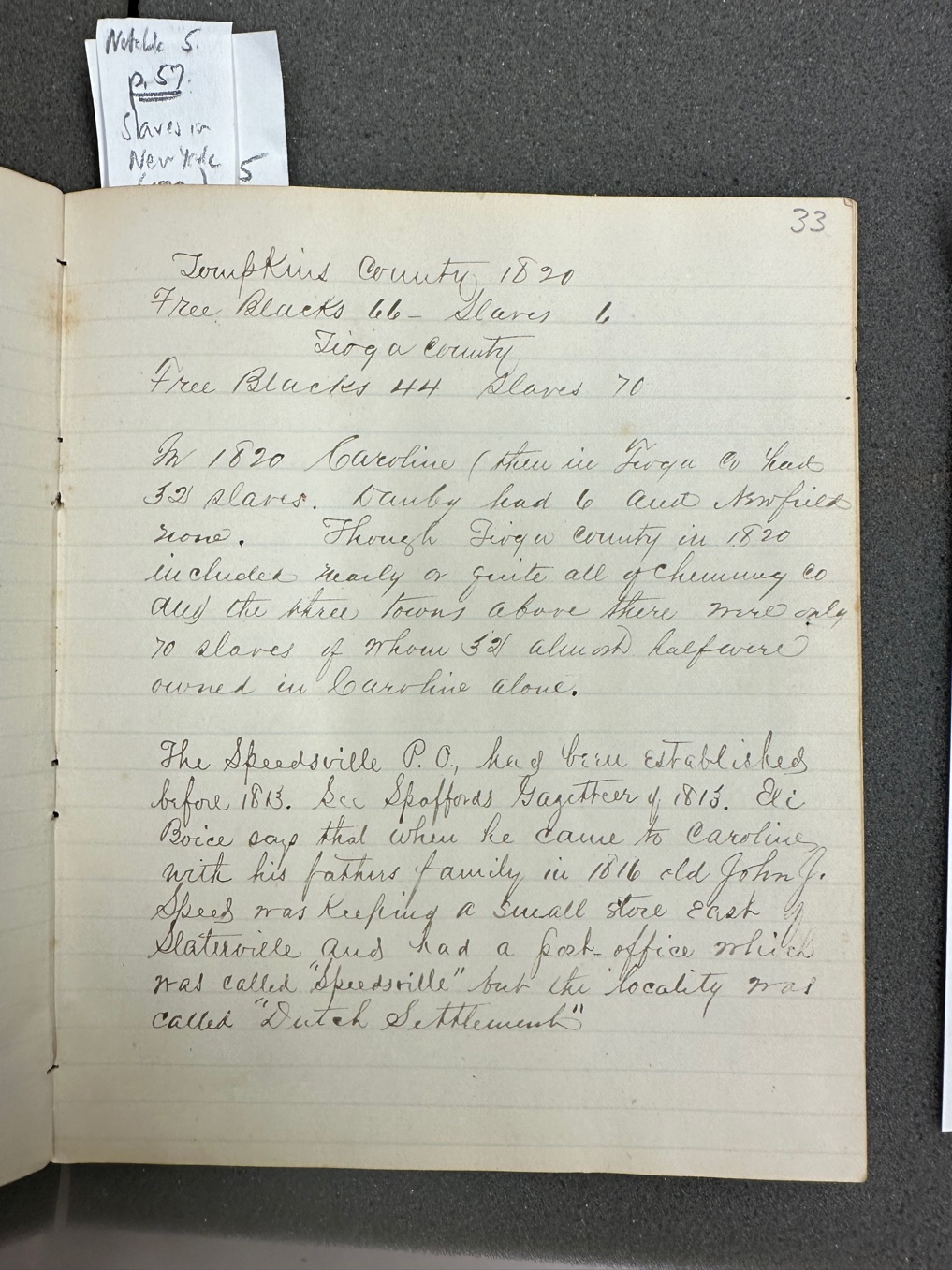
In 1820 Caroline (then in Tioga Co had 32 slaves. Danby had 6 and Newfield none. Though Tioga County in 1820 included nearly or quite all of Chemung Co and the three towns above there were only 70 slaves of whom 32 almost half were owned in Caroline alone.
The Speedsville P.O. had been established before 1813. See Spaffords Gazetteer of 1813. Eli Boyce says that when he came to Caroline with his fathers family in 1816 old John J. Speed was keeping a small store east of Slaterville and had a post office which was called “Speedsville” but the locality was called “Dutch Settlement”
V_0142
34
Page is blank.
V_0143
35
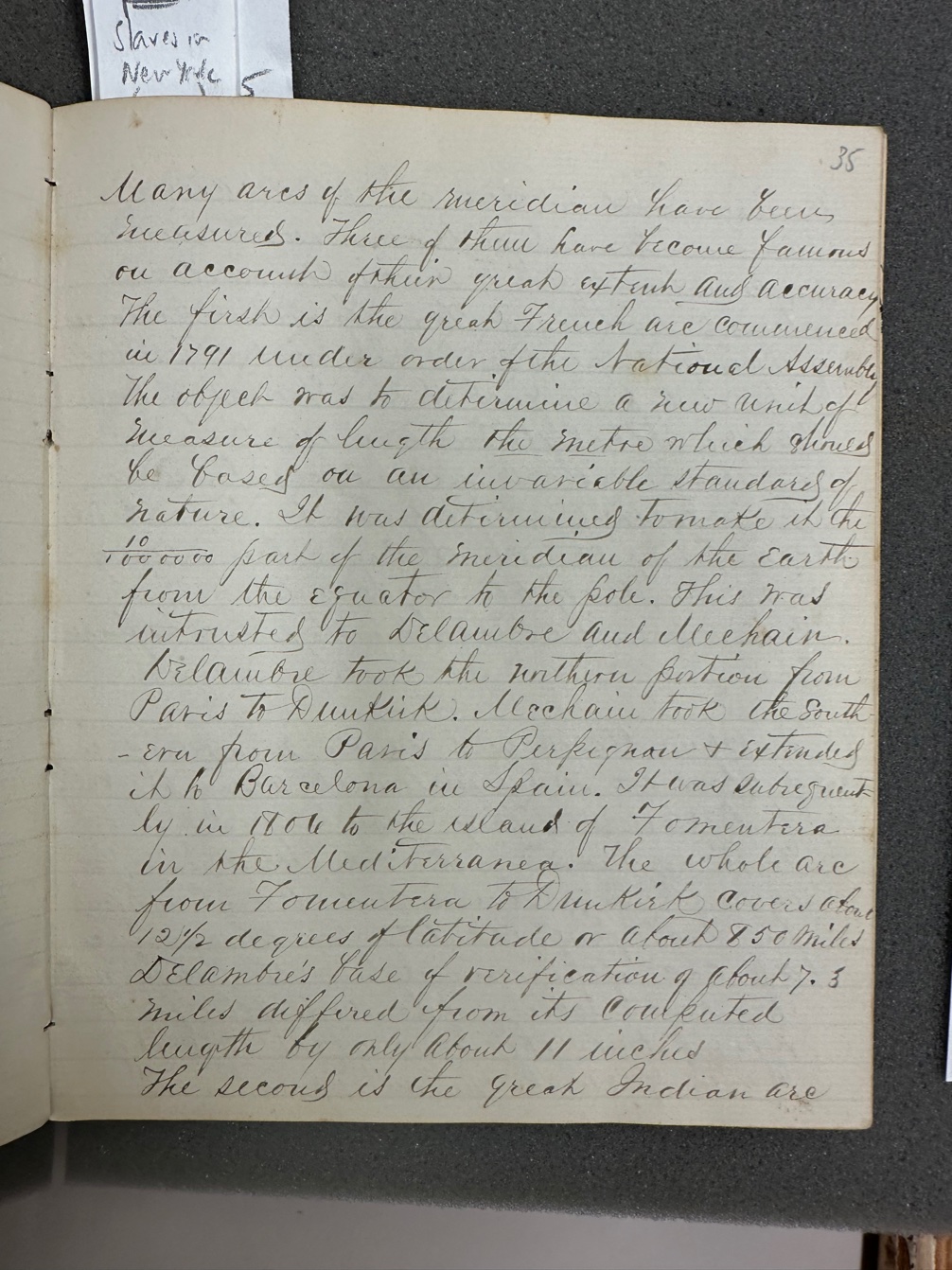
Many arcs of the meridian have been measured. Three of them have become famous on account of their great extent and accuracy. The first is the great French arc commenced in 1791 under order of the National Assembly. The object was to determine a new unit of measure of length the metre which should be based on an invariable standard of nature. It was determined to make it the ¹⁰⁄₁₀₀₀₀₀₀ part of the meridian of the earth from the equator to the pole. This intrusted to Delambre and Mechain. Delambre took the northern portion from Paris to Dunkirk. Mechain took the southern from Paris to Perpignan + extended it to Barcelona in Spain. It was subsequently in 1806 to the island of Fomentera in the Mediterranea[sic]. The whole arc from Fomentera to Dunkirk covers about 12½ degrees of latitude or about 850 miles. Delambre's base of verification of about 7.3 miles differed from its computed length by only about 11 inches The second is the great Indian arc
Annual report of the Board of Regents of the Smithsonian Institution 1858, p. 85, “Astronomy”.
V_0144
36
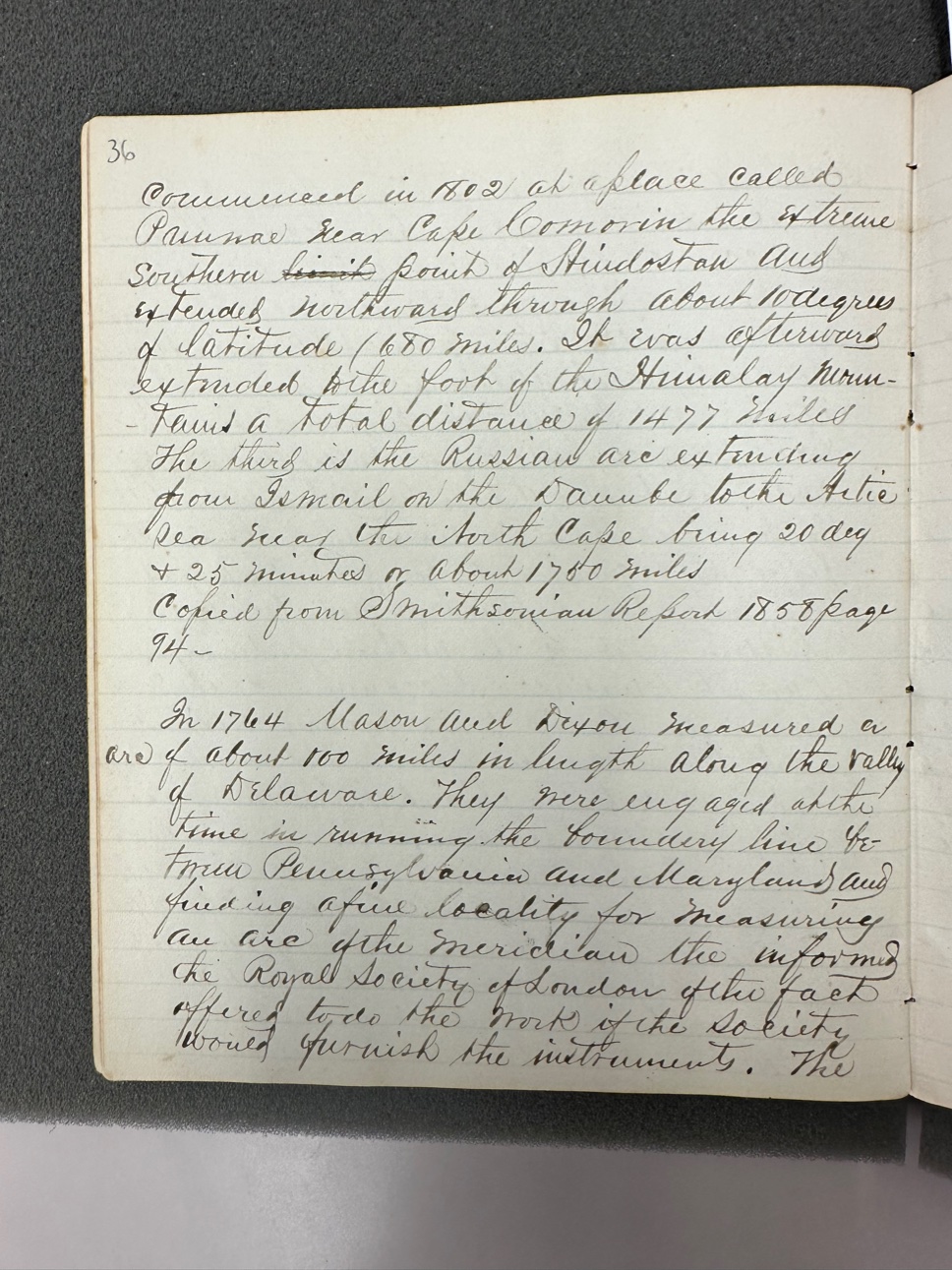
commenced in 1802 at a place called Paunae [Punnœ] near Cape Comorin the extreme southern limit point of Hindustan and extended northward through about 10 degrees of latitude (680 miles. It was afterward extended to the foot of the Himalay Mountains a total distance of 1477 miles
The third is the Russian arc extending from Ismail on the Danube to the Artic sea near the North Cape being 20 deg + 25 minutes or about 1750 miles.
Copied from Smithsonian Report 1858 page 94.
In 1764 Mason and Dixon measured a[sic] arc of about 100 miles in length along the valley of Delaware. They were engaged at the time in running the boundery[sic] line between Pennsylvania and Maryland and finding a fine locality for measuring an arc of the meridian the[sic] informed the Royal Society of London of the fact offered to do the work if the society would furnish the instruments. The
Punnœ, the town near Camorin is currently named Punnai Nagar.
V_0145
37
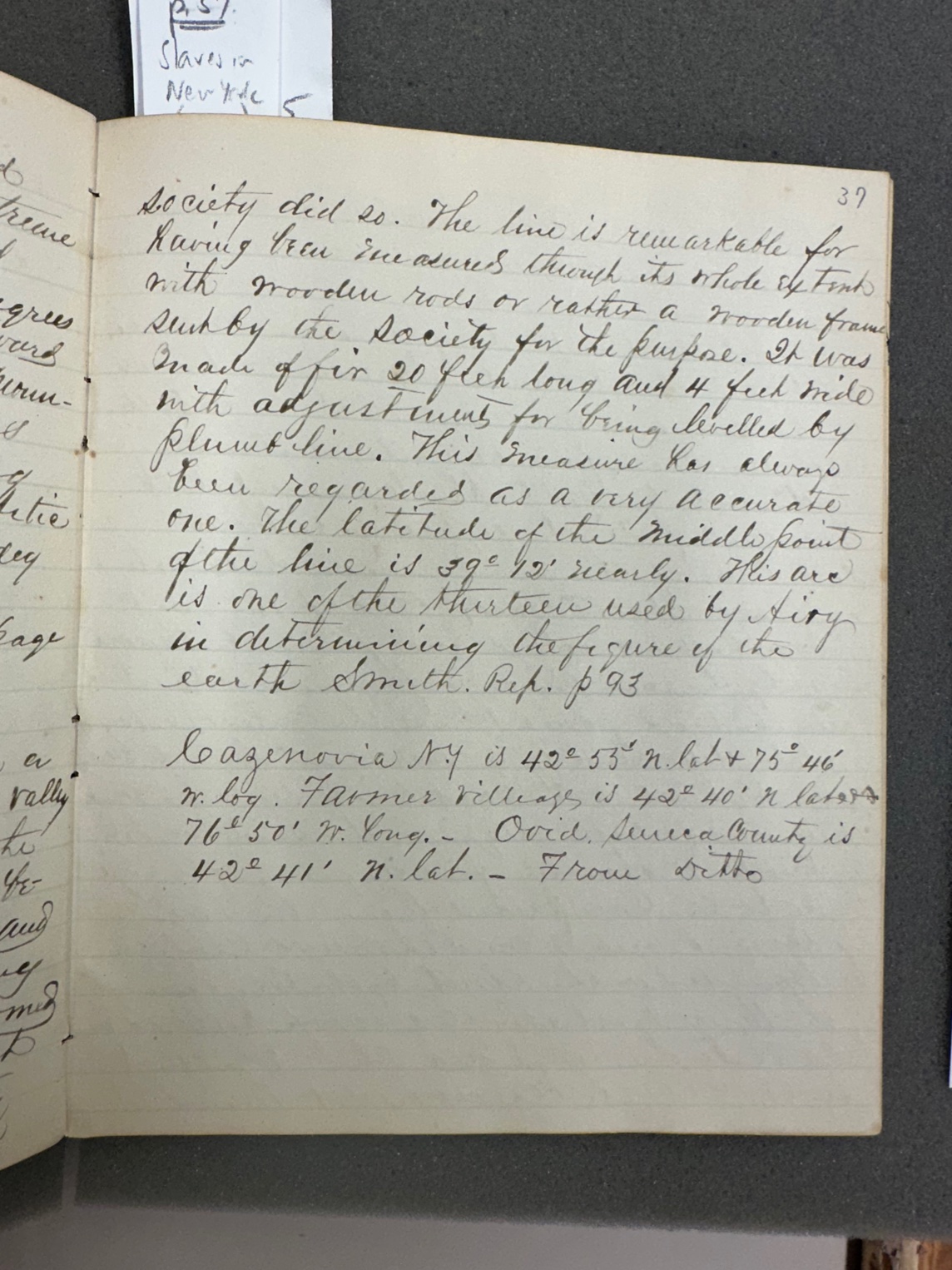
society did so. The line is remarkable for having been measured through its whole extent with wooden rods or rather a wooden frame sent by the society for the purpose. It was made of fir 20 feet long and 4 feet wide with adjustments for being levelled by plumb line. This measure has always been regarded as a very accurate one. The latitude of the middle point of the line is 39°12′ nearly. This arc is one of the thirteen used by Airy in determining the figure of the earth. Smith. Rep. p 93
Cazenovia N.Y. is 42°53′ N.lat + 75°46′ W.log. Farmer Villiage[sic] is 42°40′N latitude 76°50′ W. long. Ovid Seneca County is 42°41′ N. lat._ From Ditto.
V_0146
38
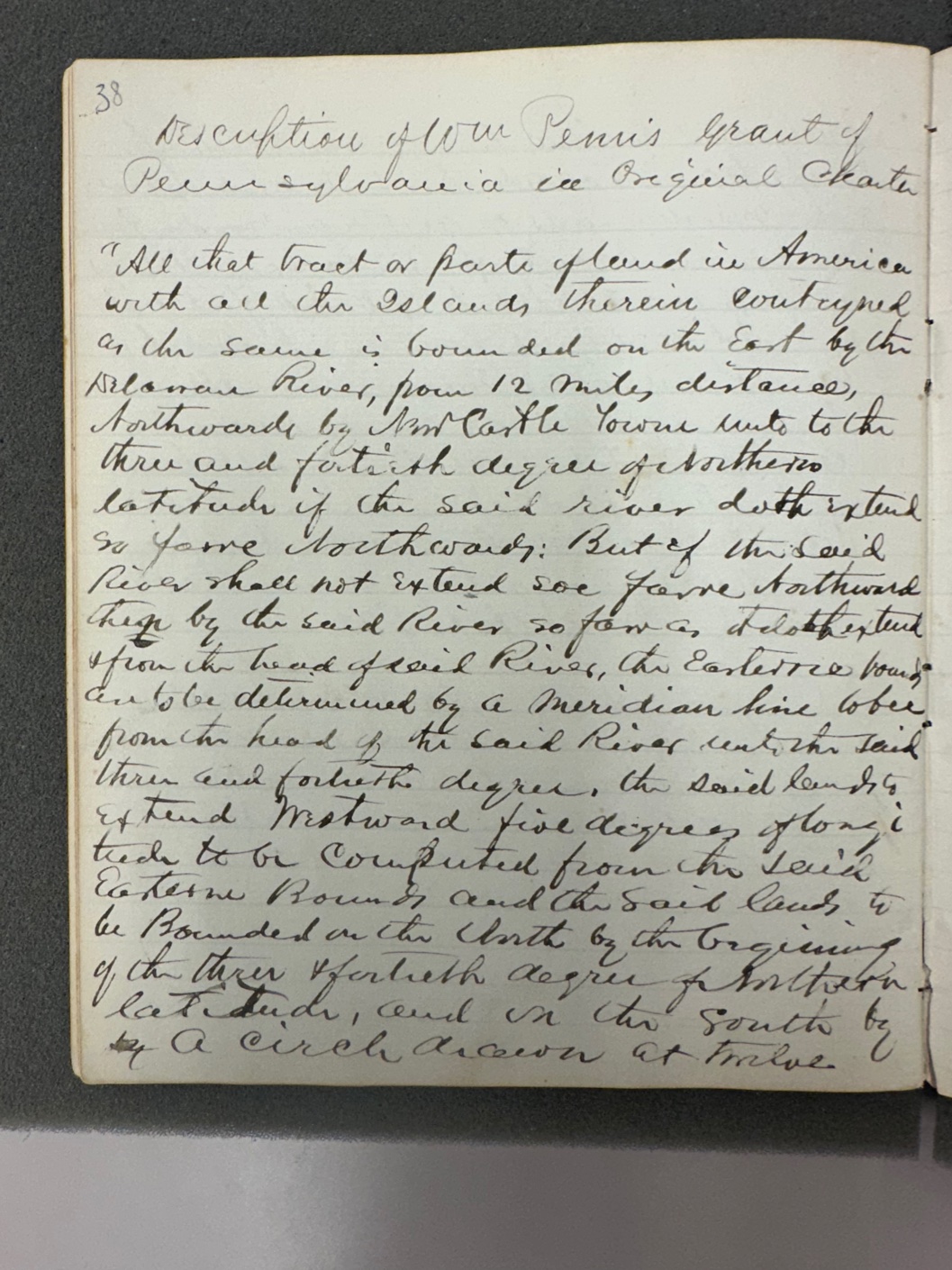
“All that tract or parts of land in America with all the islands therein conteyned as the same is bounded on the East by the Delaware River, from 12 miles distance, Northwards by New Castle Town unto the three and fortieth degree of Nortern latitude if the said river doth extend so farre Northwards: But if the said River shall not extend soe farre Northward then by the said River so farre as it donth extend from the head of said River, the Easterne bound are to be determined by a meridian line to bee from the head of the said River unto the said three and fortieth degree, the said lands to extend Westward five degrees of longitude to be computed from the said Eastern Bounds and the said lands to be Bounded on the North by the beginning of the three + fortieth degree of Northern latitude and on the south by a circle drawn at twelve
V_0147
39
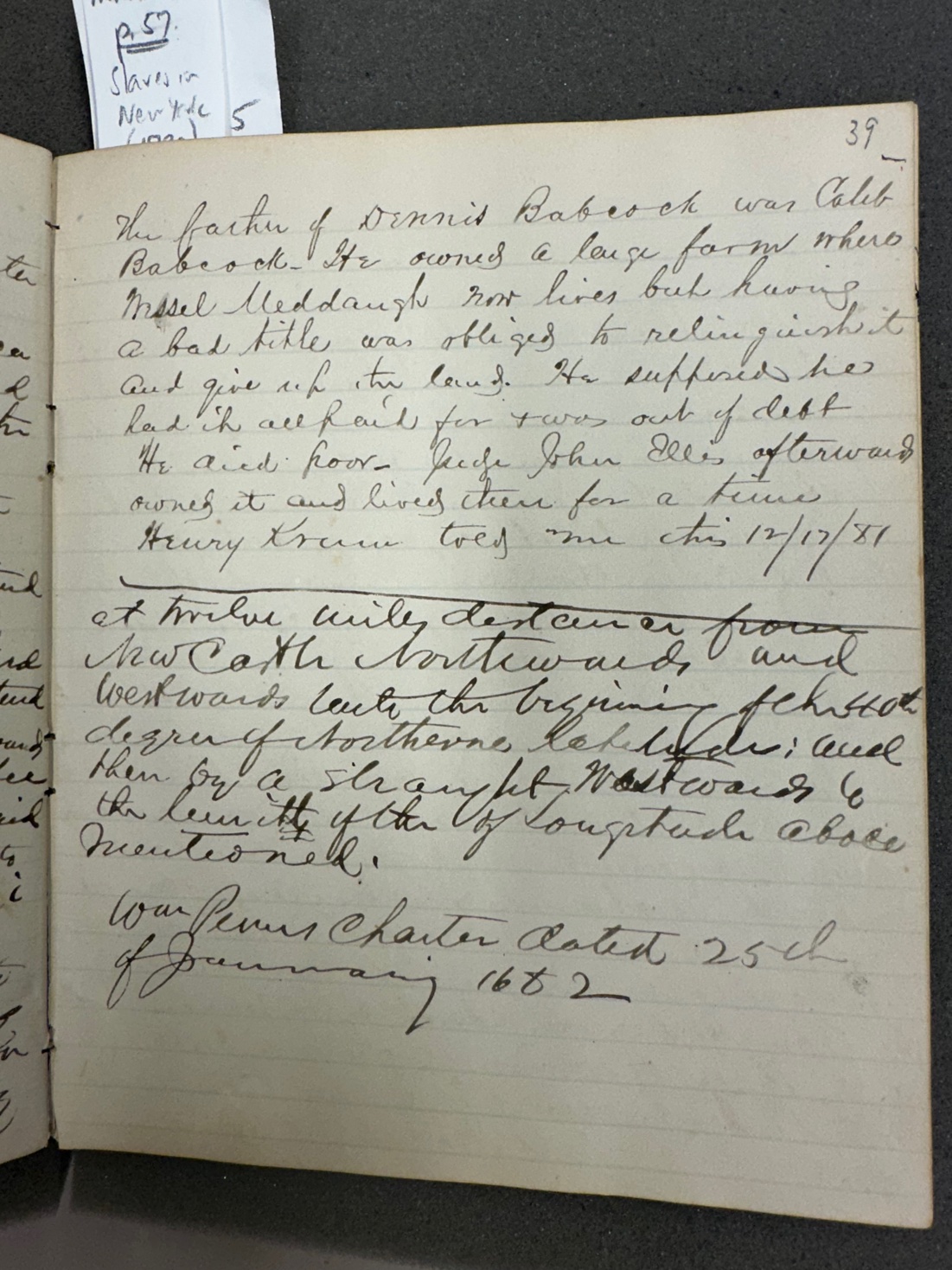
The father of Dennis Babcock was Caleb Babcock. He owned a large farm where Wessel Meddaugh now lives but having a bad title was obliged to relinquish it and give up the land. He supposed he had it all paid for + was out of debt. He died poor. Judge John Ellis afterward owned it and lived there for a time. Henry Krum told me this 12/17/81
at twelve miles distance from New Castle Northwards and Westwards back to the beginning of the 40th degree of Northerne latitude: and then by a straight Westwards to the limitty of longitude above mentioned.
Wm Penns charter dated 25th of January 1682
V_0148
40
Page is blank.
V_0149
41
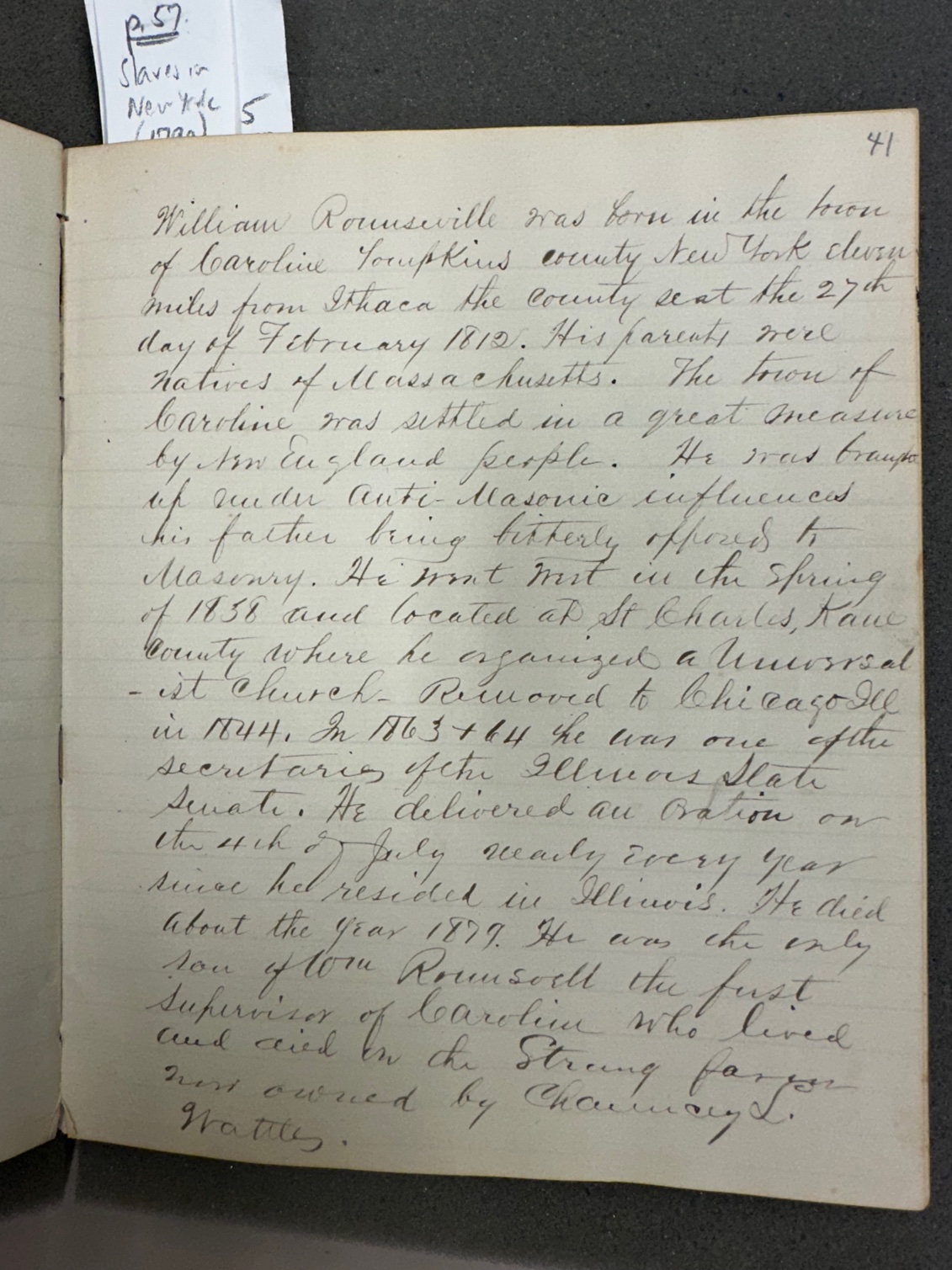
William Rounsville was born in the town of Caroline Tompkins county New York eleven miles from Ithaca the county seat the 27th day of February 1812. His parents were natives of Massachusetts. The town of Caroline was settled in a great measaure by New England people He was brought up under anti-Masonic influences his father being betterly opposed to Masonry. He went west in the spring of 1838 and located at St Charles, Kane County where he organized a Universalist Church. Removed to Chicago Ill in 1844. In 1863 + 64 he was one of the secretaries of the Illinois State Senate. He delivered an oraton on the 4th of July nearly every year since he resided in Illinois. He died about the year 1877. He was the only son of Wm Rounsvell[sic] the first Supervisor of Caroline who lived and died on the Strang farm now owned by Chauncey L. Wattles.
St Charles is in Illinois.
V_0150
42
Page is blank.
V_0151
43
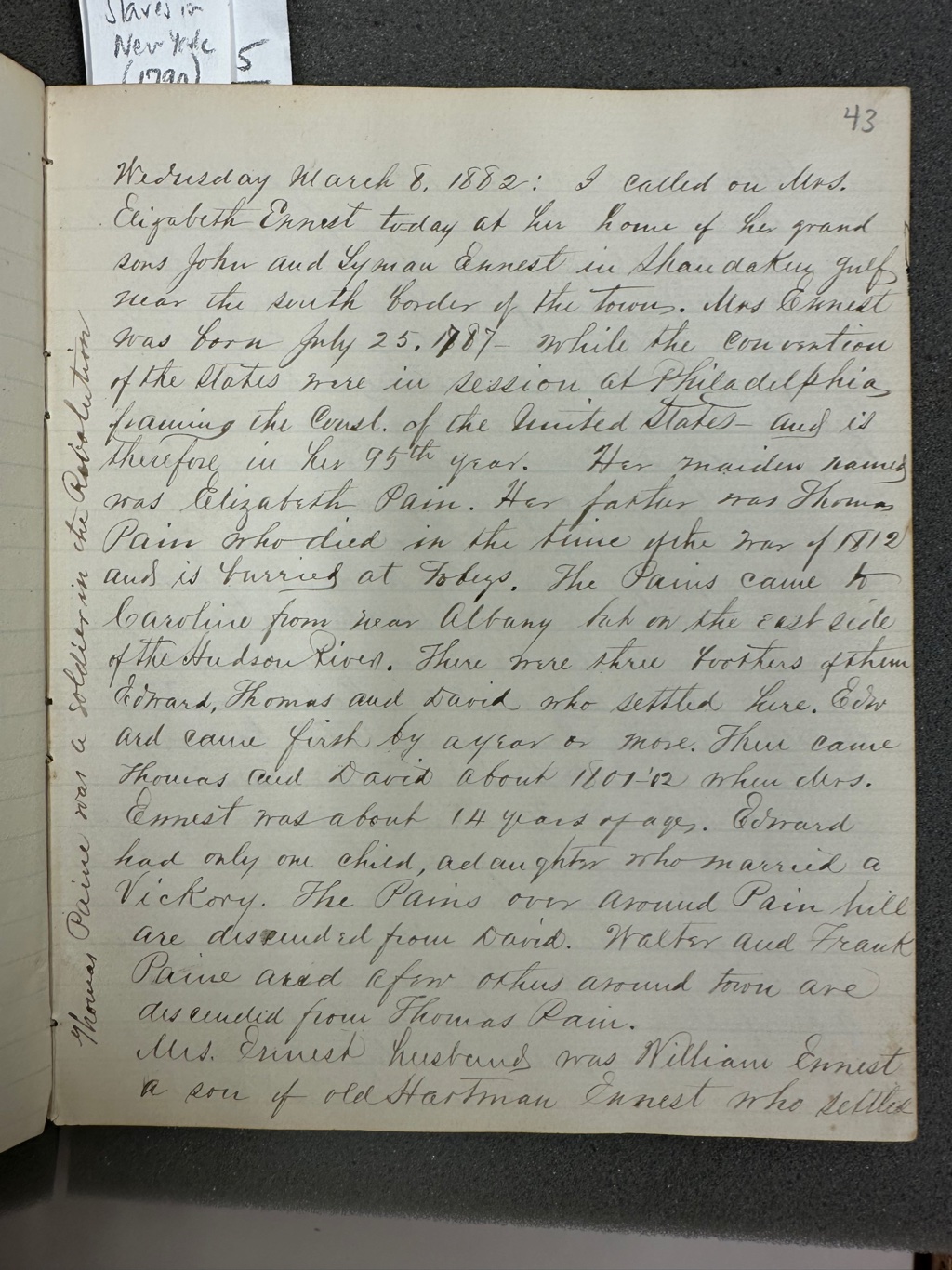
V_0153
44
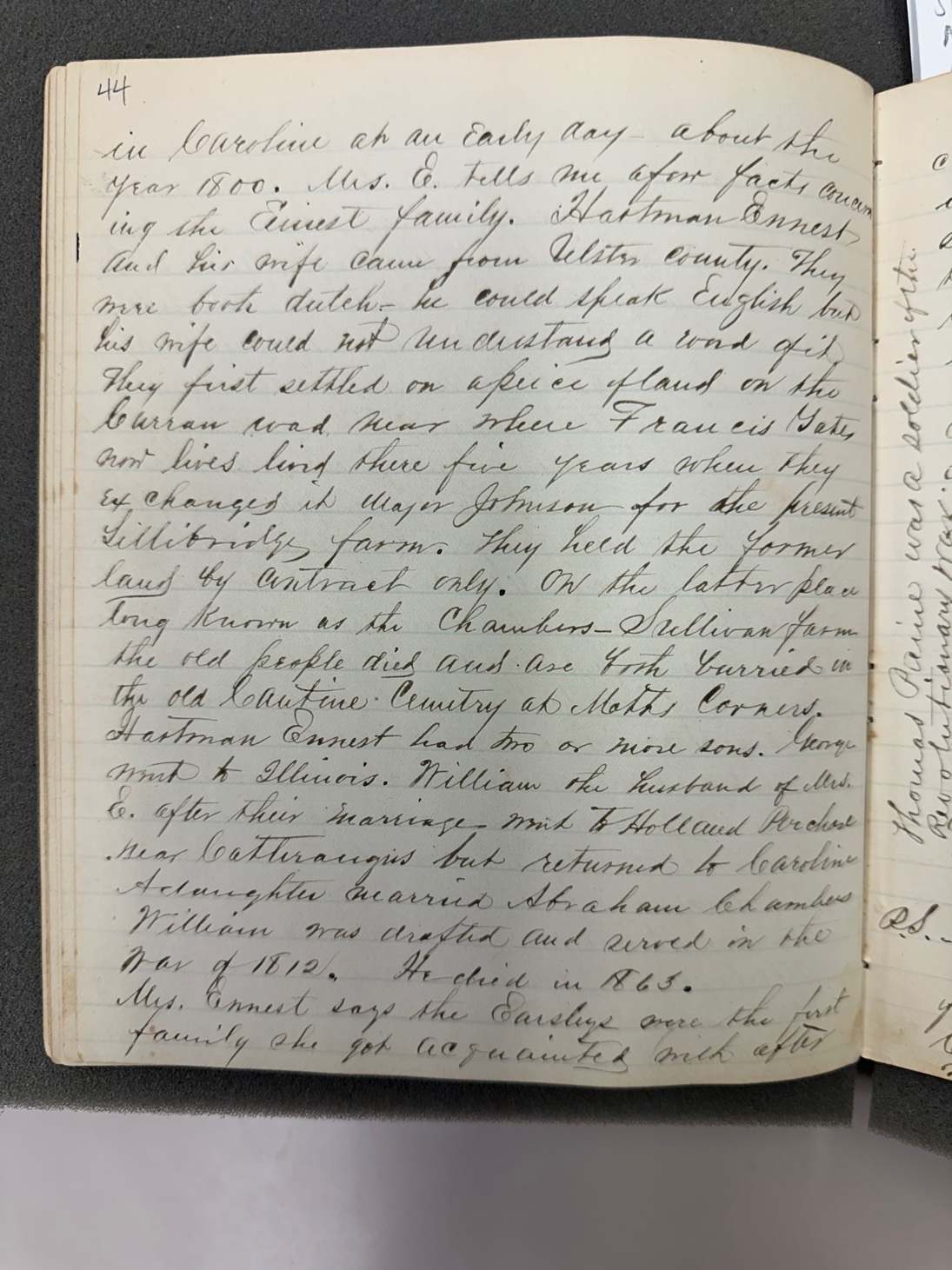
in Caroline at an early day, about the year 1800. Mrs. E. tells me a few facts concerning the Ennest family. Hartman Ennest and his wife came from Ulster County. They were both Dutch. He could speak English, but his wife could not understand a word of it. They first settled on a piece of land on the Cannan Road, near where Francis Gates now lives lived there five years when they exchanged it[sic] Major Johnson for the present Lillibridge farm. They held the former land by contract only. On the latter place long known as the Chambers-Sullivan Farm the old people died and are both buried in the old Cantine Cemetery at Motts Corners. Hartmann Ennest had two or more sons. George went to Illinois. William, the husband of Mrs. E. after their marriage went to Holland Purchase near Catteraugus[sic] but returned to Caroline. A daughter married Abraham Chambers. William was drafted and served in the War of 1812. He died in 1863. Mrs. Ennis says the Earsleys were the first family she got acquainted with after
V_0154
45
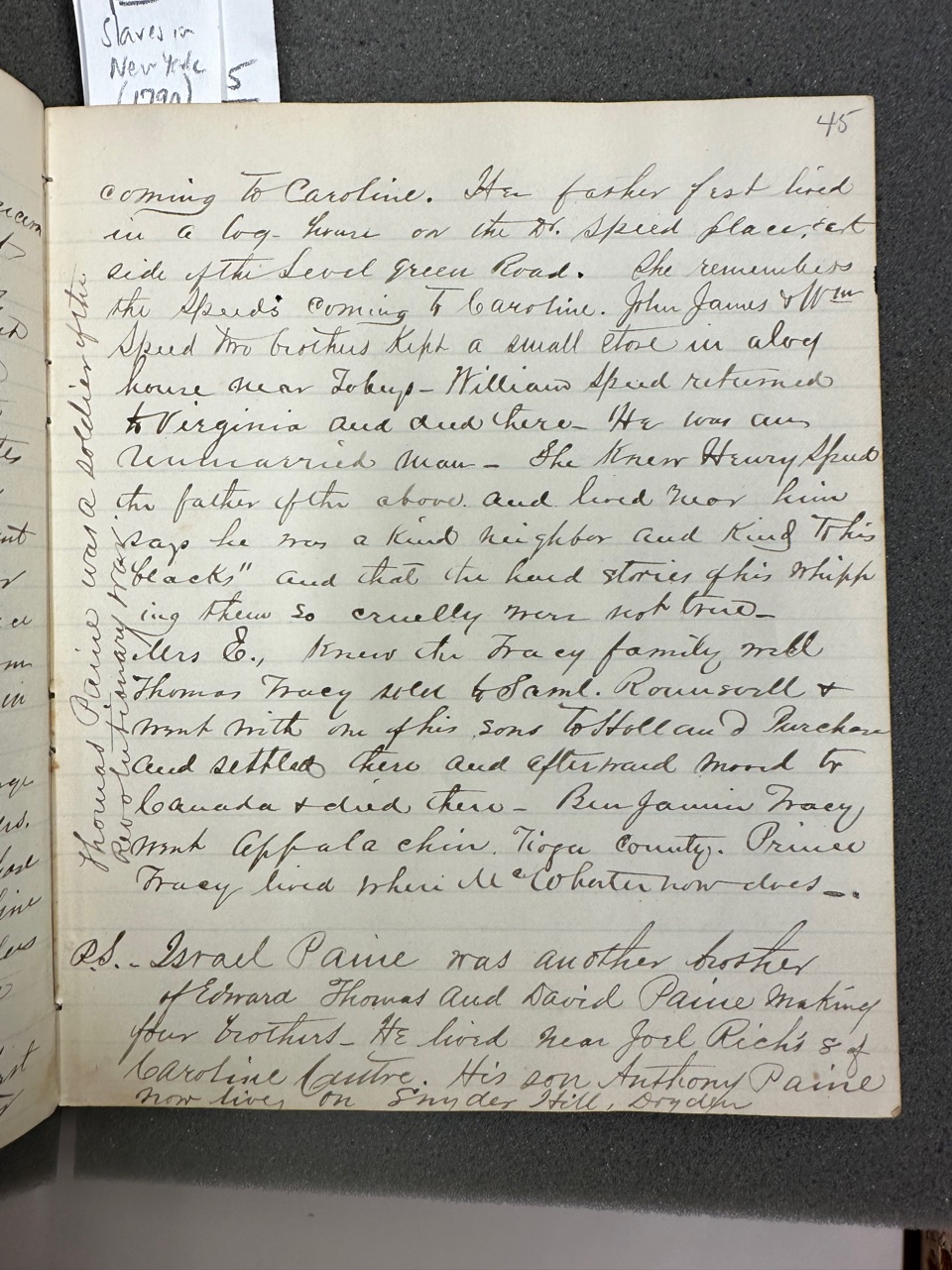
coming to Caroline. Her father first lived in a log house on the Speed Place east side of Level Green Road. She remembered the Speeds coming to Caroline. John James and William Speed two brothers kept a small store in a log house near Tobeys. William Speed returned to Virginia and died there. He was an unmarried man. She knew Henry Speed the father of the above and lived near him says he was a kind neighbor and kind to his “blacks” and that the hard stories of his whipping them so cruelly were not true. Mrs. E, knew the Tracy family well. Thomas Tracy sold to Samuel Rounsville and went with one of his sons to Holland Purchase and settled there and afterward moved to Canada and died there. Benjamin Tracy went Appalachian Tioga County. Prince Tracy lived where McCohater now does.
P.S. Israel Paine was another brother of Edward Thomas and David Paine making four brothers. He lived near Joel Rich's S of Caroline Center. His son Anthony Paine now lives on the Snyder Hill, Dryden.
V_0155
46
V_0157
47
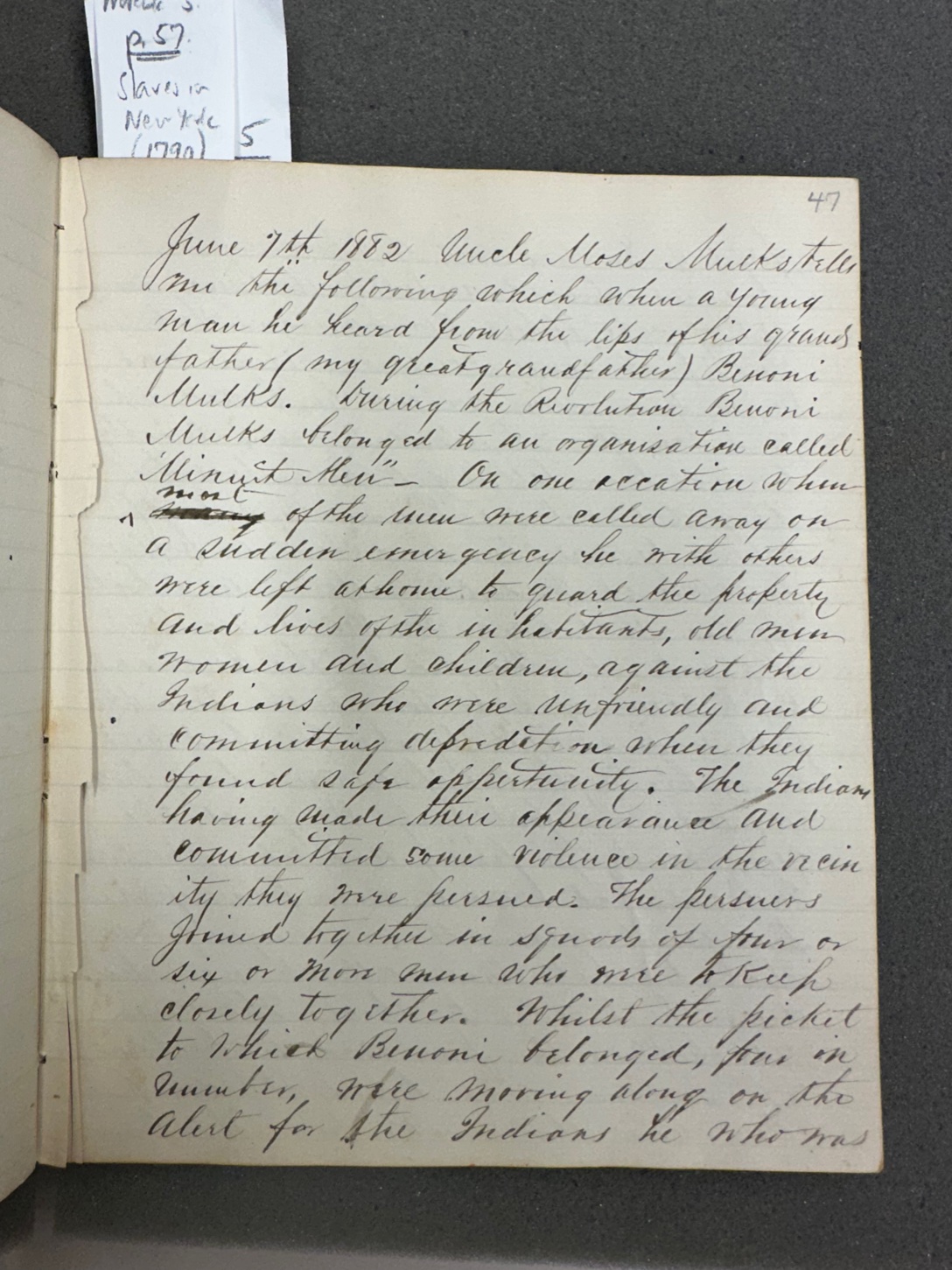
June 7th, 1882. Uncle Moses Mulks tells me the following, which when a young man he heard from the lips of his grandfather (my great grandfather) Benoni Mulks. During the Revolution Bononi Mulks belonged to an organization called “Minute Men”. On one occasion when most of the men were called away on a sudden emergency he with others were left alone to guard the property and lives of the inhabitants, old men women and children, against the Indians who were unfriendly and committing depredations when they found safe opportunity. The Indians having made their appearance and committed some violence in the vicinity they were pursued. The pursuers joined together in squads of four or five or more men who were to keep closely together. Whilst the picket to which Bononi belonged, five in number, were moving along on the alert for the Indians he who was
“During the Revolution” thus not in Caroline; probably in Wallkill in Orange County, NY. Page cut out between 46 and 47.
V_0158
48
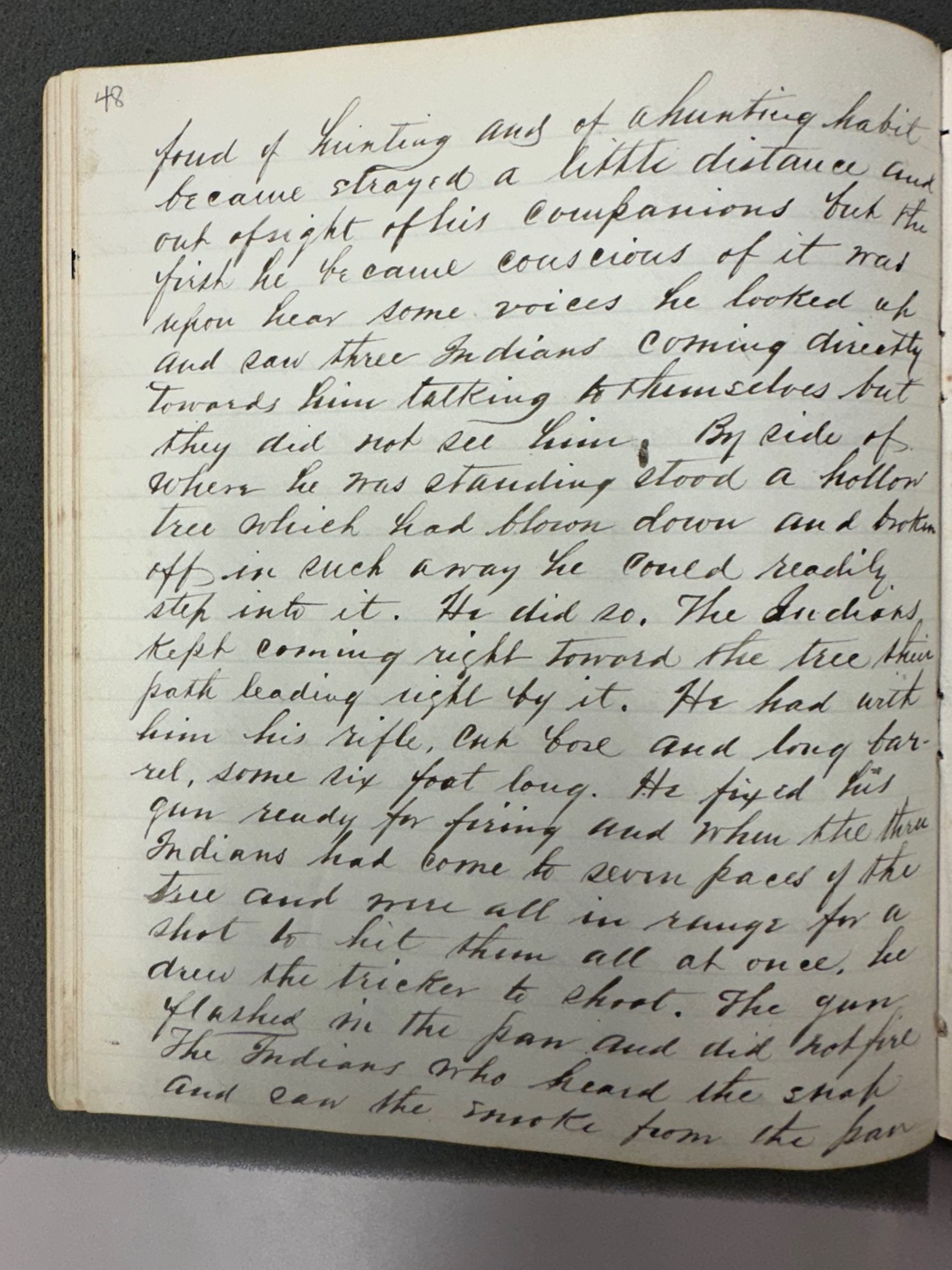
fond of hunting and of a hunting habit became strayed a little distance and out of sight of his companions but the first he became conscious of it was upon hear[sic] some voices he looked up and saw three Indians coming directly towards him talking to themselves but they did not see him. By side of where he was standing stood a hollow tree which had blown down and broken off in such a way that he could readily step into it. He did so. The Indians kept coming right towards the tree their path leading right by it. He had with him his rifle, cup bore and long barrel, some six feet long. He fixed his gun ready for firing and when the Indians had come to seven paces of the tree and were all in range for a shot he hit them with all at once. He drew the tricker to shoot. The gun flashed in the pan and did not fire. The Indians who heard the snap and saw the smoke from the pan
cup bore = smooth bore, pers. comm. Greg Clark. tricker = trigger.
V_0159
49
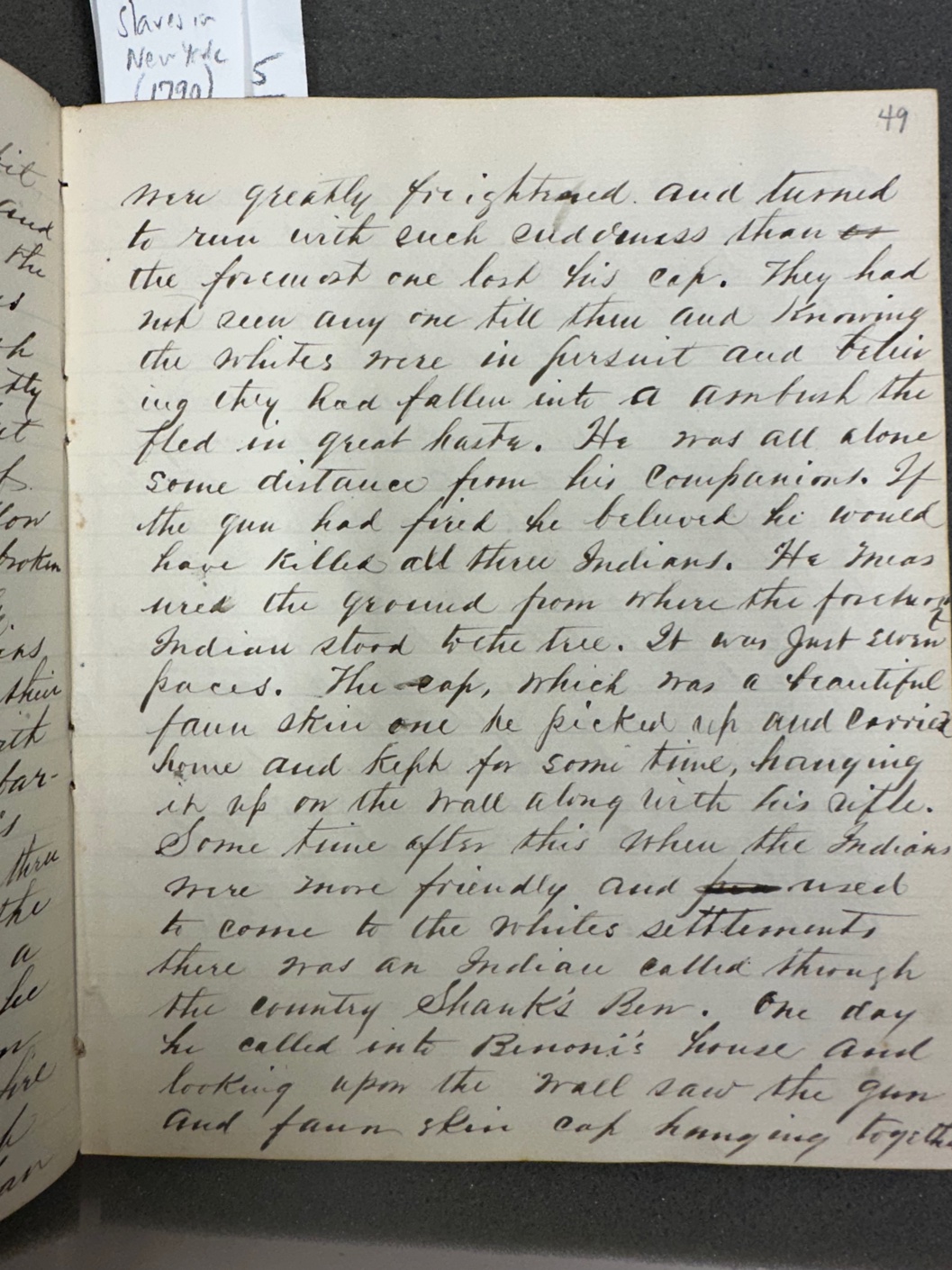
were greatly frightened and turned to run with such suddenness that the foremost one lost his cap. They had not seen anyone until then and knowing the whites were in pursuit and believing they had fallen into an ambush the[y] fled in great haste. He was all alone some distance from his companions. If the gun had fired, he believed he would have killed all three Indians. He measured the ground from where the foremost Indian stood to the tree. It was just eleven paces. The cap, which was a beautiful fawn skin one he picked up and carried home and kept for some time, hanging it on the wall along with his rifle. Sometime after this when the Indians were more friendly and used to come to the white settlements there was an Indian called through the country Shank's Ben. One day he called into Benoni's house and looking upon the wall saw the gun and faun skin cap hanging together
V_0161
50
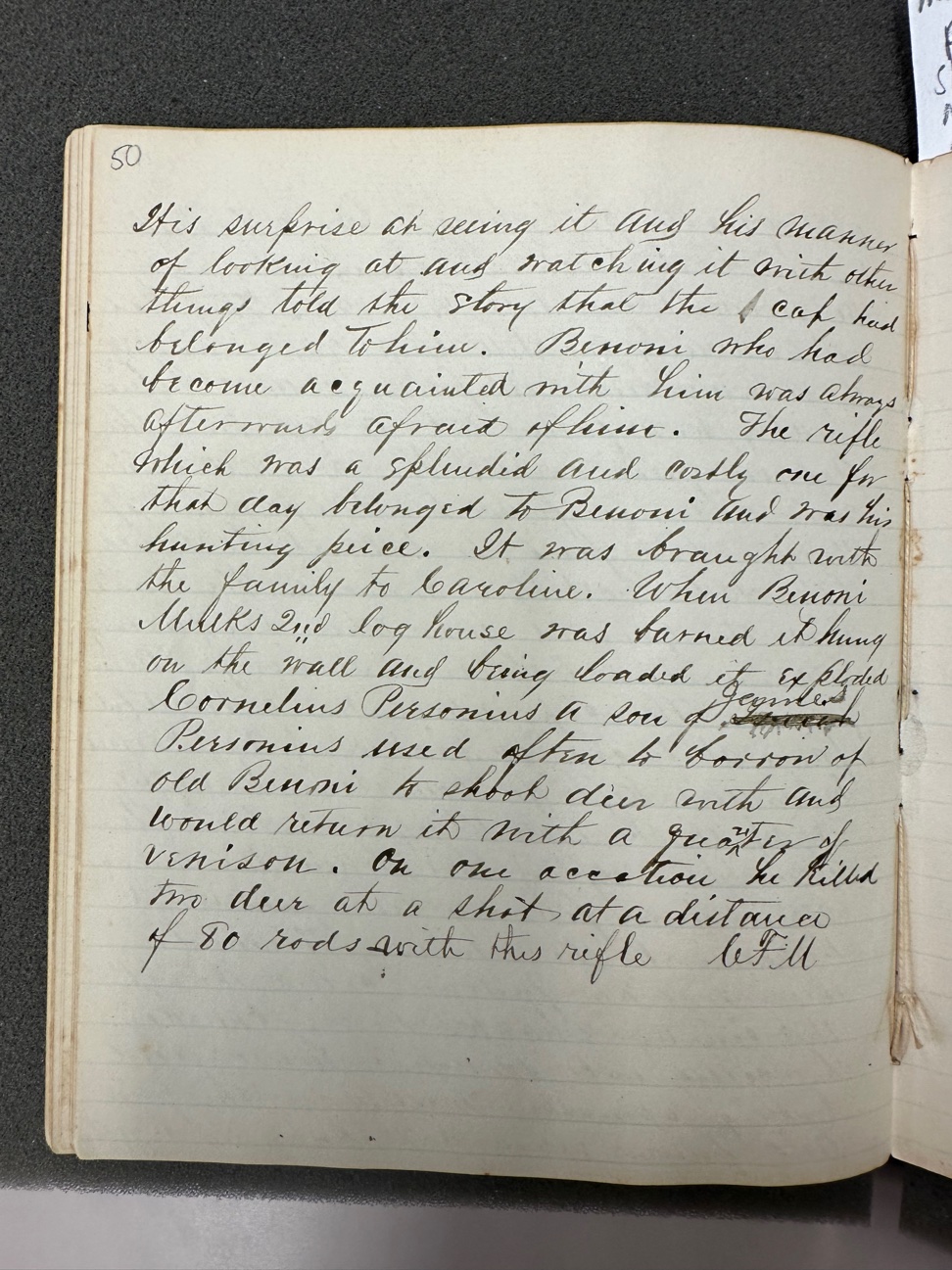
His surprise at seeing it and his manner of looking at and watching it with other things told the story that the cap had belonged to him. Benoni who had become acquainted with him was always afterwards afraid of him. The rifle which was a splendid and costly one for that day belonged to Benoni and was his hunting piece. It was brought with the family to Caroline. When Benoni Mulks 2nd log house was burned it hung on the wall and being loaded it exploded. Cornelius Personius a son of James Personius used often to borrow of old Benoni to shoot deer with and would return with a quantity of venison. On one occasion he killed two deer with a single shot at a distance of 80 rods with this rifle.
V_0162
51
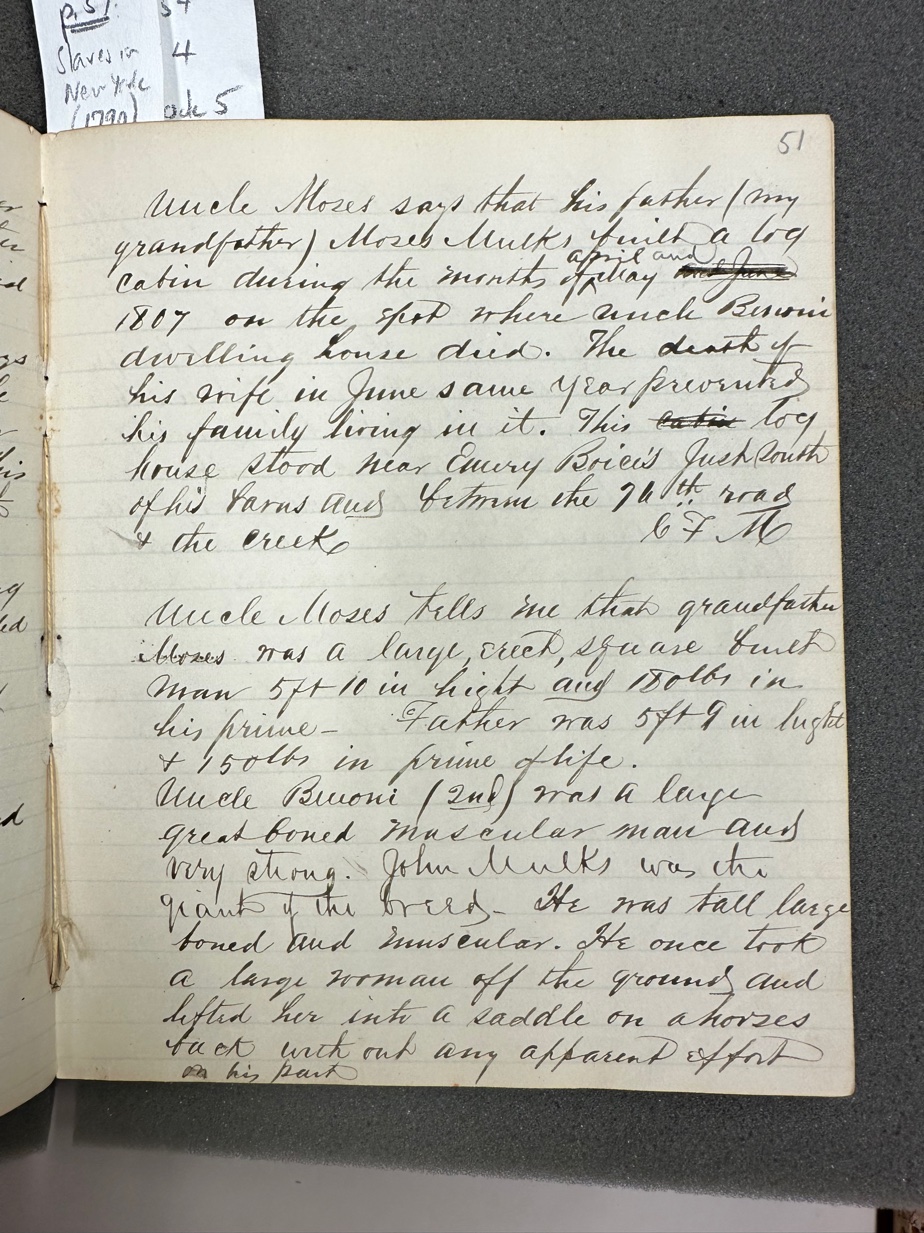
Uncle Moses said his father (my grandfather) Moses Mulks built a log cabin during the months of April and May 1807 on the spot where Uncle Benonis dwelling house died[sic]. The death of his wife in June same year prevented his family living in it. This loghouse stood near Emery Boice's just south of his farm and between the 76th road and the Creek.
Uncle Moses tells me that grandfather Moses was a large, erect, square-built man, 5ft 10 in height and 180 lbs in his prime. Father was 5 ft 9 in height and 150 lbs in prime of life. Uncle Benoni (2nd) was a large, great-boned, muscular man and very strong. John Mulks was the giant of the breed. He was tall, large boned and muscular. He once took a large woman off the ground and lifted her into the saddle on a horse back without any apparent effort on his part.
V_0163
52
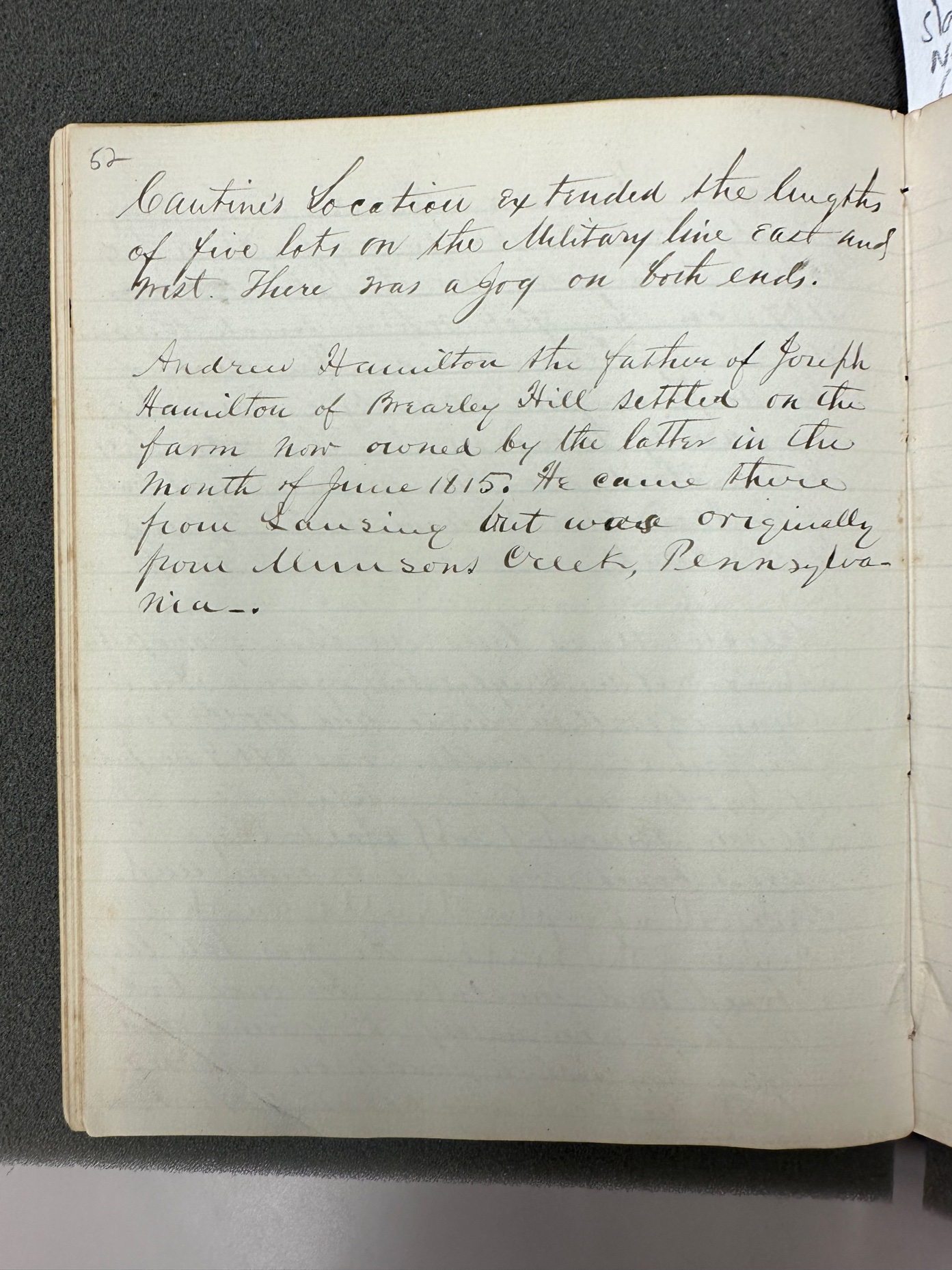
Cantine's Location extended the length of five lots on the military line east and west. There was a jog on both ends.
Andrew Hamilton, the father of Joseph Hamilton of Brearley Hill, settled on the farm now owned by the latter in the month of June 1815. He came there from Lansing but was originally from Munson's Creek, Pennsylvania.
V_0164
53
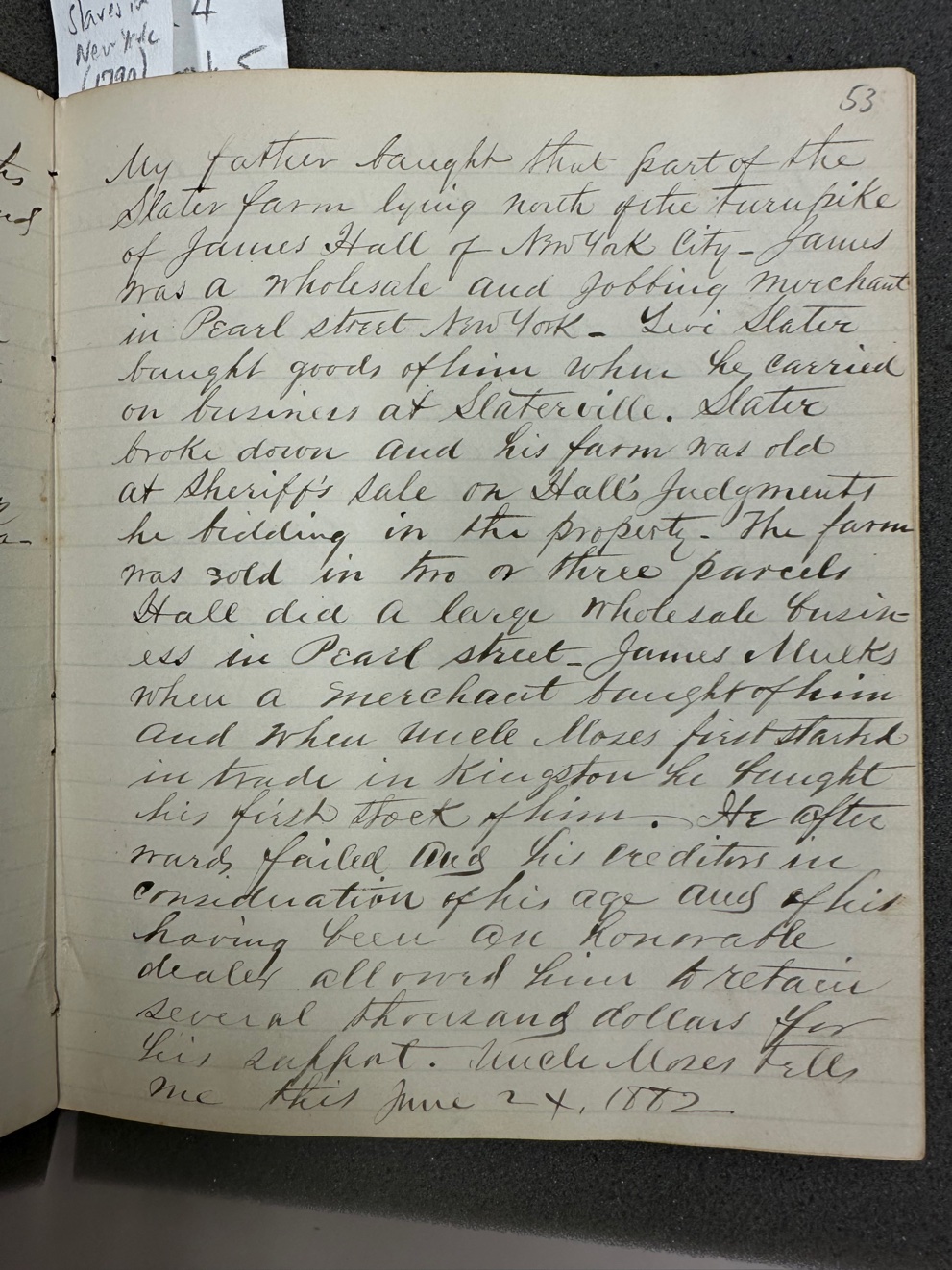
My father bought that part of the Slater farm lying north of the turnpike of James Hall of New York City. James was a wholesale and jobbing merchant in Pearl street New York. Levi Slater bought goods from him when he carried on business at Slaterville. Slater broke down and his farm was [s]old at Sheriff's sale on Hall's Judgments he bidding in the property. The farm was sold in two or three parcels Hall did a large wholesale business in Pearl street. James Mulks when a merchant bought of him and when Uncle Moses first started in the trade in Kingston he bought his first stock of him. He afterwards failed and his creditors in consideration of his age and of his having been an honorable dealer allowed him to retain several thousand dollars for his support. Uncle Moses tells me this June 2X, 1882.
Uncle Moses of Kingston lived there his entire life, not to be confused with the Moses Mulks who was CFM's grandfather.
V_0165
54
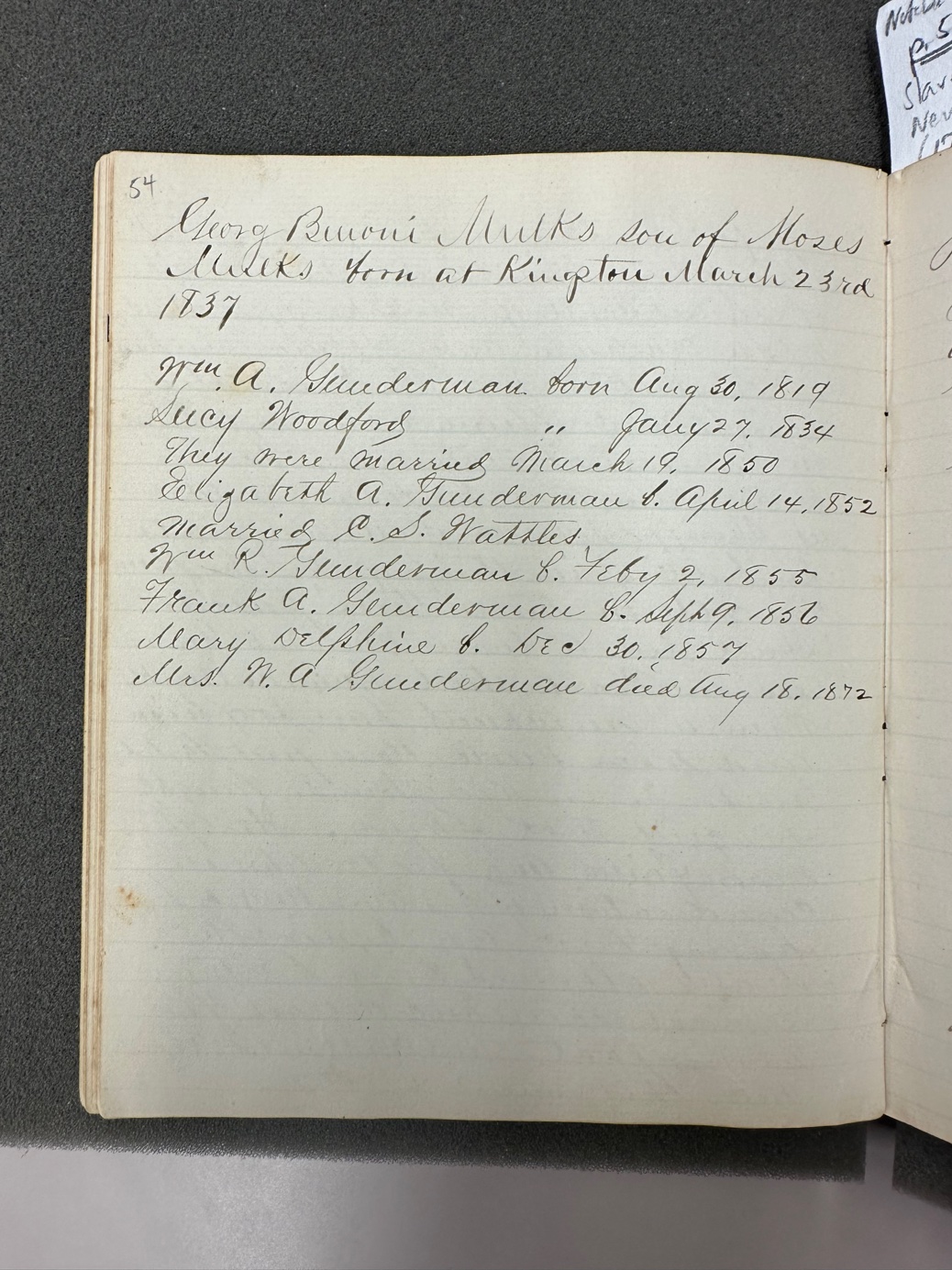
Georg[e] Benoni Mulks son of Moses Mulks, born at Kingston, March 23rd 1837.
Wm. A. Gunderman, born August 30, 1819 Lucy Woodford, born July 27, 1834 They were married March 19, 1850 Elizabeth A. Gunderman born April 14, 1852 married C.S. Wattles Wm R. Gunderman, born February 2nd, 1855 Frank A. Gunderman, b. September 9, 1856 Mary Delphine, b. December 30, 1857 Mrs. W. A. Gunderman died August 18, 1872
V_0166
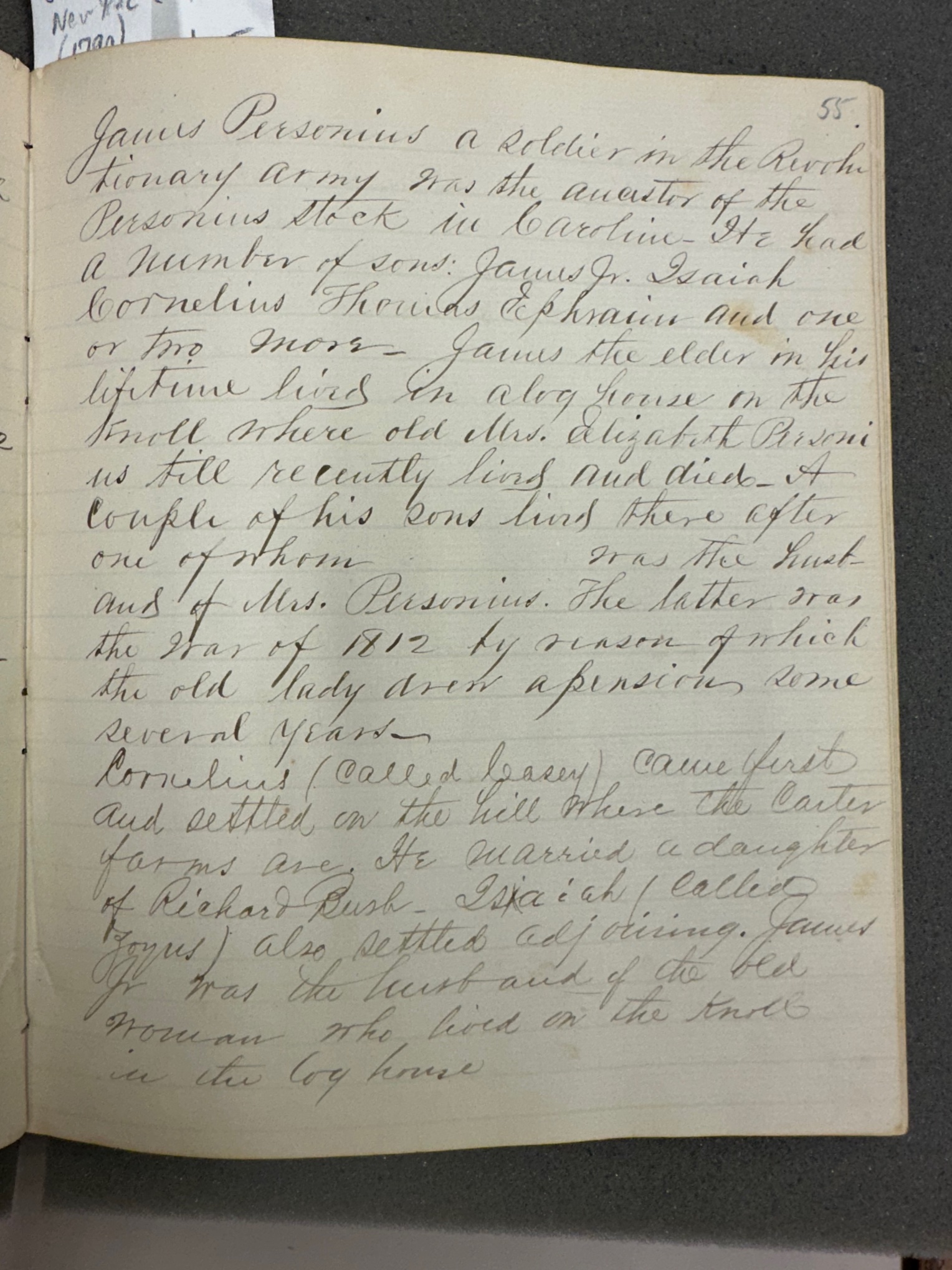
55
James Personius, a soldier in the Revolutionary army, was another of the Personius stock in Caroline. He had a number of sons: James Jr. Isaac Cornelius Thomas Ephraim and one or two more. James the elder in his lifetime lived in a log house on the knoll where old Mrs. Elizabeth Personius till recently lived and died. A couple of his sons lived there after one of whom was the husband of Mrs. Personius. The latter was [sic] the War of 1812 by reason of which the old lady drew a pension some several years. Cornelius (called Casey) came first and settled on the hill where the Carter farms are. He married a daughter of Richard Bush. Isaiah (called Joyus) also settled adjoining. James Jr. was the the husband of the old woman who lived on the Knoll in the log house.
V_0167
56
Page is blank.
V_0168
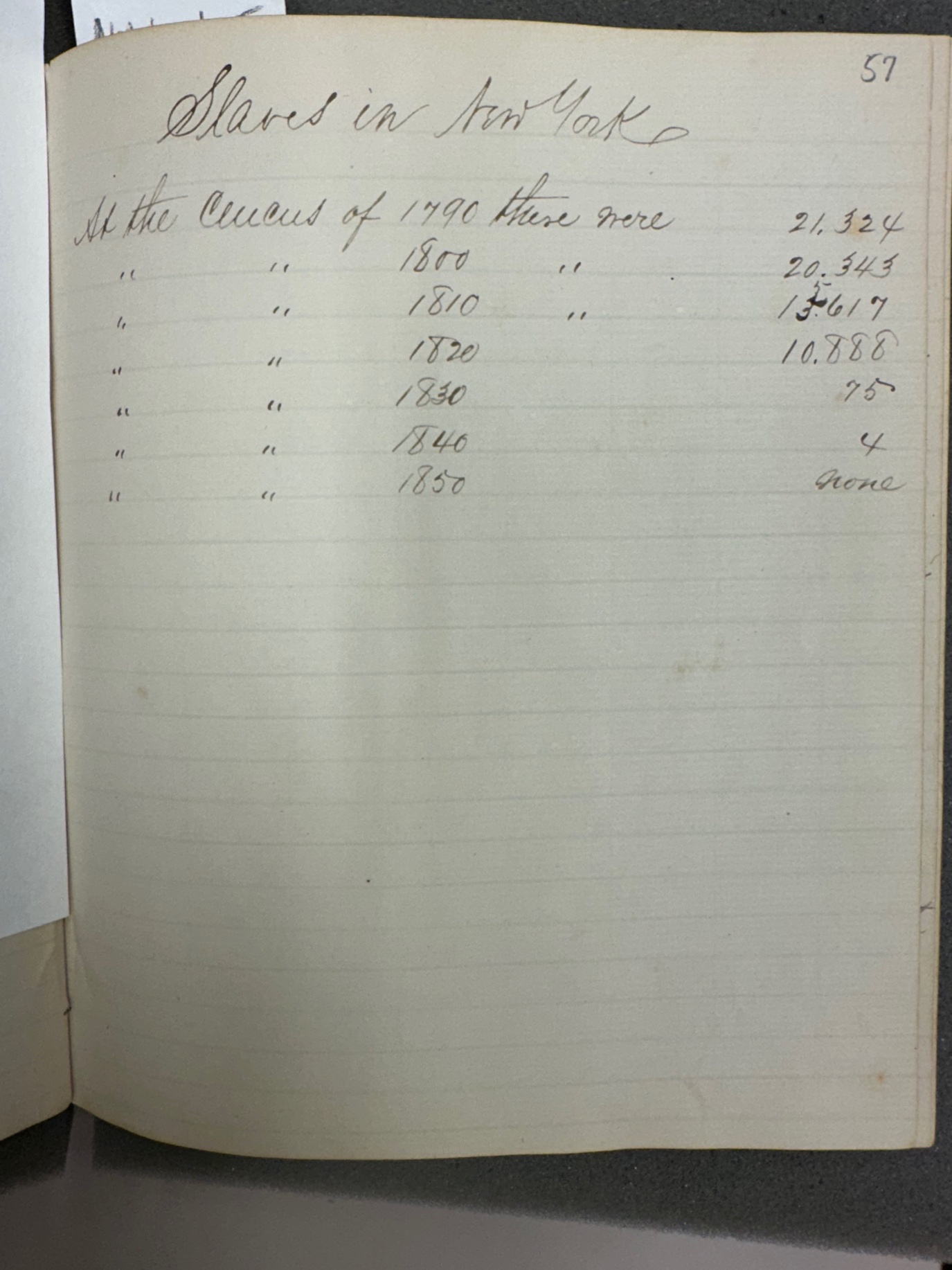
57
Slaves in New York
| At the | Caucus of | 1790 | there were | 21.324 |
| " | " | 1800 | " | 20.343 |
| " | " | 1810 | " | 15.617 |
| " | " | 1820 | " | 10.888 |
| " | " | 1830 | " | 75 |
| " | " | 1840 | " | 4 |
| " | " | 1850 | " | none |
V_0168B
58
Page is blank.

V_0170
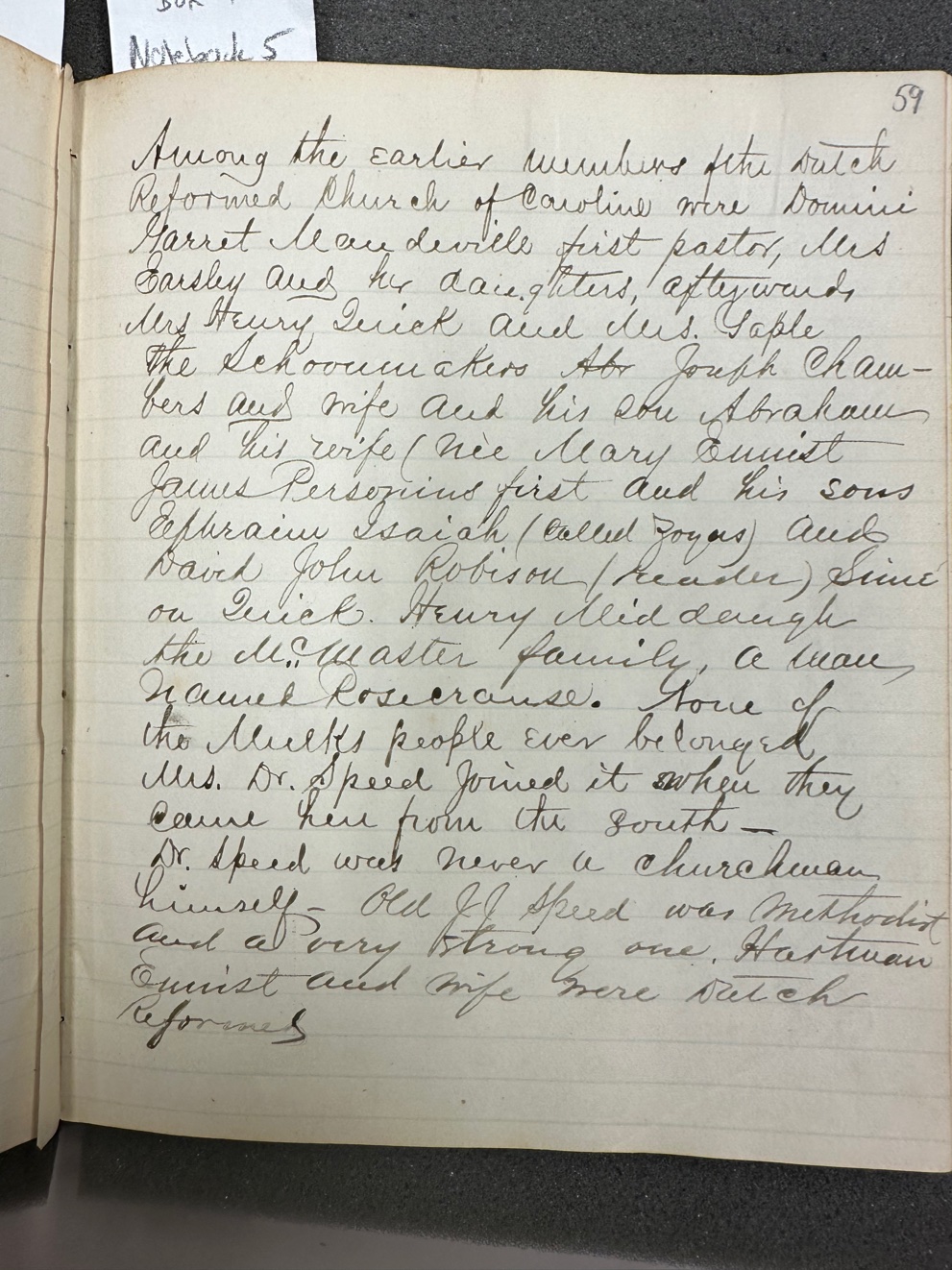
59
Among the earliest members of the Dutch Reformed Church of Caroline were Domini Garrett Mandeville first pastor, Mrs. Earsley and her daughters, afterwards Mrs. Henry Quick and Mrs. Yaple. The Schoonmakers Joseph Chambers and his wife and his son Abraham and his wife, (née Mary Ennist) James Personius first and his sons Ephraim Isaiah (called Joyus) and David John Robison/reader) Simeon Quick Henry Middaugh the McMaster family, a man named Rosencraus. None of the Mulks people ever belonged Mrs. Dr. Speed joined it when they came here from the South. Dr. Speed was never a churchman himself. Old JJ Speed was Methodist and a very strong one. Hartman Ennist and wife were Dutch Reformed.
V_0171
60
Page is blank.
V_0172
61
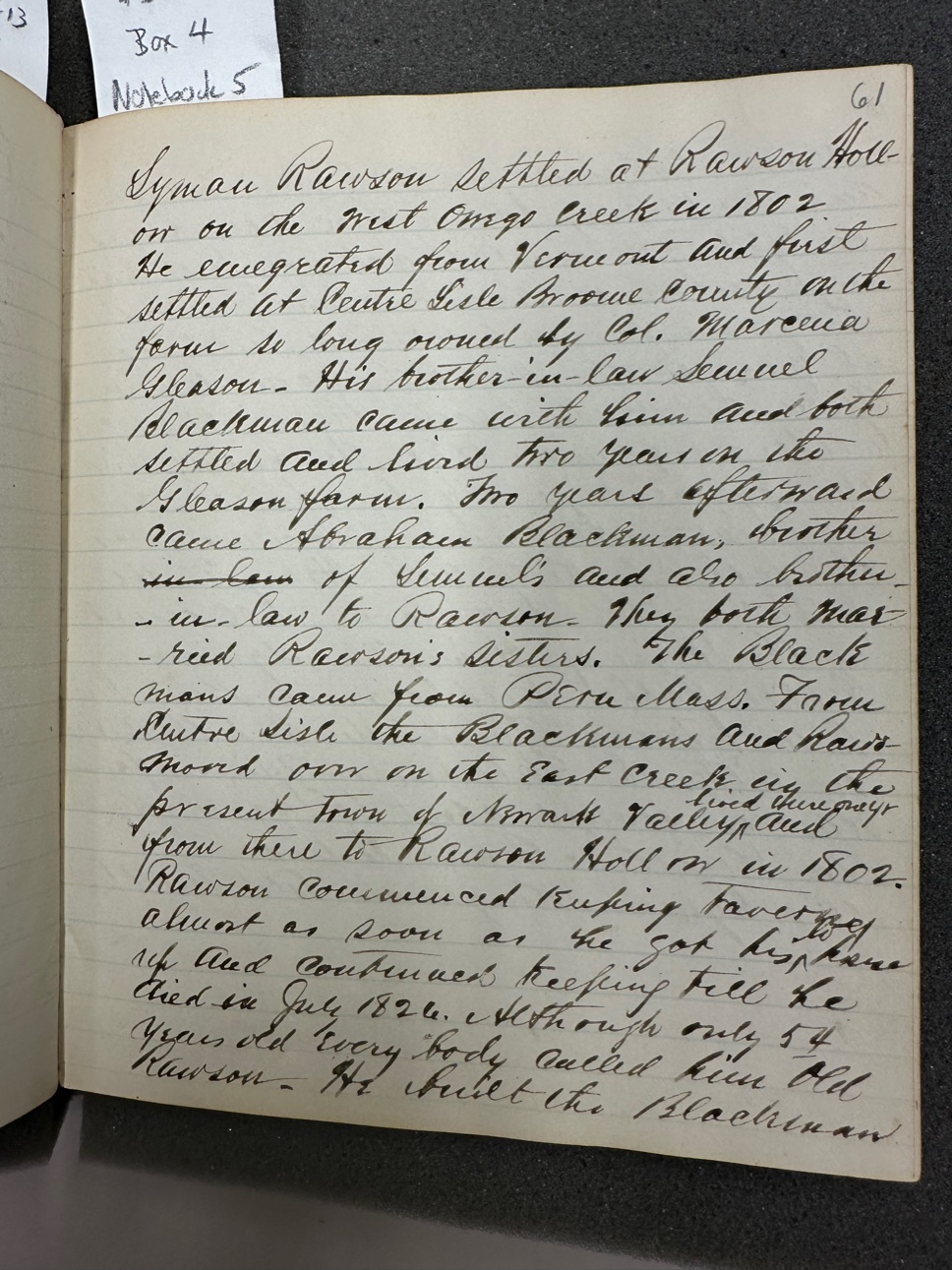
Syman Rawson settled in Rawson Hollow on the west of Owego Creek in 1802 He emigrated from Vermont and first settled at Centre Lyle Broome County on the farm so long owned by Colonel Marcena Gleason. His brother-in-law Samuel Blackman came with him and both settled and lived two years on the Gleason farm. Two years afterward came Abraham Blackman, brother-in-law of Samuel's and also brother-in-law to Rawson. They both married Rawson's sisters. The Blackmans came from Peru Mass. From Centre Lisle, the Blackmans and Rawsons moved over on the East Creek in the present town of Newark Valley lived there one year and from there to Rawson Hollow in 1802. Rawson commenced keeping tavern almost as soon as he got his log house up and continued keeping until he died in July 1826. Although only 54 years old, everyone called him Old Rawson. He built the Blackman
V_0173
62
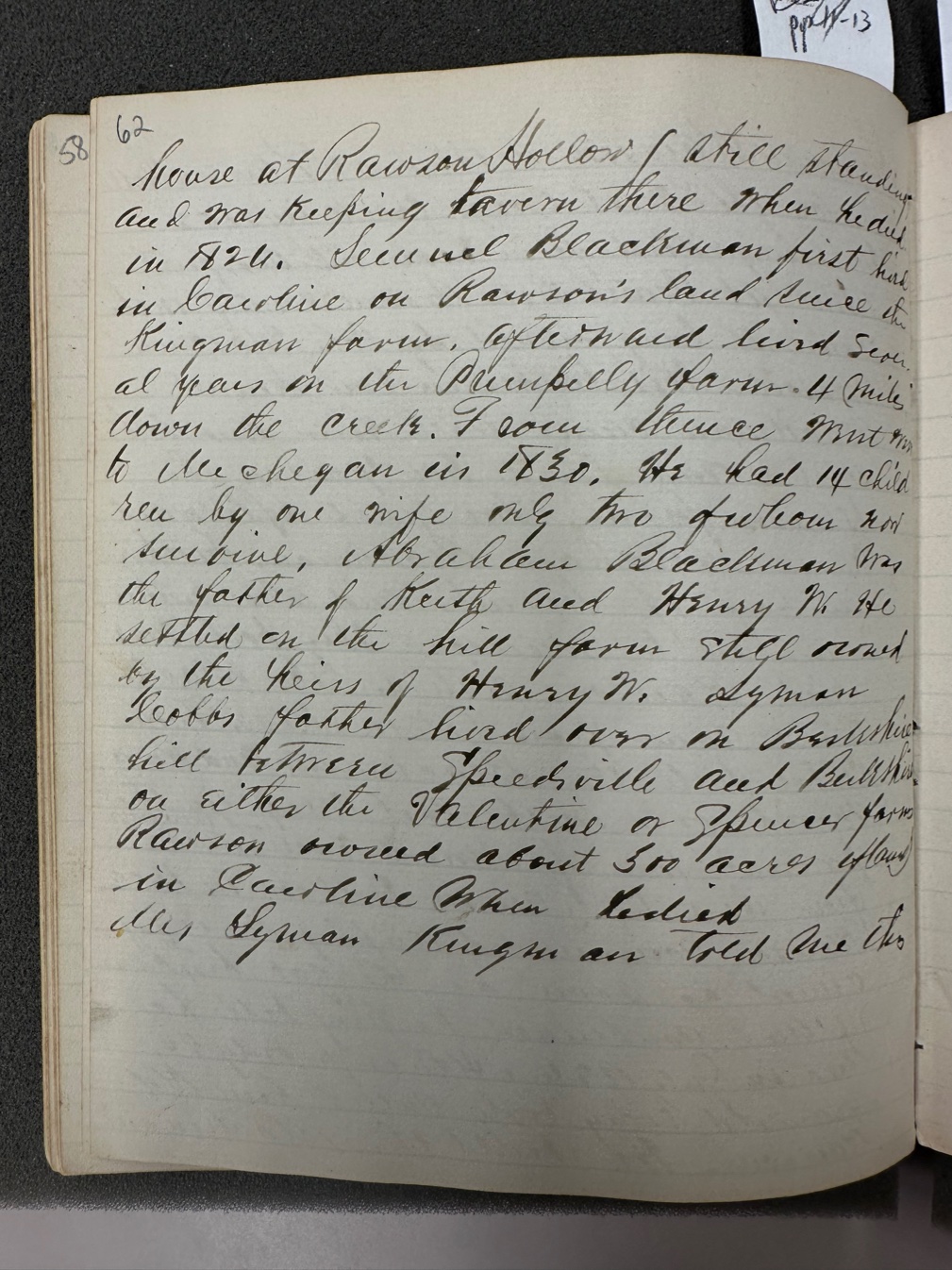
house at Rawson Hollow still standing and was keeping tavern there when he died in 1826. Samuel Blackman first lived in Caroline on Rawson's land since the Kingman farm. Afterwards lived several years on the Pumpelly farm four miles down the creek. From thence went on to Michigan in 1830. He had 14 children by one wife only two of whom now survive. Abraham Blackman was the father of Keith and Harry W. He settled on the hill farm still owned by the heirs of Henry W. Lyman Cobbs father lived over on Berkshire Hill between Speedsville and Berkshire on either the Valentine or Spencer farm. Rawson owned about 500 acres of land in Caroline when he died Mrs. Lyman Kingman told me this.
V_0174
63
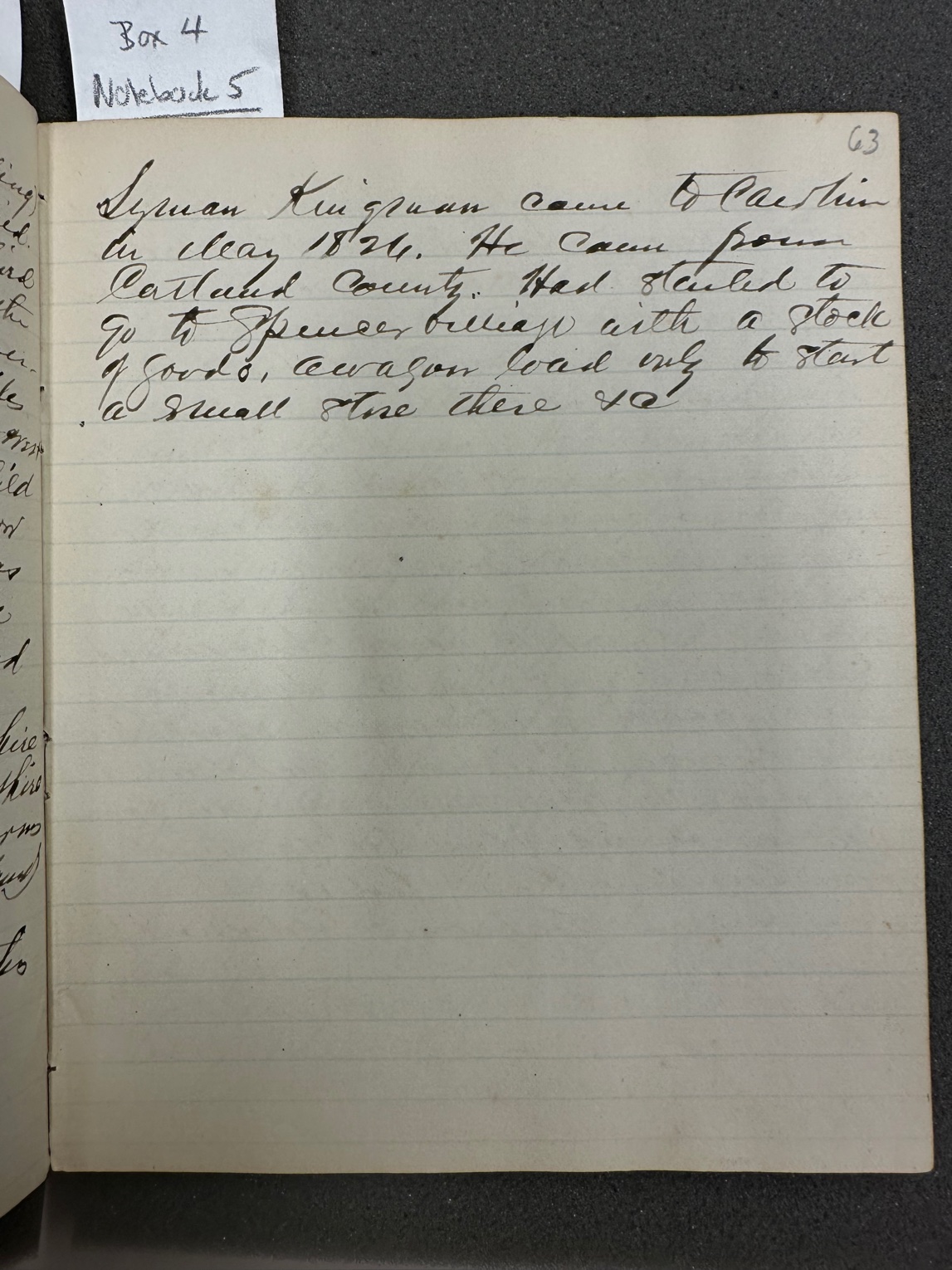
Lyman Kingman came to Caroline in May 1826. He came from Cortland County. Had started to go to Spencer village with a stock of goods, a wagon load, only to start a small store there [?…]
V_0175
64
Page is blank.
V_0176
65
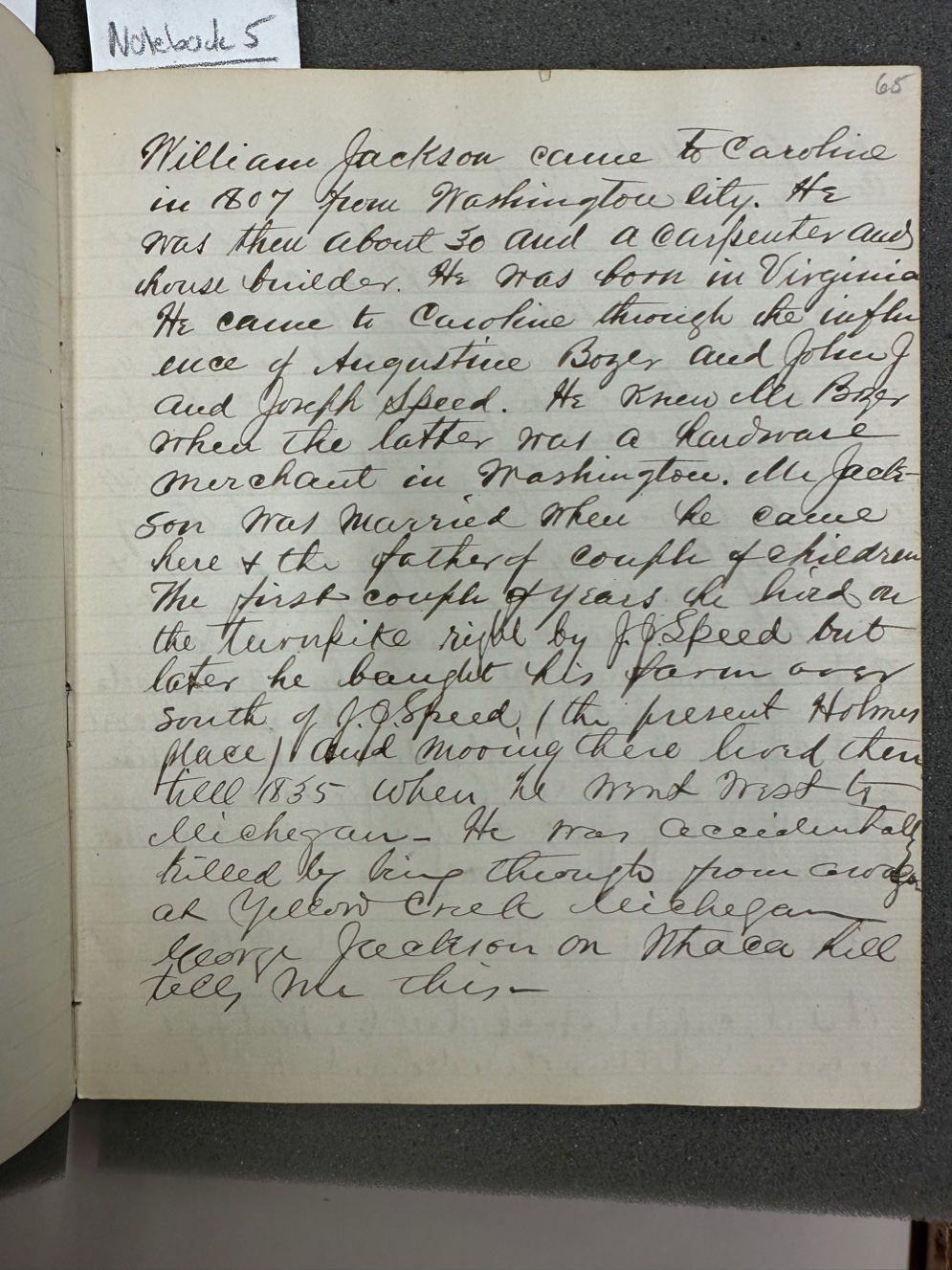
William Jackson came to Caroline in 1807 from Washington City. He was then about thirty and a carpenter and house builder. He was born in Virginia. He came to Caroline through the influence of Augustine Boyer and John J. and Joseph Speed. He knew Mr. Boyer when the latter was a hardware merchant in Washington. Mr. Jackson was married when he came here and the father of a couple of children. The first couple of years he lived on the turnpike right by J.J. Speed. But later he bought his farm over south of J.J. Speed (the present Holmes Place) and moving there, lived there till 1835 when he went west to Michigan. He was accidentally killed by being [?…] from [?…] at Yellow Creek, Michigan. George Jackson on Ithaca Hill told me this.
V_0177
66
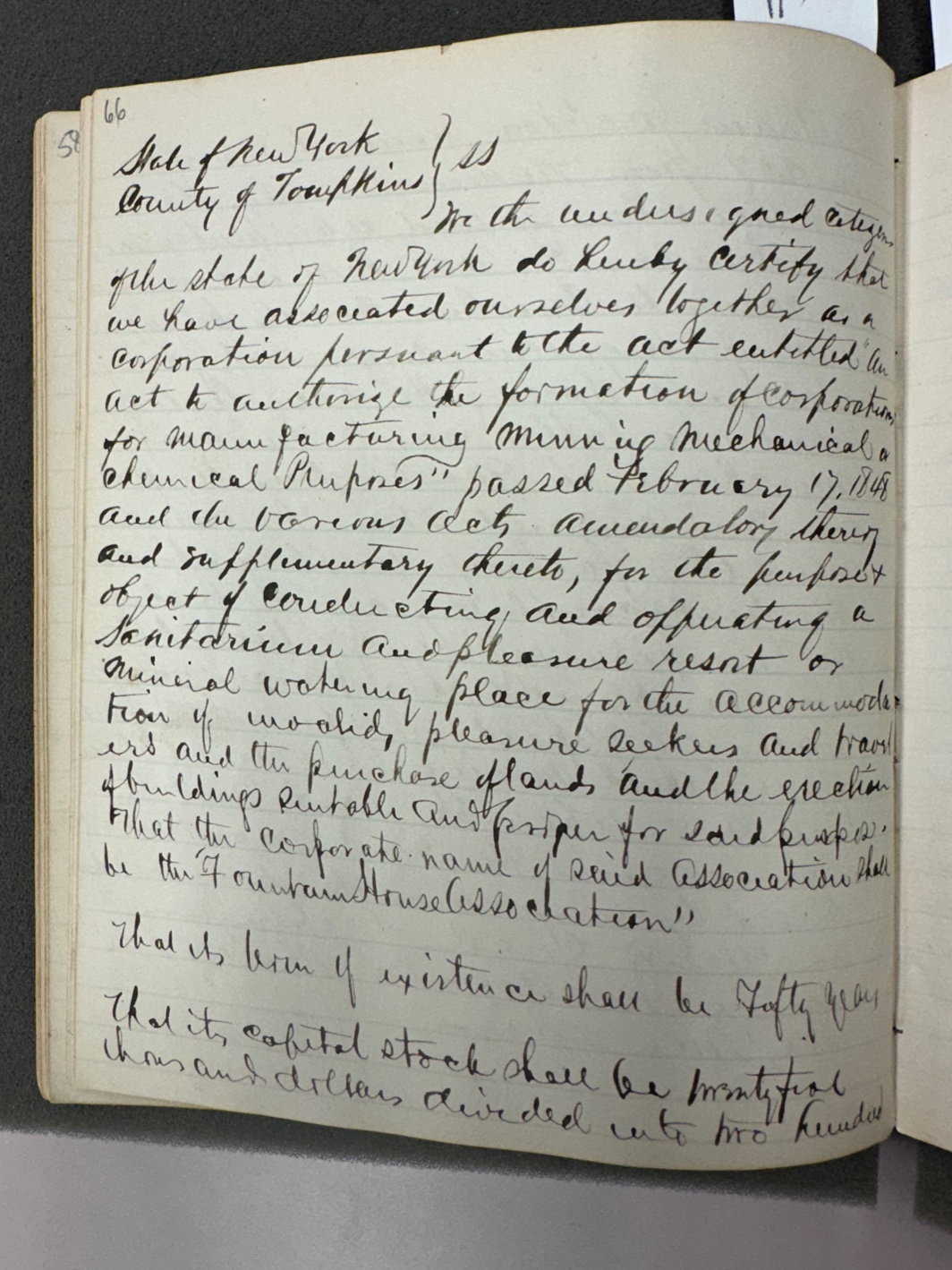
County of Tompkins
We the undersigned citizens of the State of New York do hereby certify that we have associated ourselves together as a corporation pursuant to the act entitled “An act to authorize the formation of corporations for manufacturing, mining, mechanical and chemical purposes” passed February 17, 1848 and the various acts amendatory thereto and supplementary thereto for the purpose and object of conducting and operating a sanitarium and pleasure resort or mineral watering place for the accommodation of invalid, pleasure seekers and travelers and the purchase of land and the erection of buildings, rentable and proper for said purposes. That the corporation name of Center Association shall be the “Fountain House Association”
That its term of existence shall be Forty years.
That its capital stock shall be twentyfive thousand dollars divided into two hundred
V_0178
67
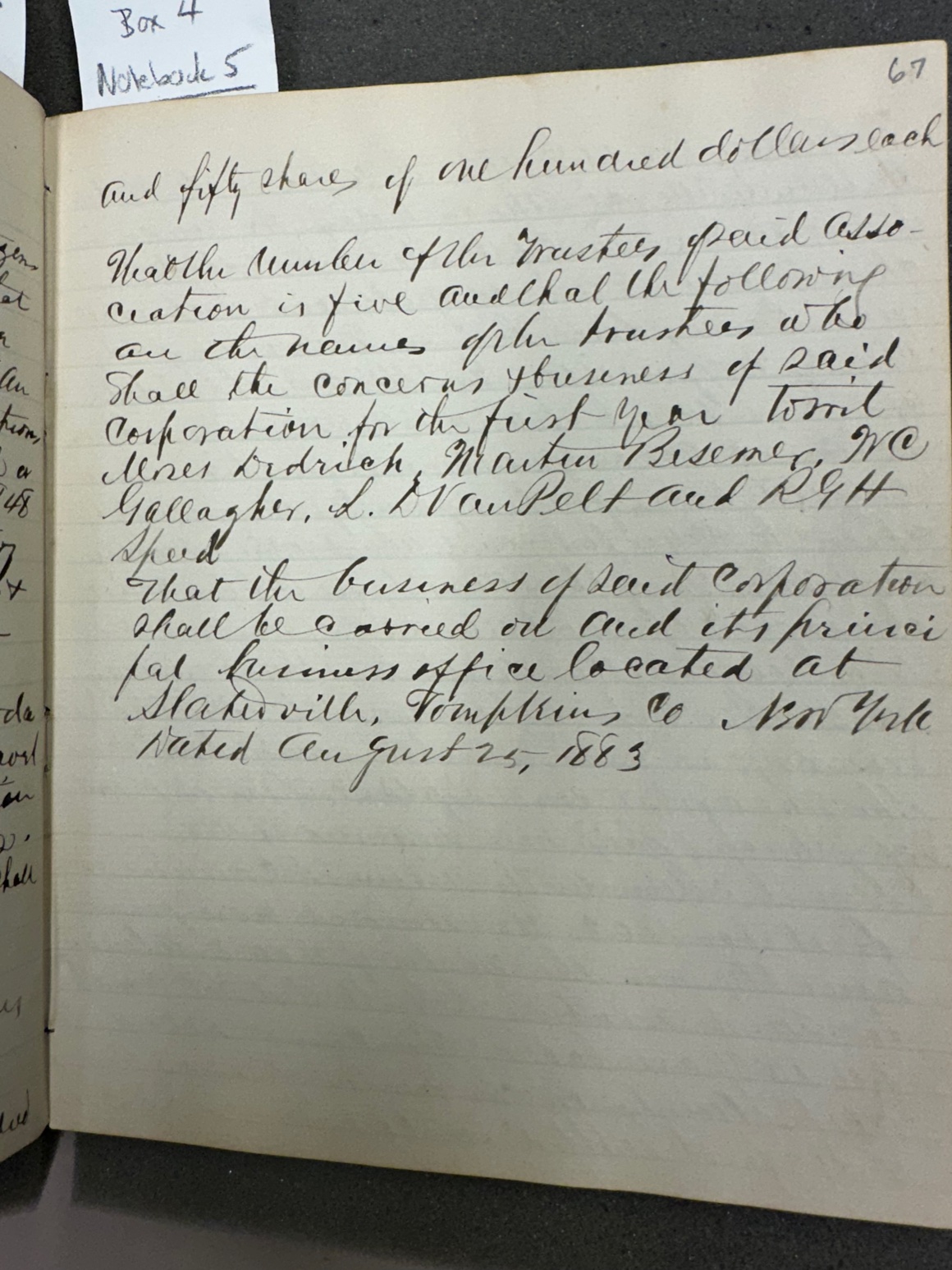
and fifty shares of one hundred dollars each
That the number of the trustees of said association is five and that the following are the names of the trustees who shall the concerns + business of said corporation for the first year to wit Moses Dedrich, Martin Besemer, W.C. Gallagher, L.D. Van Pelt and R.G.H. Speed. That the business of said corporation shall be carried out and its principal business office located at Slaterville, Tompkins Co New York. Dated August 25, 1883.
V_0179
68
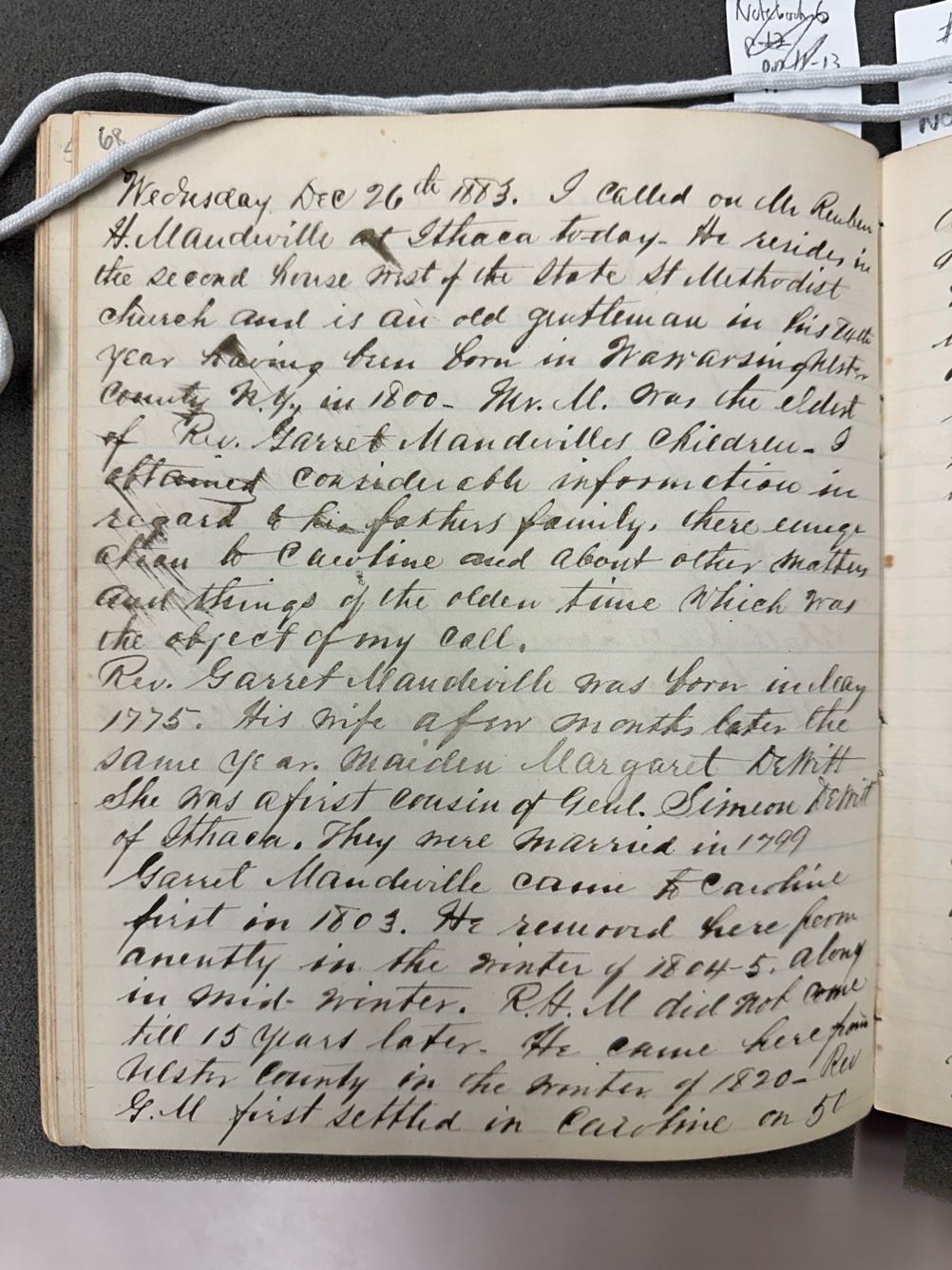
Wednesday, Dec 26th 1883. I called on Ruben H. Mandeville of Ithaca today. He resides in the second house west of the State Street Methodist Church and is an old gentleman in his 84th year having been born in Wawarsing Ulster County N.Y. in 1800. Mr. M was the eldest of Reverend Garrett Mandeville's children. I obtained considerable information in regard to his father's family, their emigration to Caroline, and about other matters and things of the olden times, which was the object of my call. Rev. Garrett Mandeville was born in May 1775. His wife a few months later the same year, maiden Margaret DeWitt. She was the first cousin of Genl. Simeon DeWitt of Ithaca. They were married in 1799. Garrett Mandeville came to Caroline first in 1803. He returned here permanently in the winter of 1804–5 along in midwinter. R.H.M. did not come here until 15 years later. He came here from Ulster County in the winter of 1820. Rev GM first settled in Caroline on 50
V_0180
69
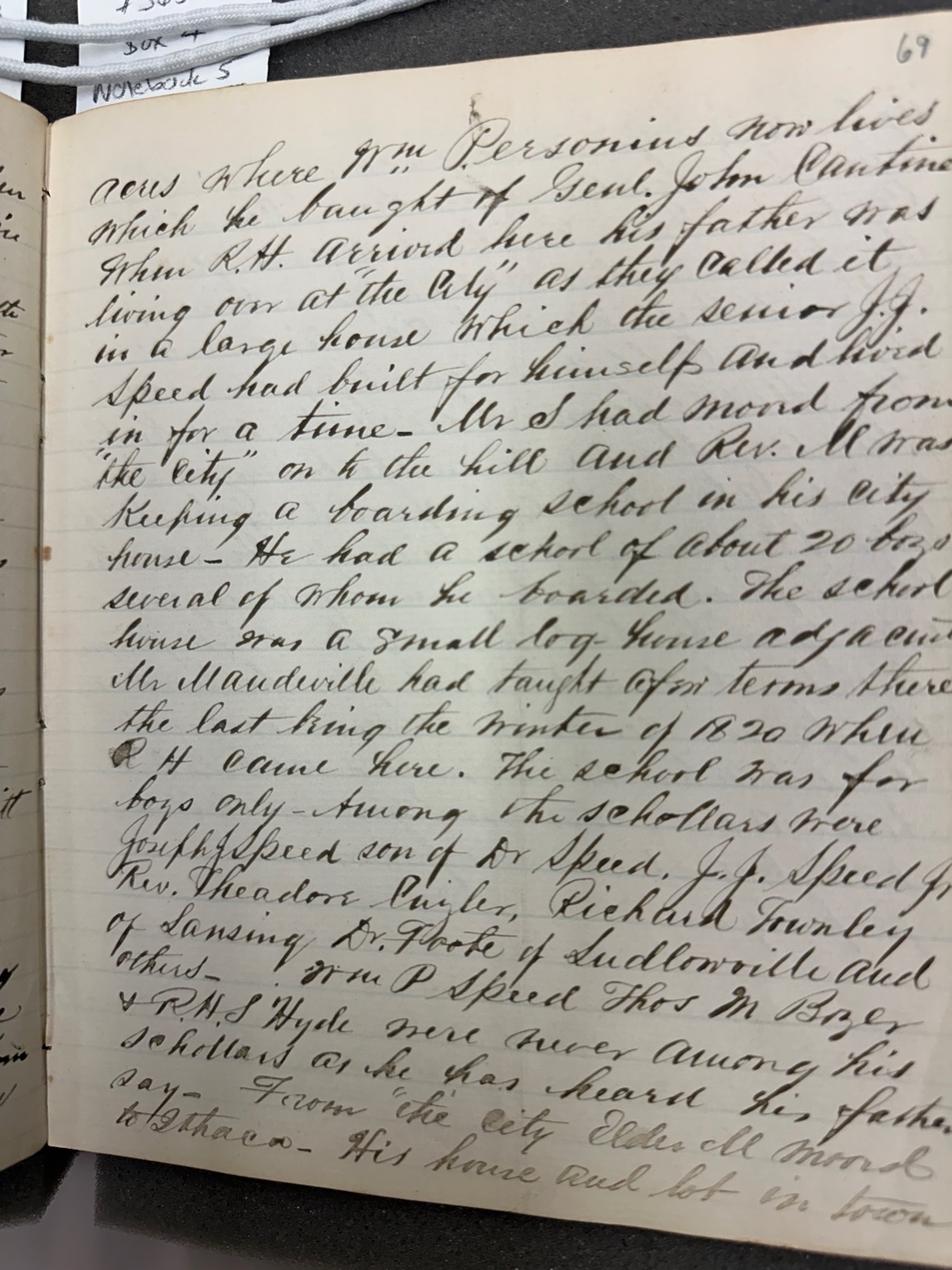
acres where Wm Personius now lives, which he bought from Genl. John Cantine. When R.H. arrived here, his father was living over at "the City" as they called it, in a large house which the senior J.J. Speed had built for himself and lived in for a time. Mr. S. Had moved from "the City" on the hill and Rev. M. Was keeping a boarding school in his city house. He had a school of about 20 boys, several of whom he boarded. The school was a small log house adjacent. Mr. Mandeville had taught a few terms there, the last being the winter of 1820, when R.H. came here. The school was for boys only. Among the scholars were Joseph J. Speed, son of Dr. Speed, J.J. Speed, Jr., Rev. Theodore [?…]ler, Richard Townley of Lansing, Dr. Foote of Ludlowville, and others. Wm P. Speed, Thomas M. Boyer, R.H.S. Hyde were never among his scholars as he has heard his father say. From the city, Elder M moved to Ithaca, his house and lot in town
V_0181
70
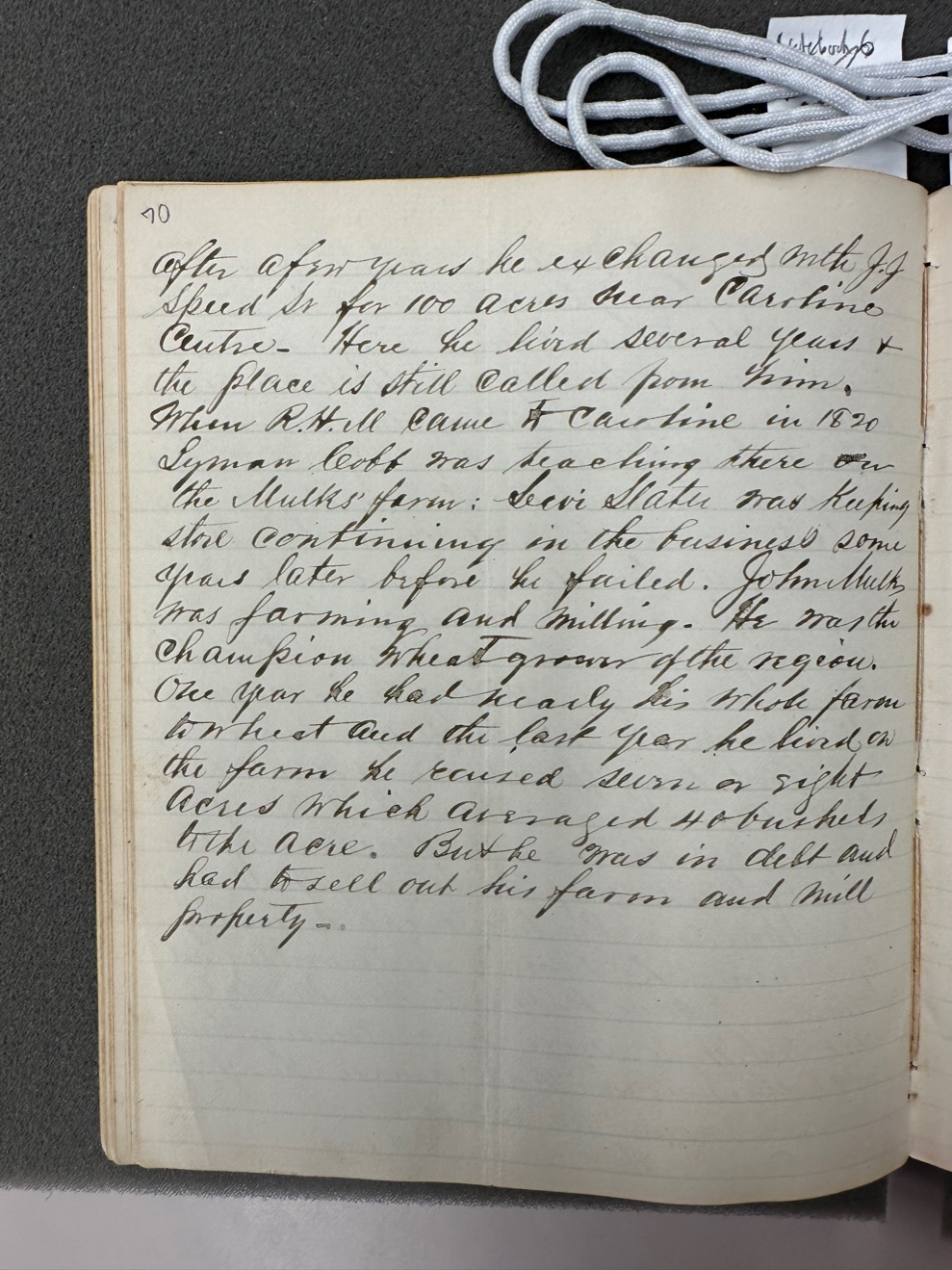
after a few years, he exchanged with J.J. Speed for 100 acres near Caroline Centre. Here he lived several years, and the place is still called from him. When R.H.M. came to Caroline in 1820, Lyman Cobb was teaching there on the Mandeville Farm. Levi Slater was keeping the store, continuing in the business some years later before he failed. John Mulks was farming and milling. He was the champion wheat grower of the region. One year he had nearly his whole farm to wheat and the last year he lived on the farm he raised seven or eight acres which averaged 40 bushels per acre. But he was in debt and had to sell his farm and mill property.
V_0182
71
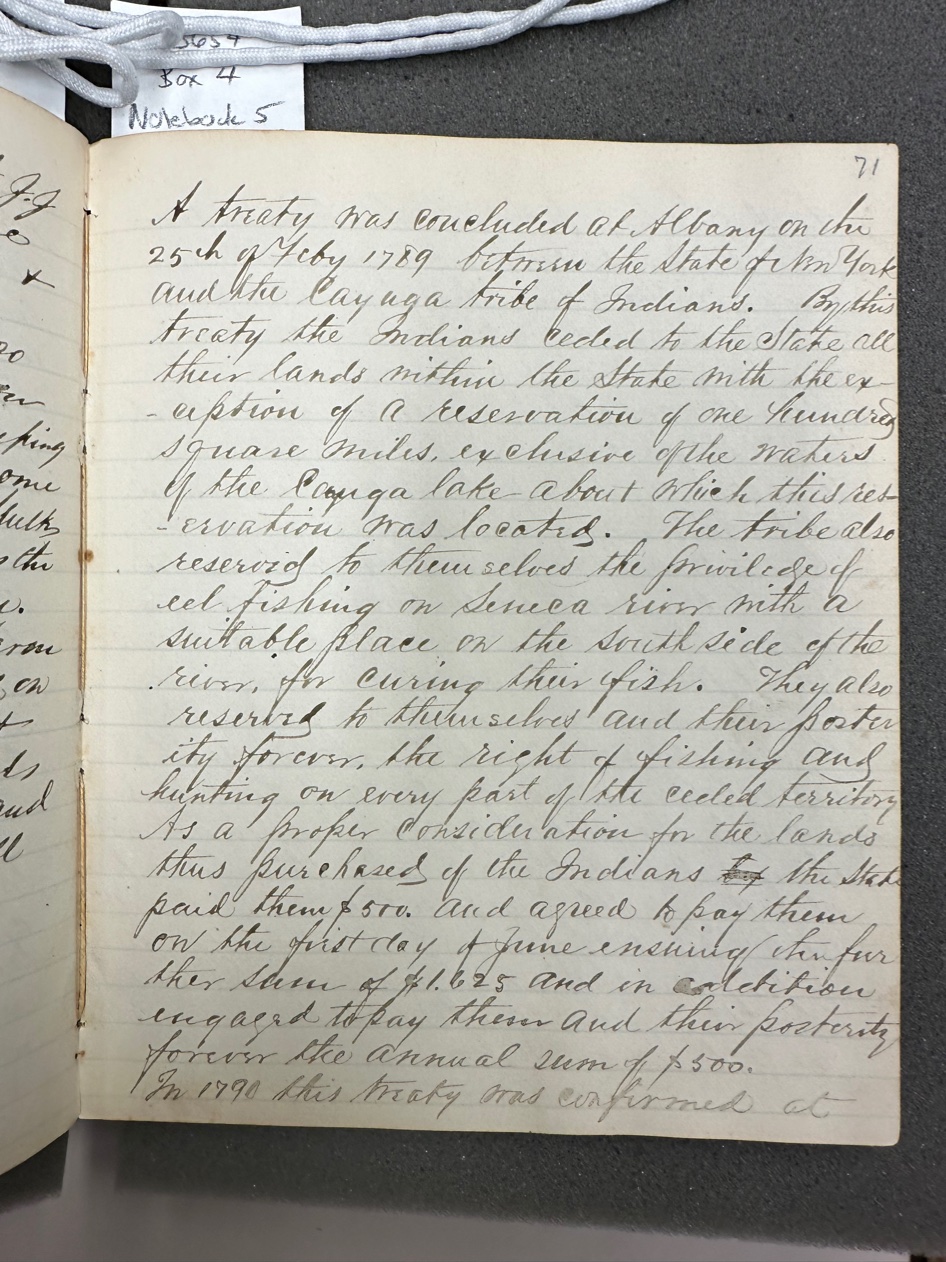
A treaty was concluded at Albany on the 25th of Febry 1789, between the State of New York and the Cayuga tribe of Indians. By this treaty, the Indians ceded to the state all their lands within the state, with the exception of a reservation of 100 square miles exclusive of the waters of the Cayuga Lake about which this reservation was located. The tribe also reserved to themselves the privilege of eel fishing on Seneca River with a suitable place on the south side of the river for curing their fish. They also reserved to themselves and their posterity forever the right of fishing and hunting on every part of the ceded territory. As a proper consideration for the lands thus purchased of the Indians, the state paid them $500 and agreed to pay them on the first day of June ensuing the further sum of $1,625, and in addition, engaged to pay them and their posterity forever the sum of $500. In 1790 this treaty was confirmed at
V_0183
72
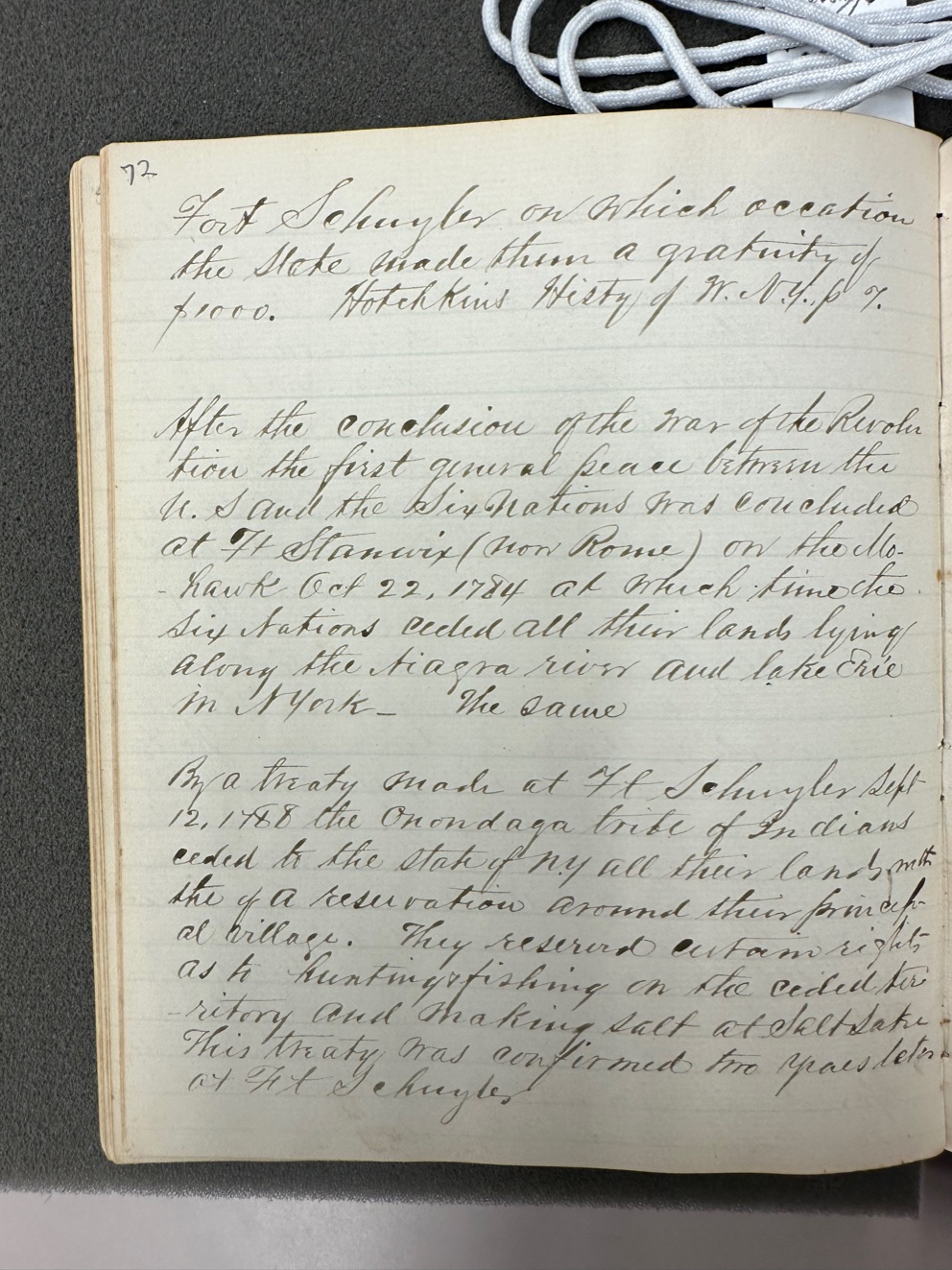
Fort Schuyler on which occasion the state paid them a gratuity of $1,000. Hotchkiss Histy of W.N.Y. p 7.
After the conclusion of the War of the Revolution, the first general peace between the U.S. and the Six Nations was concluded at Fort Stanwix (near Rome) on the Mohawk Oct 22, 1784 at which time the Six Nations ceded all of their lands lying along the Niagara River and Lake Erie in New York. The same.
By a treaty made at Fort Schuyler, Sept 12, 1788, the Onondaga tribe of Indians ceded to the state of N.Y. all their lands with the [sic] of a reservation around their principal village. They reserved custom rights as to hunting and fishing on the ceded territory and making salt at Salt Lake. This treaty was confirmed two years later at Fort Schuyler.
V_0184
73
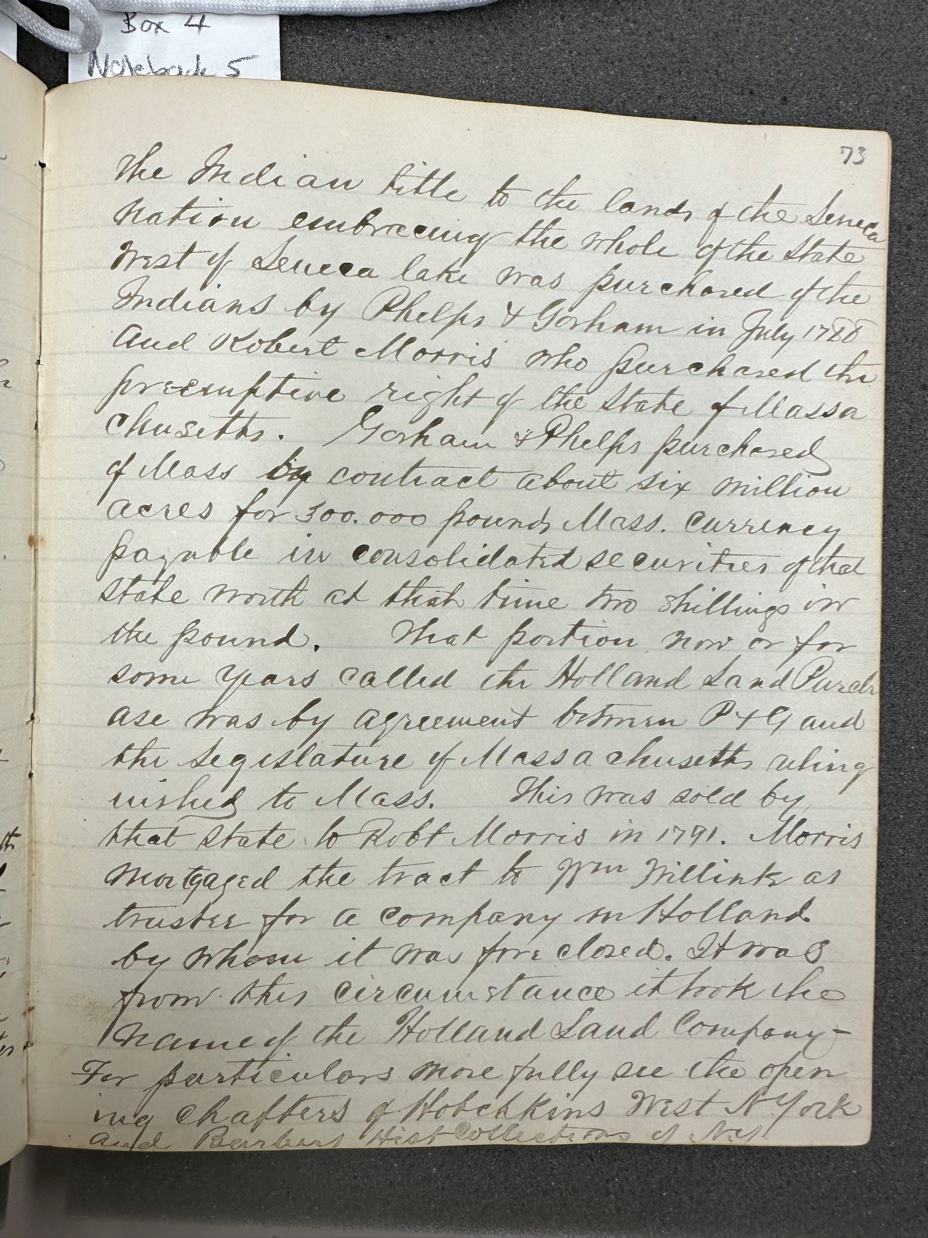
The Indian title to the lands of the Seneca Nation embracing the whole of the state west of Seneca Lake, was purchased of the Indians by Phelps and Gorham in July 1788 and Robert Morris, who purchased the preemptive right of the state of Massachusetts. Gorham and Phelps purchased of Mass by contract about 6 million acres for 300,000 pounds Mass currency payable in consolidated securities of that state worth at that time two shillings on the pound. That portion now or for some years called the Holland Land Purchase was by agreement between P+G and the legislature of Massachusetts relinquished to Mass. This was sold by that state to Robert Morris in 1791. Morris mortgaged the tract to William Willink as trustee for a company in Holland by whom it was foreclosed. It was from this circumstance it took the name of the Holland Land Company. For particulars more fully, see the opening chapters of Hotchkin's West N York and Barber's Hist Collections of N.Y.
V_0185
74
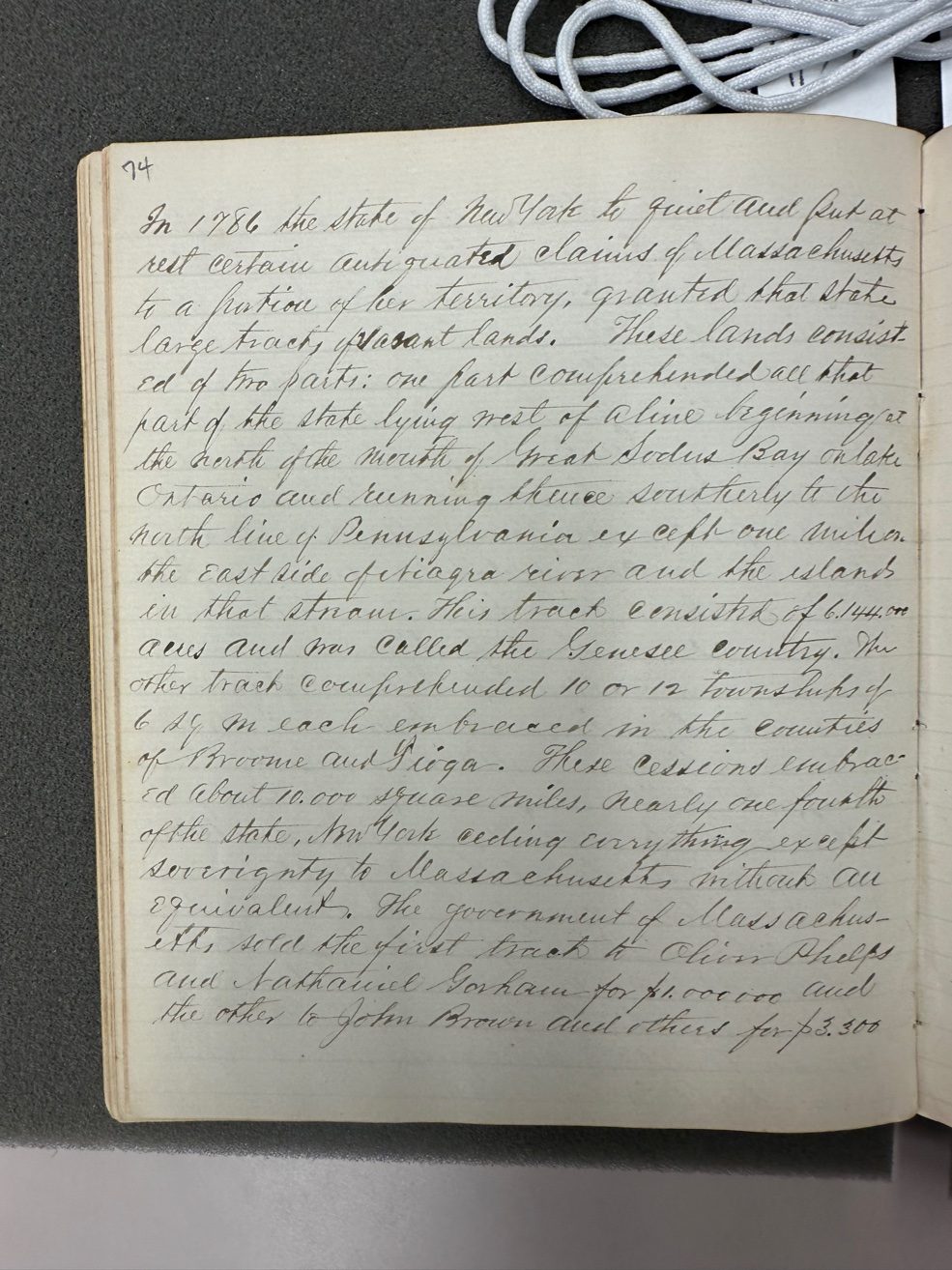
In 1786, the state of New York, to quiet and put at rest certain antiquated claims of Massachusetts to a portion of her territory, granted that state large tracts of vacant lands. These lands consisted of two parts. One part comprehended all that part of the state lying west of a line beginning at the north of the mouth of the Great Sodis Bay on Lake Ontario and running then south or southerly to the north line of Pennsylvania except one mile on the east side of the Niagara River and the islands in that stream. This tract consisted of 6,144,000 acres and was called the Genesee Country. The other tract comprehended 10 or 12 townships of 6 square miles each, embraced in the counties of Rome and Tioga. These cessions embraced about 10,000 square miles, nearly one-fourth of the state, New York ceding everything except sovereignty to Massachusetts without an equivalent. The government of Massachusetts sold the first tract to Oliver Phelps and Nathaniel Gorham for $1,000,000 and the other to John Brown and others for $3,300.
V_0186
75
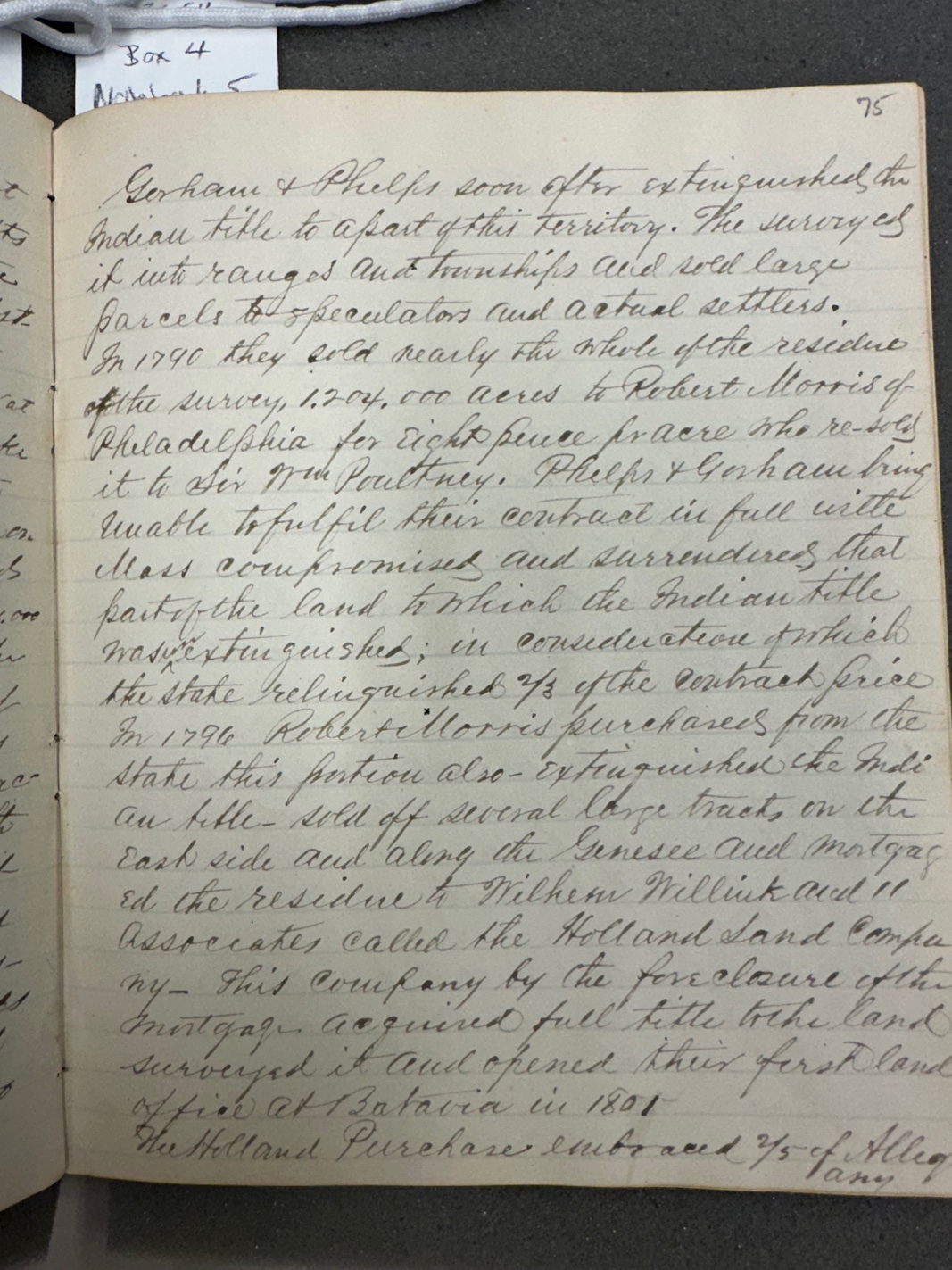
Gorham and Phelps soon after extinguished the Indian title to a part of this territory. The[y] surveyed it into ranges and townships and sold large parcels to speculators and actual settlers. In 1790, they sold nearly the whole of the residue of the survey, 1,204,000 acres, to Robert Morse of Philadelphia for eight pence per acre, who re-sold it to Sir William Poultney. Phelps and Gorham, being unable to fulfill this contract in full with Mass compromised and surrendering that part of the land to which the Indian title was unextinguished, in consideration of which the state relinquished ⅔ of the contract price. In 1796, Robert Morris purchased from the state this portion also—extinguished the Indian title—sold off several large tracts on the east side and along the Genesee and mortgaged the residue to William Willink and 11 associates called the Holland Land Company NY. This company, by the foreclosure of the mortgage, acquired full title to the land, surveyed it, and opened their first land office at Batavia in 1801. The Holland Purchase embraced ⅔ of Allegheny
V_0187
76
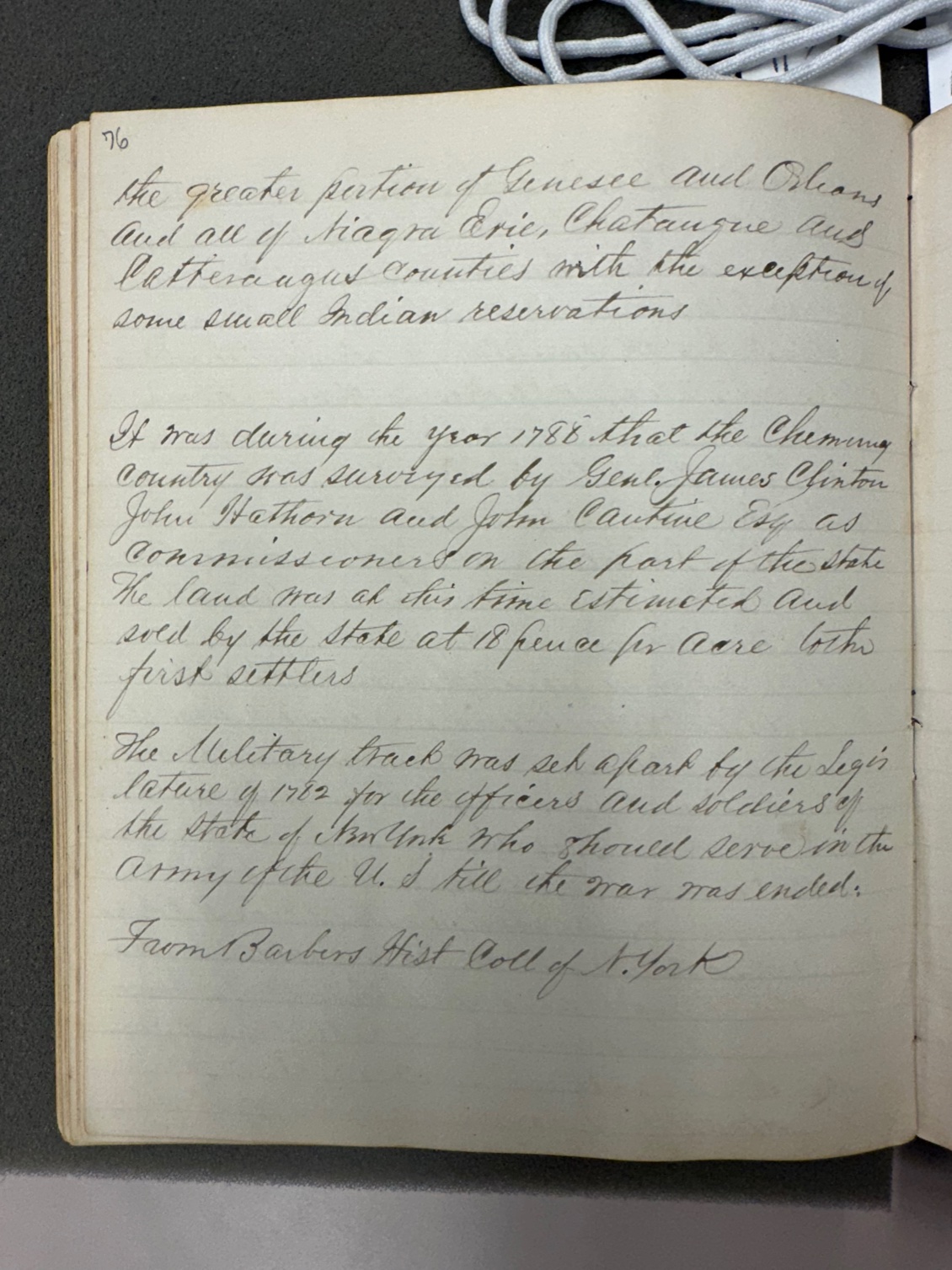
the greater portion of Genesee and Orleans and all of Niagara, Erie, Chatauque and Catteraugus counties with the exception of some small Indian reservations.
It was during the year 1788 that the Chemung County was surveyed by Genl. James Clinton, John Hathorn, and John Cantine Esq as commissioners on the part of the state. The land was at this time estimated and sold by the state at 18 pence per acre to the first settlers.
The Military tract was set apart by the legislature of 1782 for the officers and soldiers of the State of New York who should serve in the army of the U.S. till the war was ended.
From Barbers Hist Coll of N.York
V_0188
77
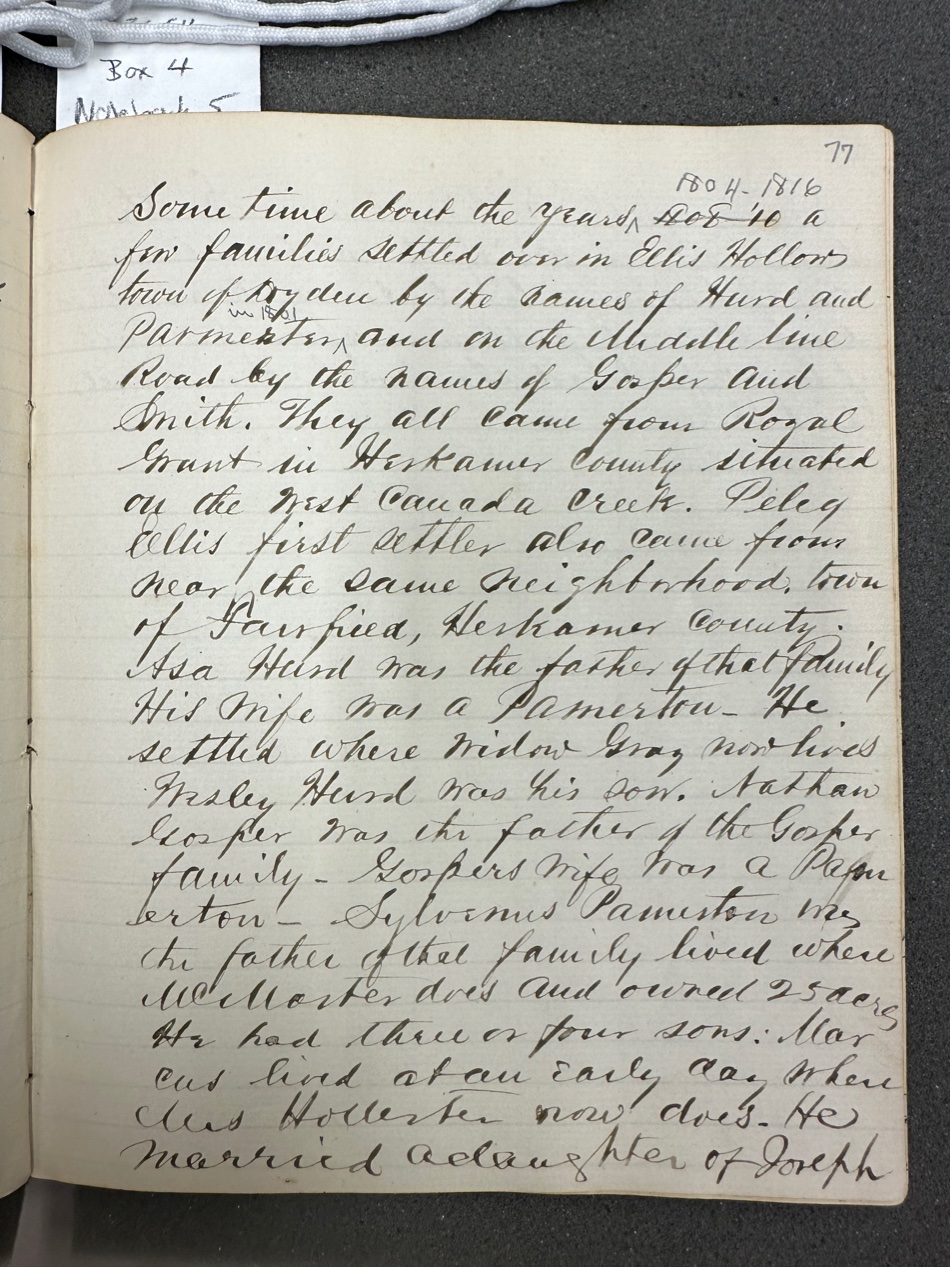
Sometime about the year 1808–'10 1804—1816 a few families settled over in Ellis Hollow town of Dryden by the names of Hurd and Parmerter [sic] in 1801 and on the Middleline Road by the names of Gosper and Smith. They all came from Royal Grant in Herkimer County situated on the West Canada Creek. Peleg Ellis first settler also came from over the same neighborhood town of Fairfield, Herkimer County. Asa Hurd was the father of that family. His wife was a Pamerton. He settled where Widow Gray now lives Wesley Hurd was his son. Nathan Gosper was the father of the Gosper family—Gosper's wife was a Pamerton—Silvenus Pamerton was the father of that family lived where McMaster does and owned 25 acres. He had three or four sons. Marcus lived at an early day where Mrs. Hollister now does. He married a daughter of Joseph
V_0189
78
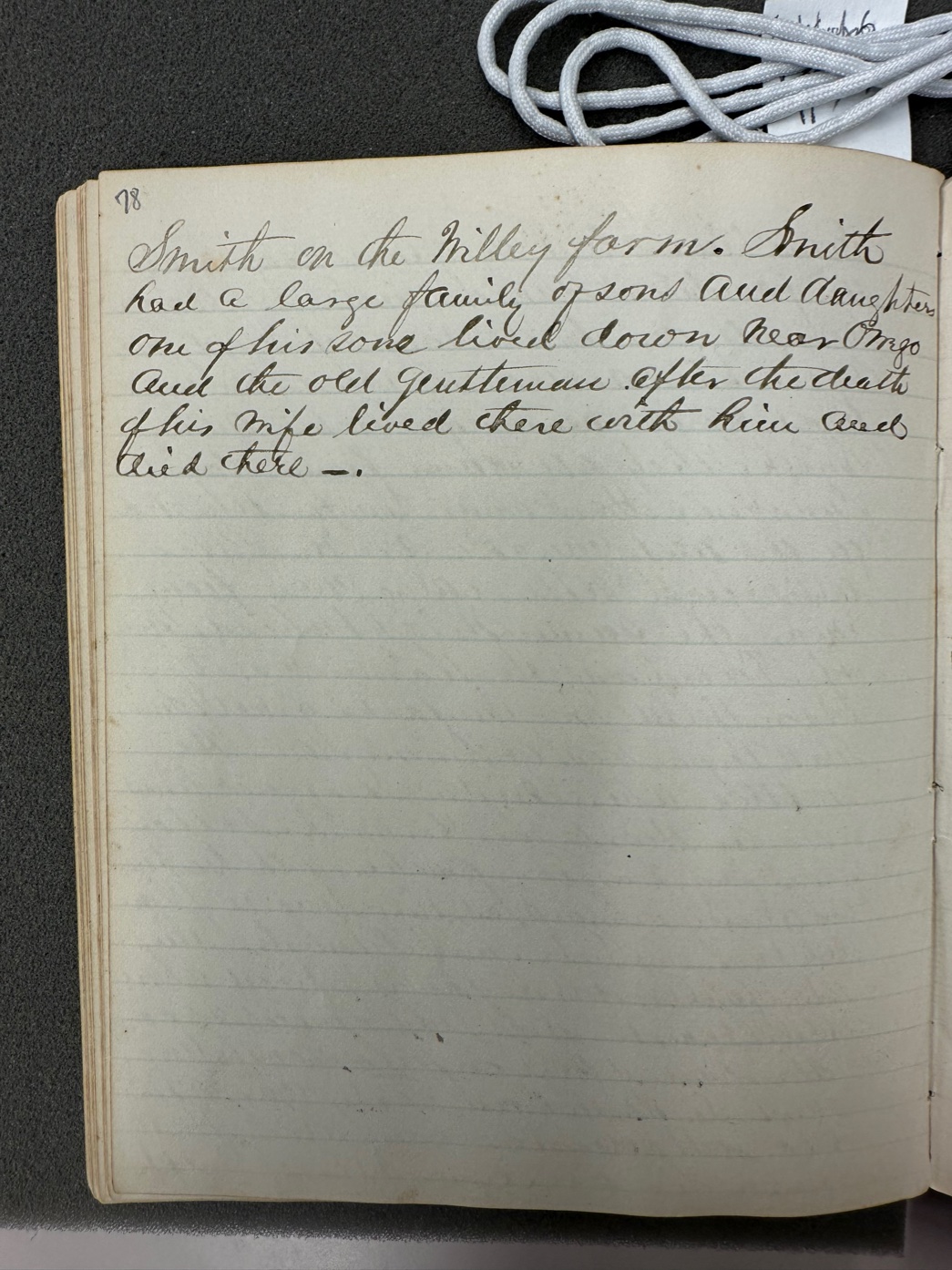
Smith on the Willey farm. Smith had a large family of sons and daughters one of his sons lived down near Owego and the old gentleman after the death of his wife lived there with him and died there.
V_0190
79
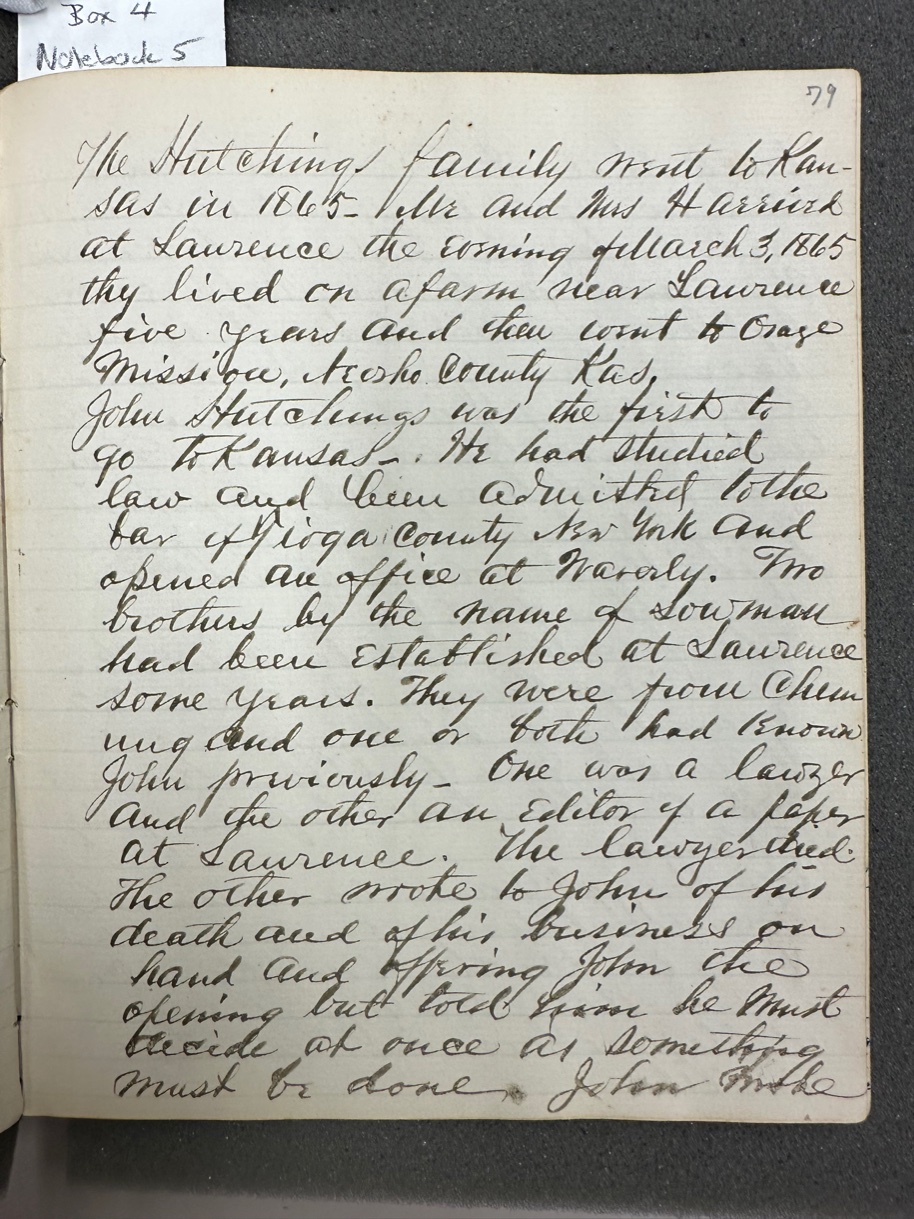
The Hutchings family went to Kansas in 1865. Mr and Mrs H married at Laurence the evening of March 3 1865 they lived on a farm near Laurence five years and then went to Osage Mission, Neosho County Kan. John Hutchings was the first to go to Kansas. He had studied law and been admitted to the bar of Tioga County New York and opened an office at Waverly. Two brothers by the name of Lowman had been established at Lawrence some years. They were from Chemung and one or both had known John previously. One was a lawyer and the other an editor of a paper at Laurence. The lawyer died. The other wrote to John of his death and of his business on hand and offering John the opening but told him he must decide at once that something must be done. John wrote
V_0191
80
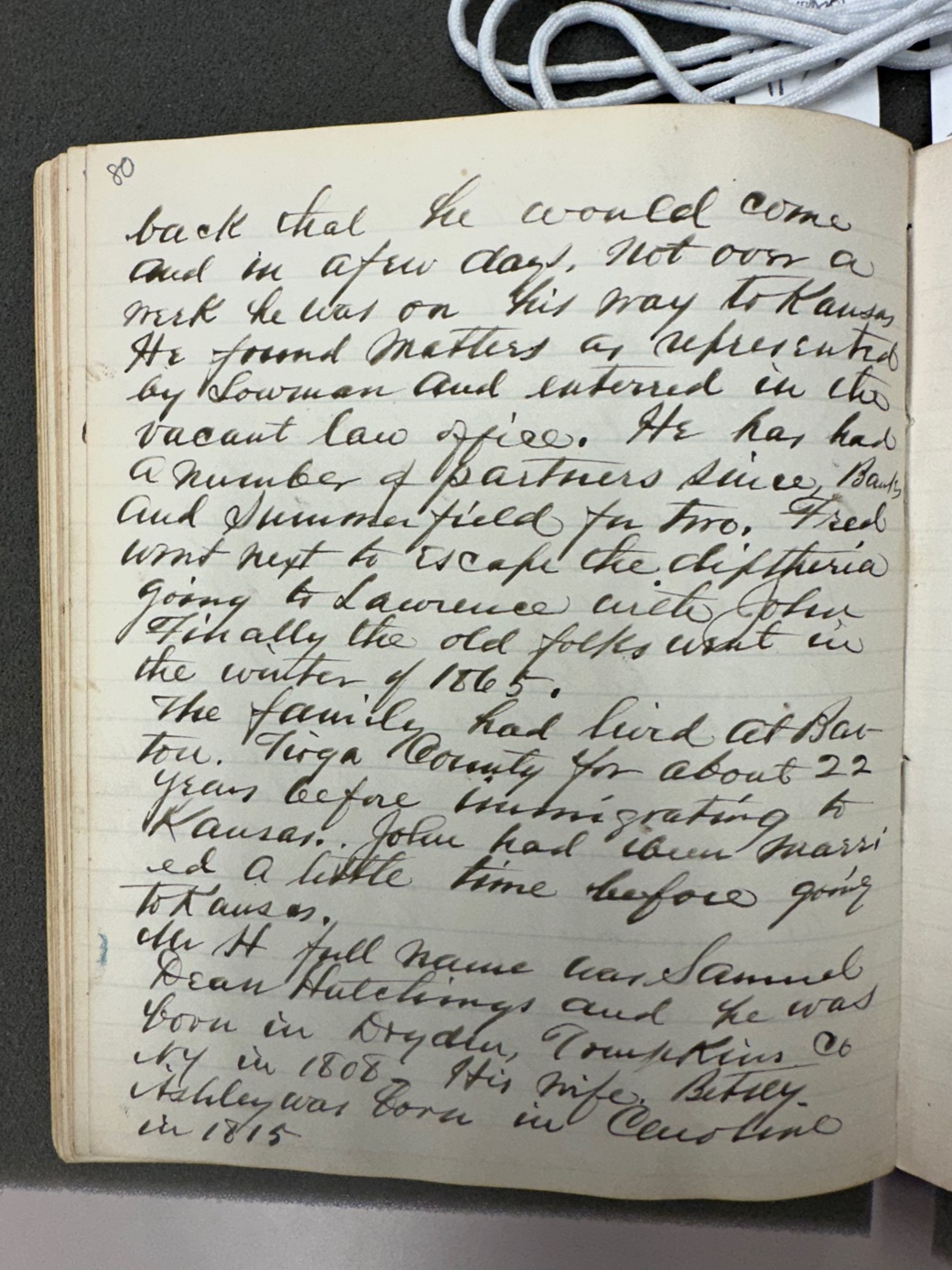
back that he would come and in a few days, not over a week, he was on his way to Kansas. He found matters as represented by Lowman and entered into the vacant law office. He has had a number of partners since, Banks and Summerfield for two. Fred went next to escape the diphtheria going to Lawrence with John. Finally, the old folks went in the winter of 1865. The family had lived at Barton, Tioga County, for about 22 years before immigrating to Kansas. John had been married a little time before going to Kansas. Mr H full name was Samuel Dean Hutchings and he was born in Dryden, Tompkins Co N.Y in 1808. His wife, Betsy Ashley was born in Caroline in 1815.
V_0192
81
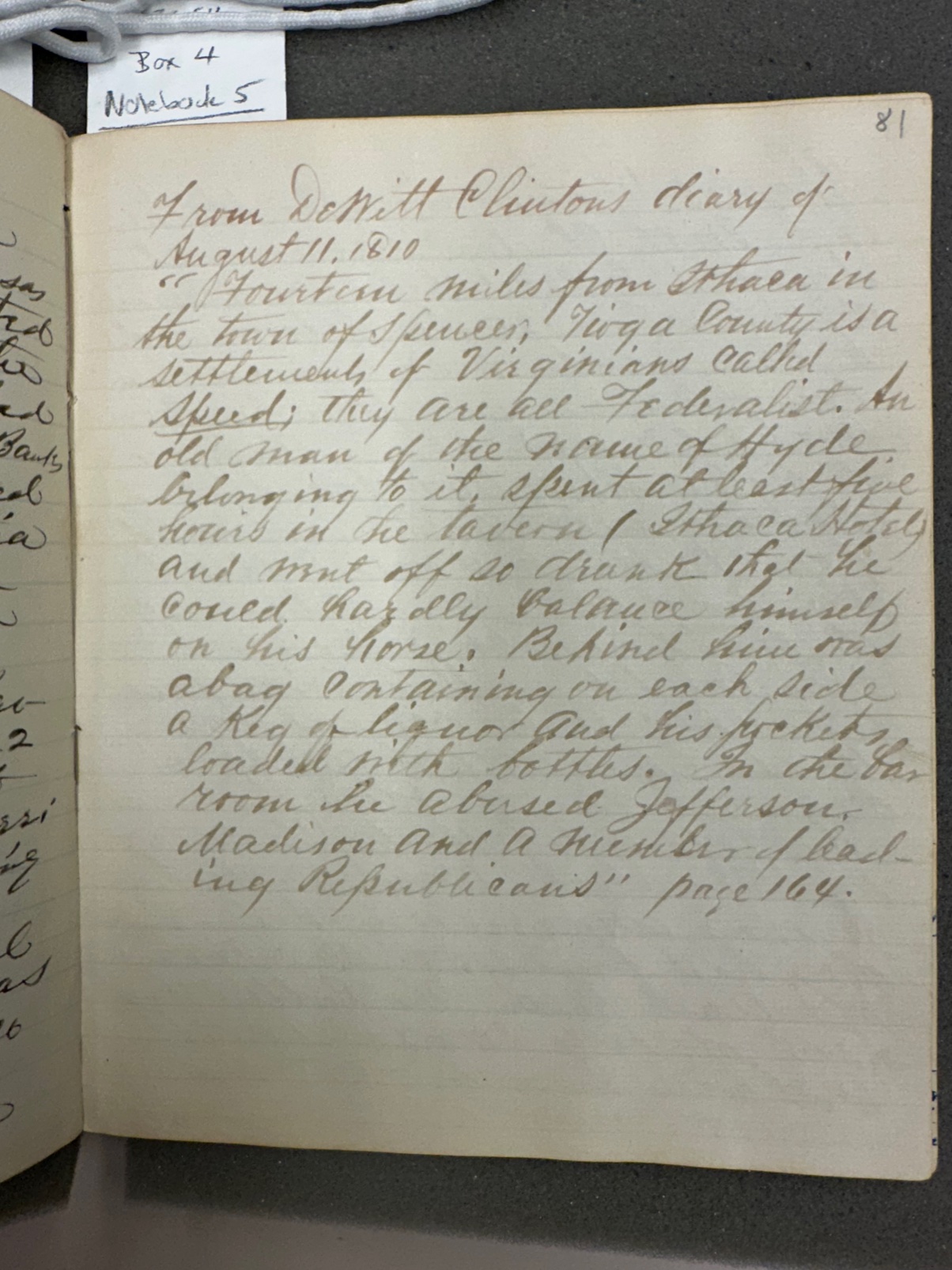
From DeWitt Clinton's diary of August 11, 1810. “Fourteen miles from Ithaca in the town of Spencer, Tioga County, is a settlement of Virginians called Speed. They are all Federalists. An old man of the name of Hyde belonging to it spent at least five hours in the tavern (Ithaca Hotel) and went off so drunk that he could hardly balance himself on his horse. Behind him was a bag containing on each side a keg of liquor and his pockets loaded with bottles. In the bar room he abused Jefferson, Madison, and a number of leading Republicans” page 164.
V_0193
82
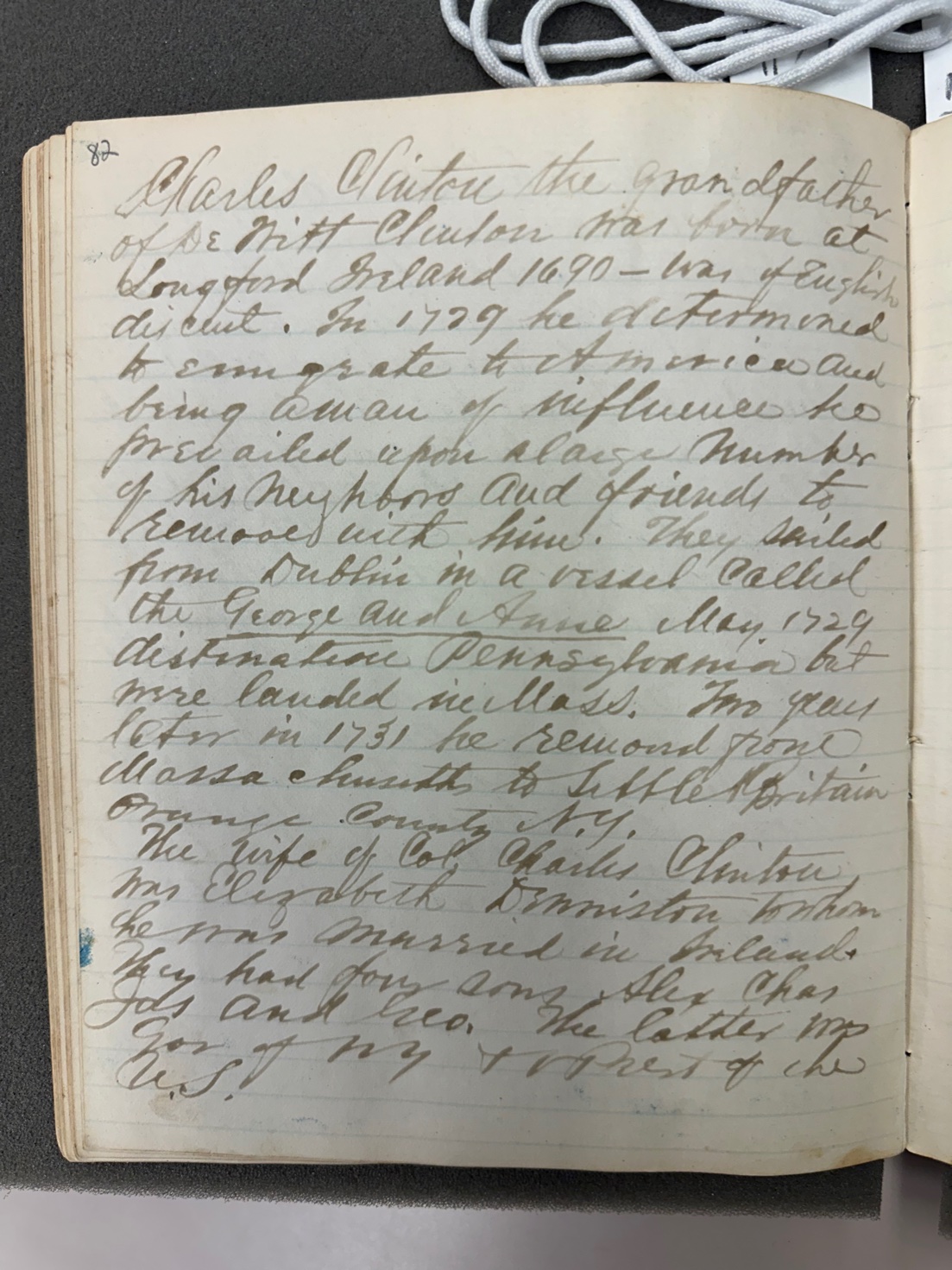
Charles Clinton, the grandfather of DeWitt Clinton, was born in Longford, England, 1690—was of English descent. In 1729, he determined to emigrate to America and being a man of influence he prevailed upon a large number of his neighbors and friends to move with him. They sailed from Dublin in a vessel called the George and Anne May 1729, destination Pennsylvania but were landed in Mass. Two years later, in 1731, he removed from Massachusetts to Little Britain Orange County N.Y. The wife of Col Charles Clinton was Elizabeth Denniston, to whom he was married in Ireland. They had four sons, Alex, Chas, Jas, and Geo. The latter was Governor of NY + v Prest of the U.S.
V_0194
83
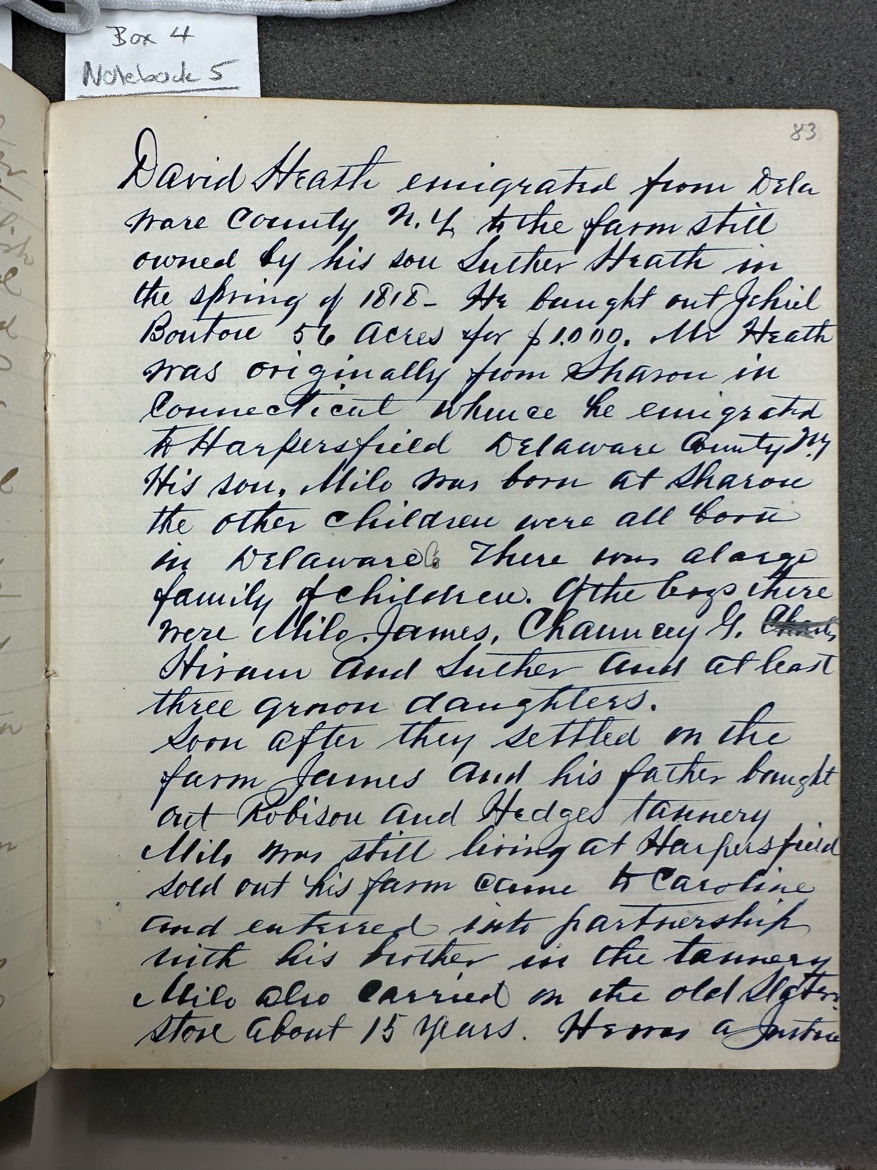
David Heath emigrated from Delaware County, N.Y. to the farm still owned by his son Luther Heath in the spring of 1818. He bought out Jehiel Bouton 56 acres for $1,000. Mr. Heath was originally from Sharon in Connecticut whence he immigrated to Harpersfield Delaware County N.Y. His son Milo was born in Sharon. The other children were all born in Delaware. There was a large family of children. Of the boys, there were Milo, James, Chauncey G, Charles Hiram and Luther and at least three grown daughters.
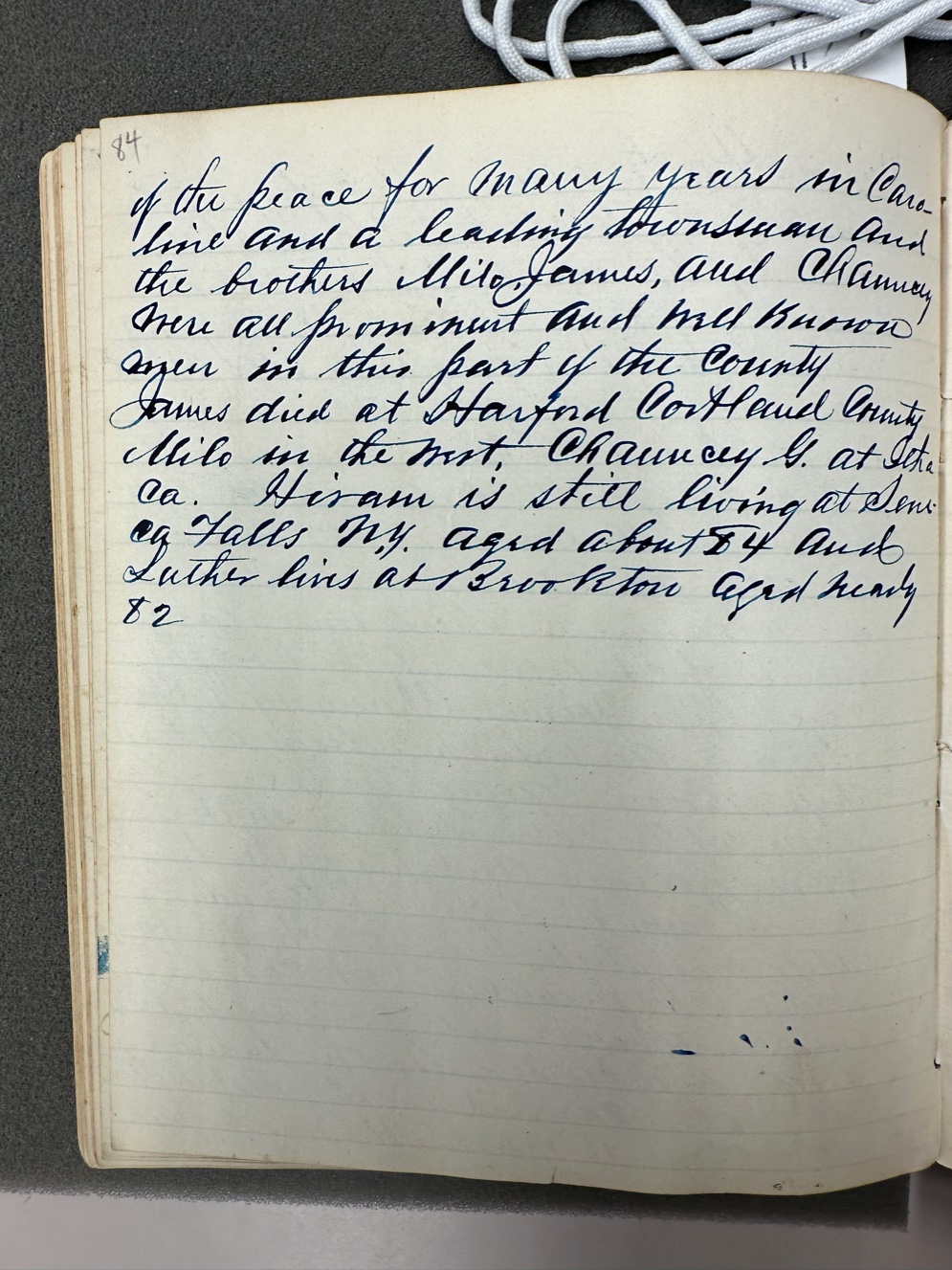
Soon after they settled on the farm James and his father bought out Robison and Hedges tannery. Milo was still living in Harpersfield sold out his farm came to Caroline and entered into partnership with his father in the tannery. Milo also carried on the old Slater store about 15 years. Hiram a Justice
V_0195
84
of the Peace for many years in Caroline and a leading townsman and the brothers Milo, James, and Chauncey were all prominent and well known men in this part of the county James died at Harford, Cortland County Milo in the West, Chauncey G. at Ithaca. Hiram is still living in Seneca Falls N.Y., aged about 84 and Luther lives at Brookton aged nearly 82
V_0196
85
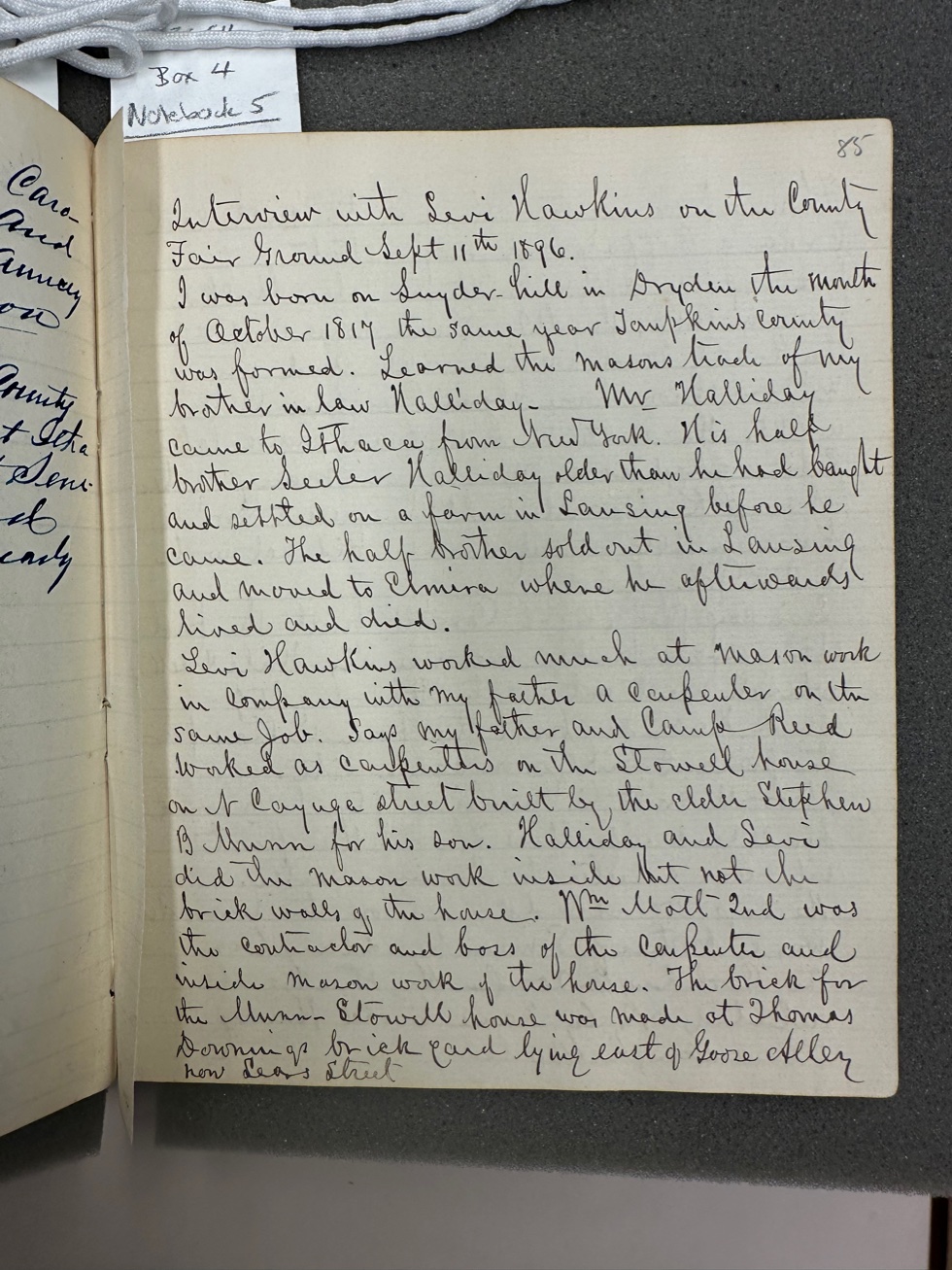
Interview with Levi Hawkins on the county fairground, September 11th 1896. I was born on Snyder Hill in Dryden the month of October 1817, the same year Tompkins County was formed. Learned the masons trade of my brother in law Halliday. Mr. Halliday came to Ithaca from New York. His half-brother Seeler Halliday older than he had bought and settled on a farm in Lansing before he came. The half brother sold out in Lansing and moved to Elmira, where he afterwards lived and died. Livi Hawkins worked much at mason work in company with my father a carpenter on the same job. Says my father and Camp Reed worked as carpenters on the Stowell House on North Cayuga Street built by the elder Stephen B. Munn for his son. Halliday and Levy did the mason work inside but not the brick walls of the house. Wm Mott 2nd was the contractor and boss of the carpenter and inside mason work of the house. The brick for the Munn-Stowell house was made at Thomas Downing's brick yard lying east of Goose Alley now Sears Street
The Stowell House is now the William Henry Miller Inn.
V_0197
86
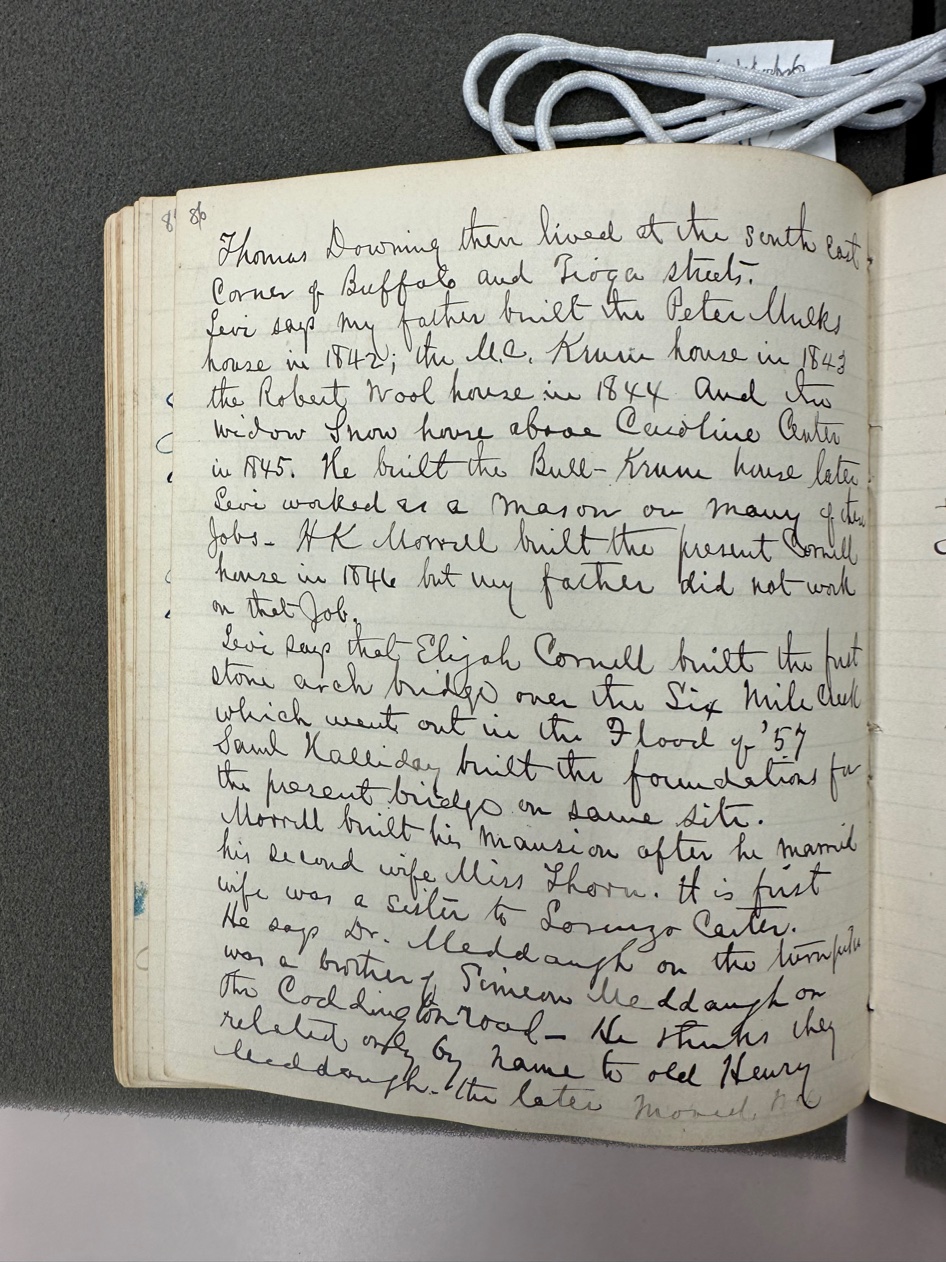
Thomas Downing then lived at the southeast corner of Buffalo and Cayuga Streets. Levi says my father built the Peter Mulks house in 1842, the M.C. Krum house in 1843, the Robert Wool house in 1844, and the Widow Snow house above Caroline Center in 1845. He built the Bull-Krum house later. Levi worked as a mason on many of these jobs. H.K. Morrill built the present Cornell House in 1846, but my father did not work on that job. Levi says that Elijah Cornell built the first stone arch bridge over Six Mile Creek, which went out in the flood of '57. Samuel Halliday built the foundation for the present bridge on the same site. Morrill built his mansion after he married his second wife, Miss Thorn. His first wife was a sister of Lorenzo Carter. He says Dr. Middaugh on the turnpike was a brother of Simeon Middaugh on the Coddington Road. He thinks they were related only by name to old Henry Middaugh. The later[sic] moved west.
V_0198
87
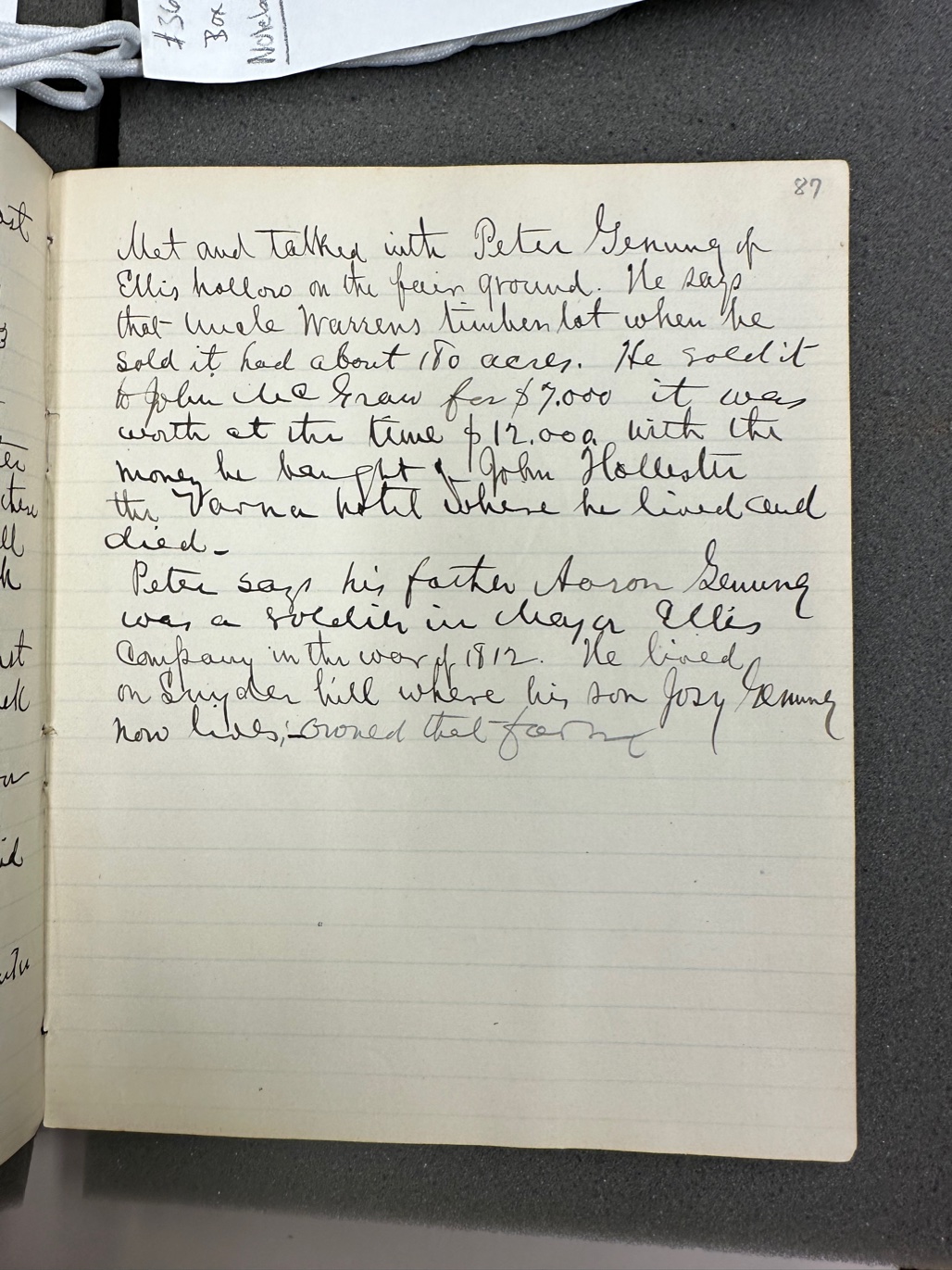
Met and talked with Peter Genung of Ellis Hollow on the fairground. He says that Uncle Warren's timber lot, when he sold it, had about 180 acres. He sold it to John McGraw for $7,000. It was worth, at the time, $12,000. With the money he bought of John Hollister the Varna Hotel where he lived and died. Peter said his father, Aaron Genung, was a soldier in Major Ellis Company in the War of 1812. He lived on Snyder Hill where his son, Josy Genung, now lives, owned that farm.
V_0199
88
Page is blank.
V_0200
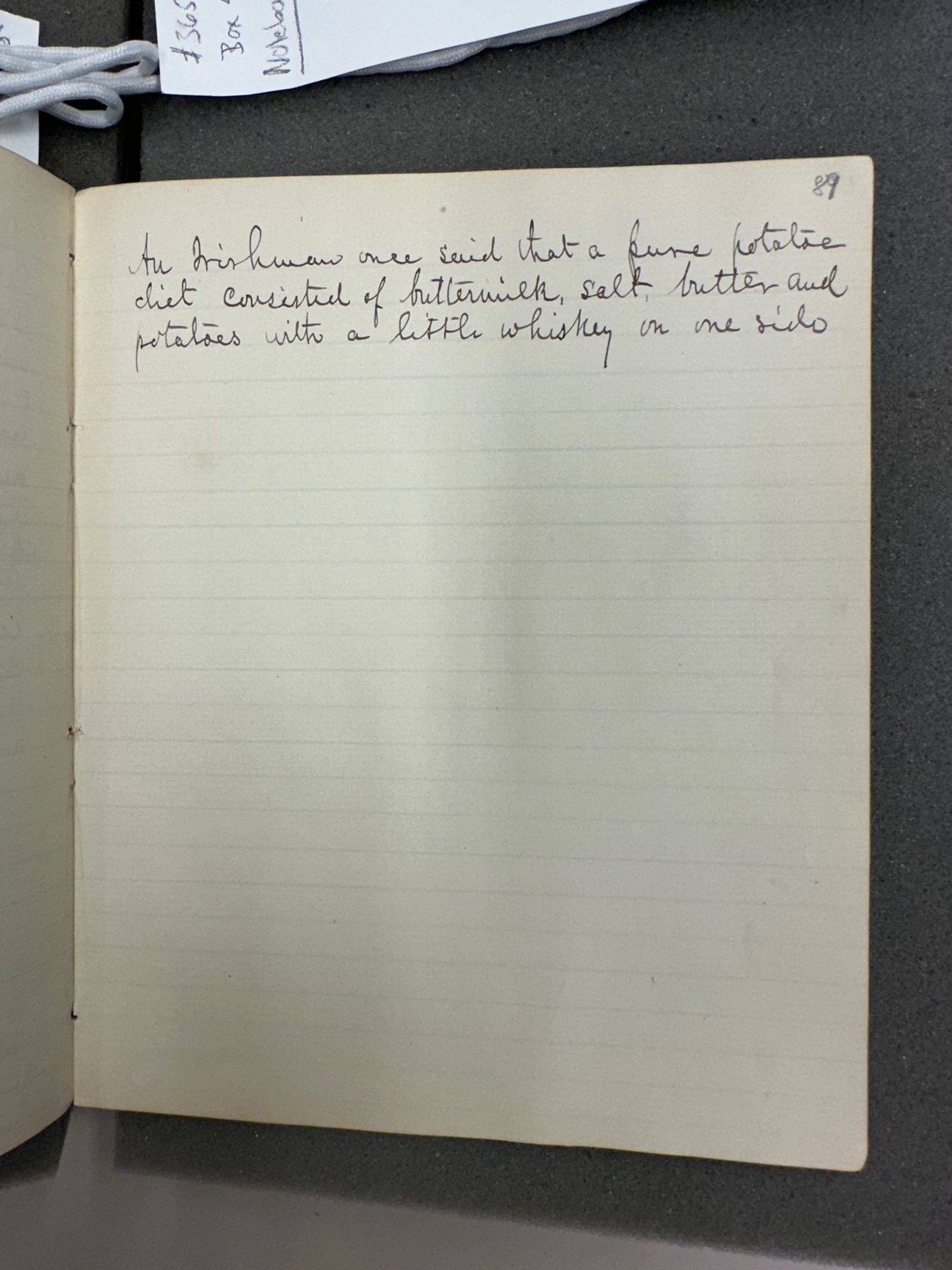
89
An Irishman once said that a pure potato diet consists of buttermilk, salt, butter, and potatoes with a little whiskey on one side.
V_0201
90
Page is blank.
V_0202
91
Page is blank.
V_0203
92
Page is blank.
V_0204
93
Page is blank.
V_0205
94
Page is blank.
V_0206
95
Page is blank.
V_0207
96
Page is blank.
V_0208
97
Page is blank.
V_0209
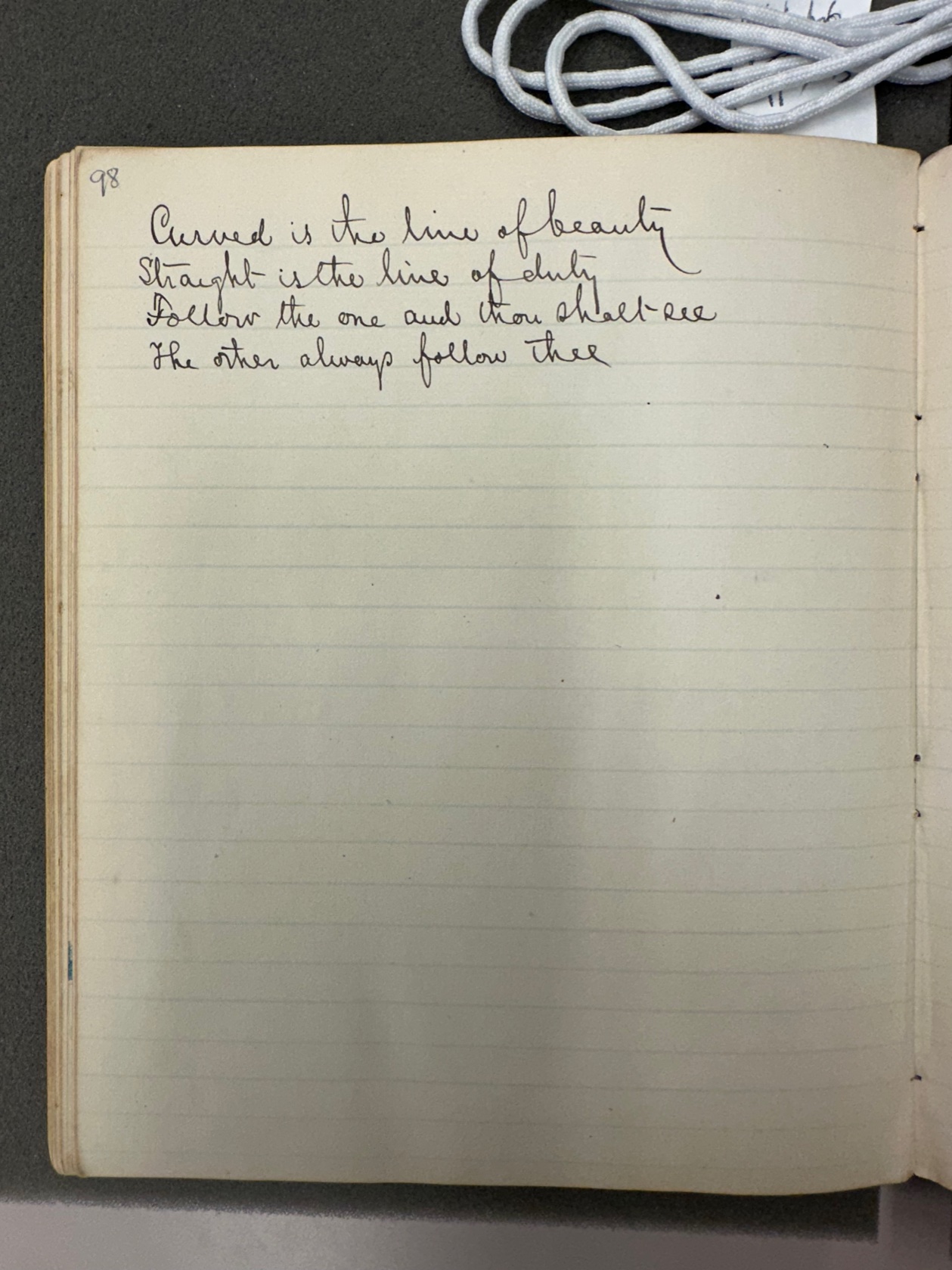
98
Curved is the line of beauty Straight is the line of duty Follow the one and thou shalt see The other always follow thee
V_0210
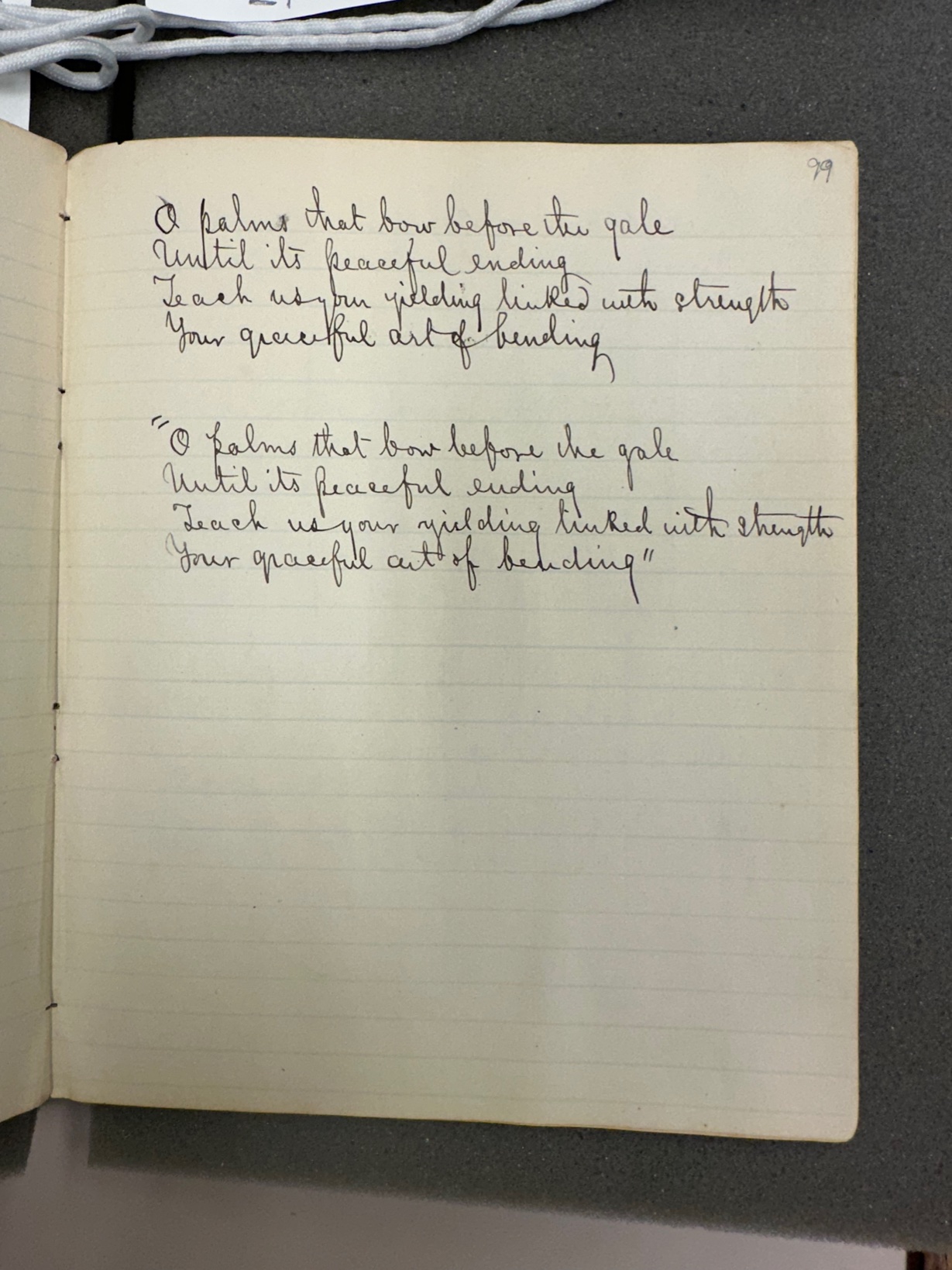
99
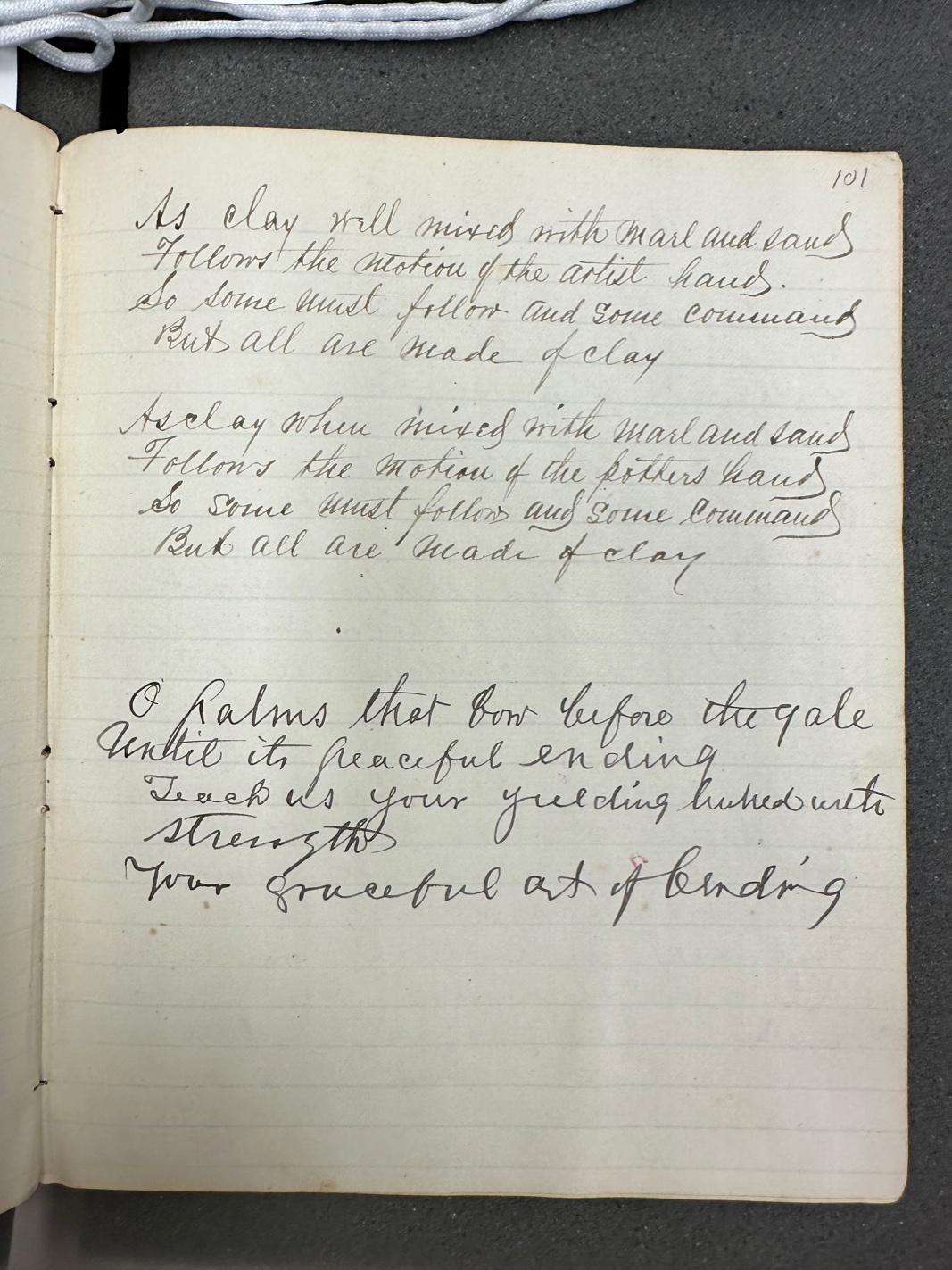
O palms that bow before the gale Until its peaceful ending Teach us your yielding linked with strength Your graceful art of bending
“O palms that bow before the gale Until its peaceful ending Teach us your yielding linked with strength Your graceful art of bending”
V_0211
100
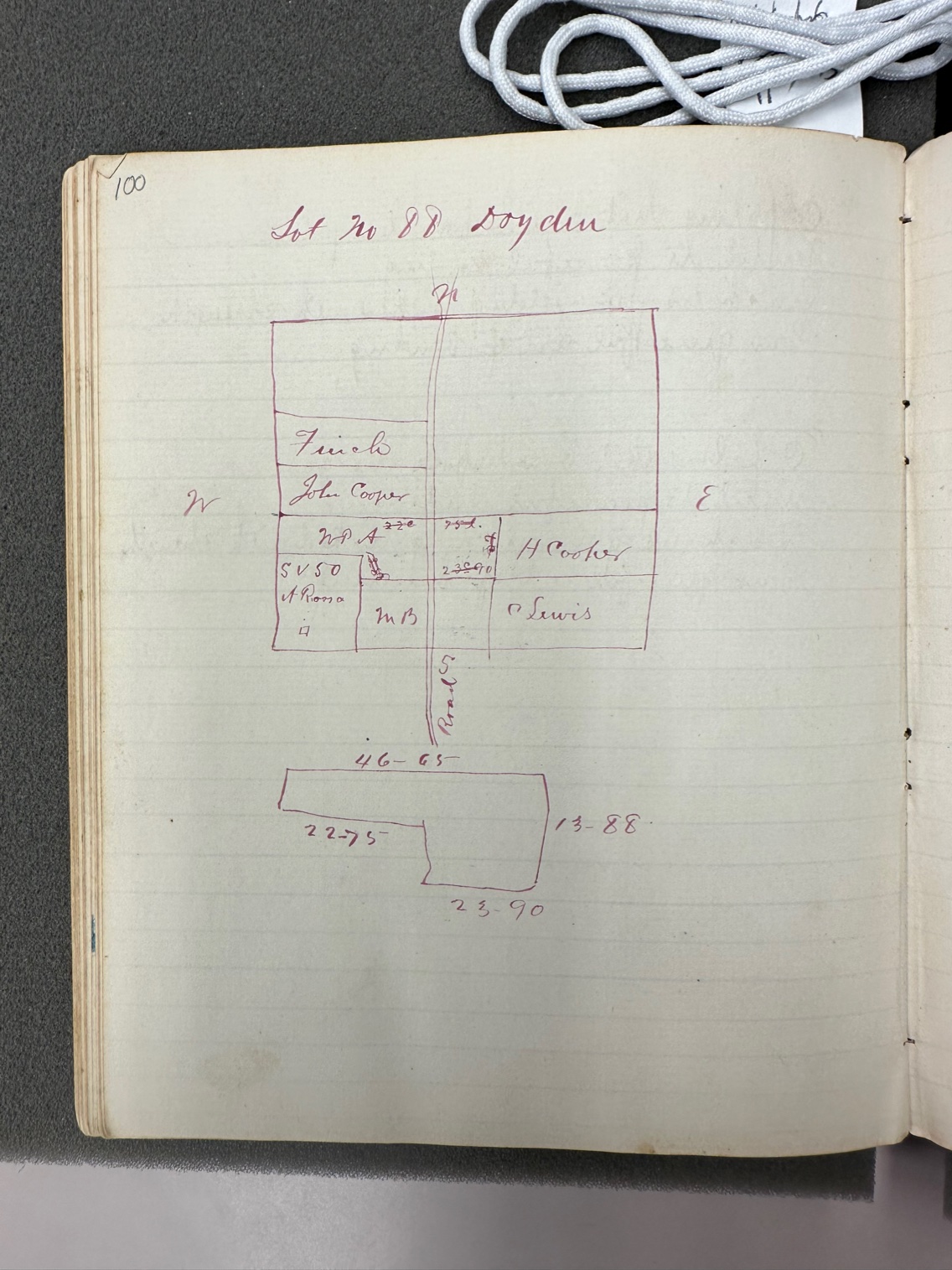
Lot no 88 Dryden
Plat map of the lot with names Finch, John Cooper, WPA, H Cooper, A Roma, MB, Lewis.
V_0212
V_0213
V_0214
V_0215
V_0216
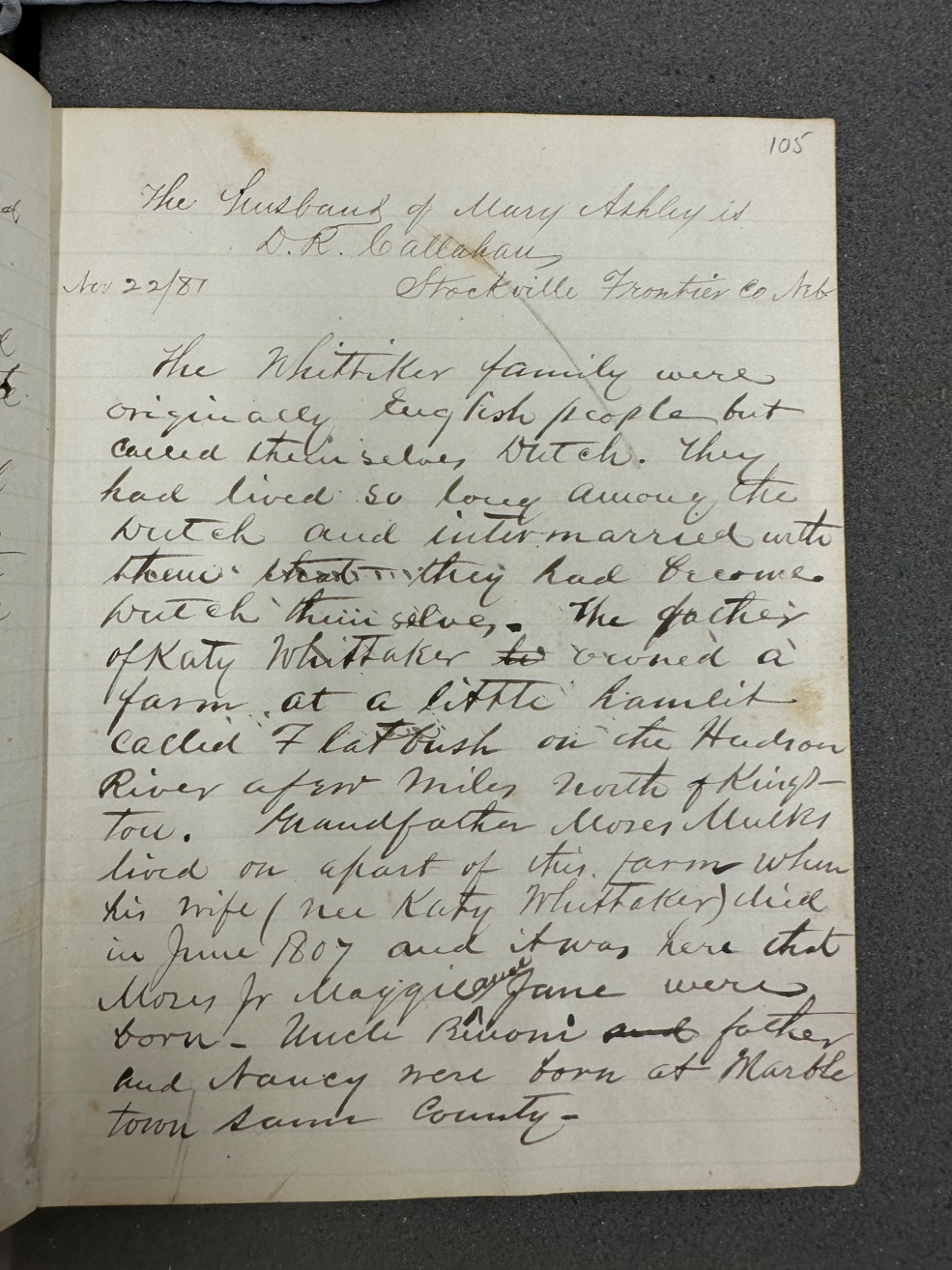
105
The Whittaker family were originally English people, but called themselves Dutch. They had lived so long among the Dutch and intermarried with them that they had become Dutch themselves. The father of Katy Whittaker owned a farm at a little hamlet called “Flatbush” on the Hudson River, a few miles north of Kingston. Grandfather Moses Mulks lived on a part of this farm when his wife (née Katy Whittaker) died in June 1807. And it was here that Moses Jr., Maggie, and Jane were born. Uncle Benoni said father and Nancy were born in Marbletown, same county.
V_0217
106
Page is blank.
V_0218
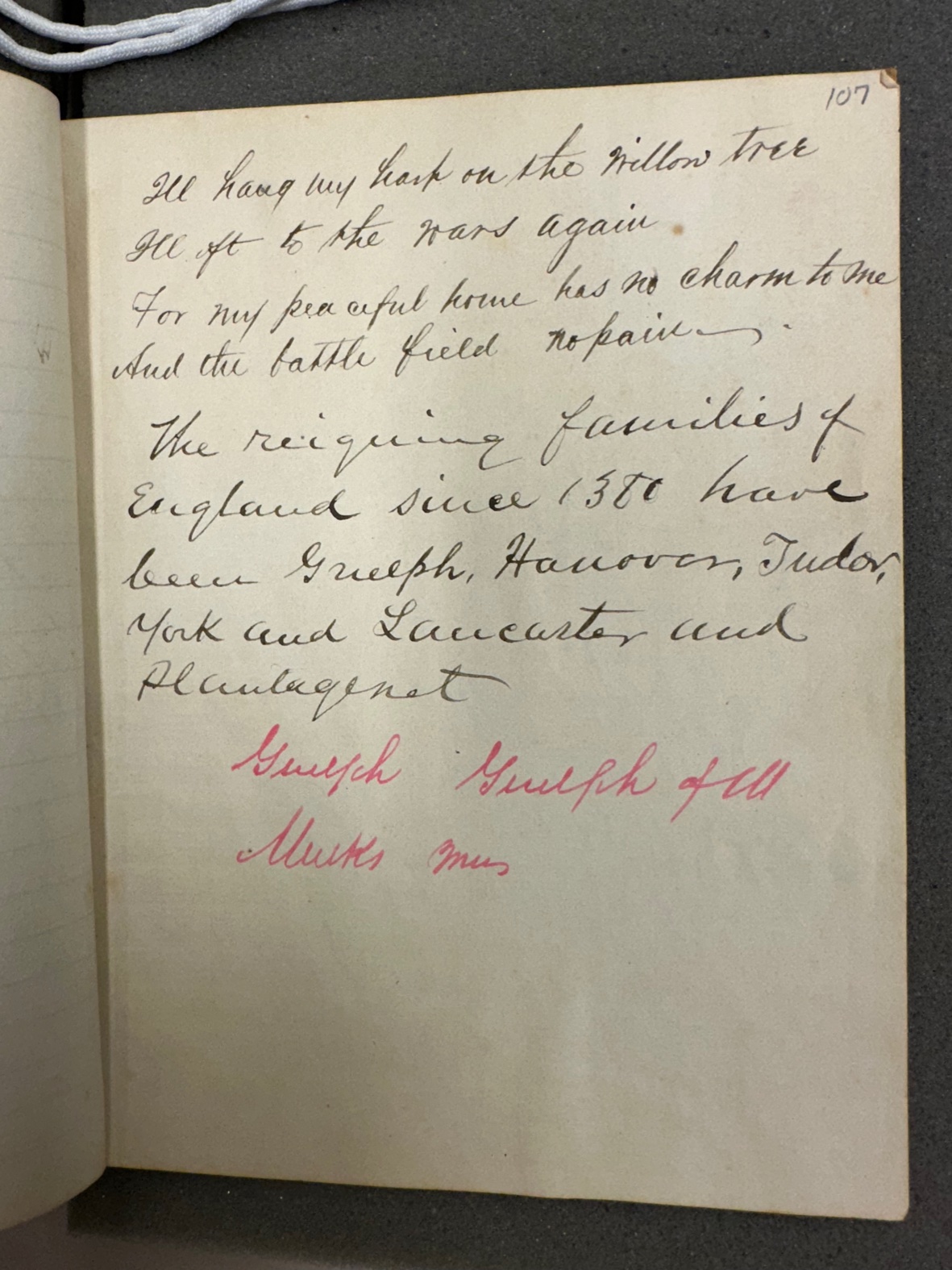
107
I'll hang my harp on the willow tree I'm oft[sic] to the wars again For my peaceful home has no charm to me And the battlefield no pain.
The reigning families of England since 1380 have been Guelph, Hanover, Tudor, York and Lancaster and Plantagenet
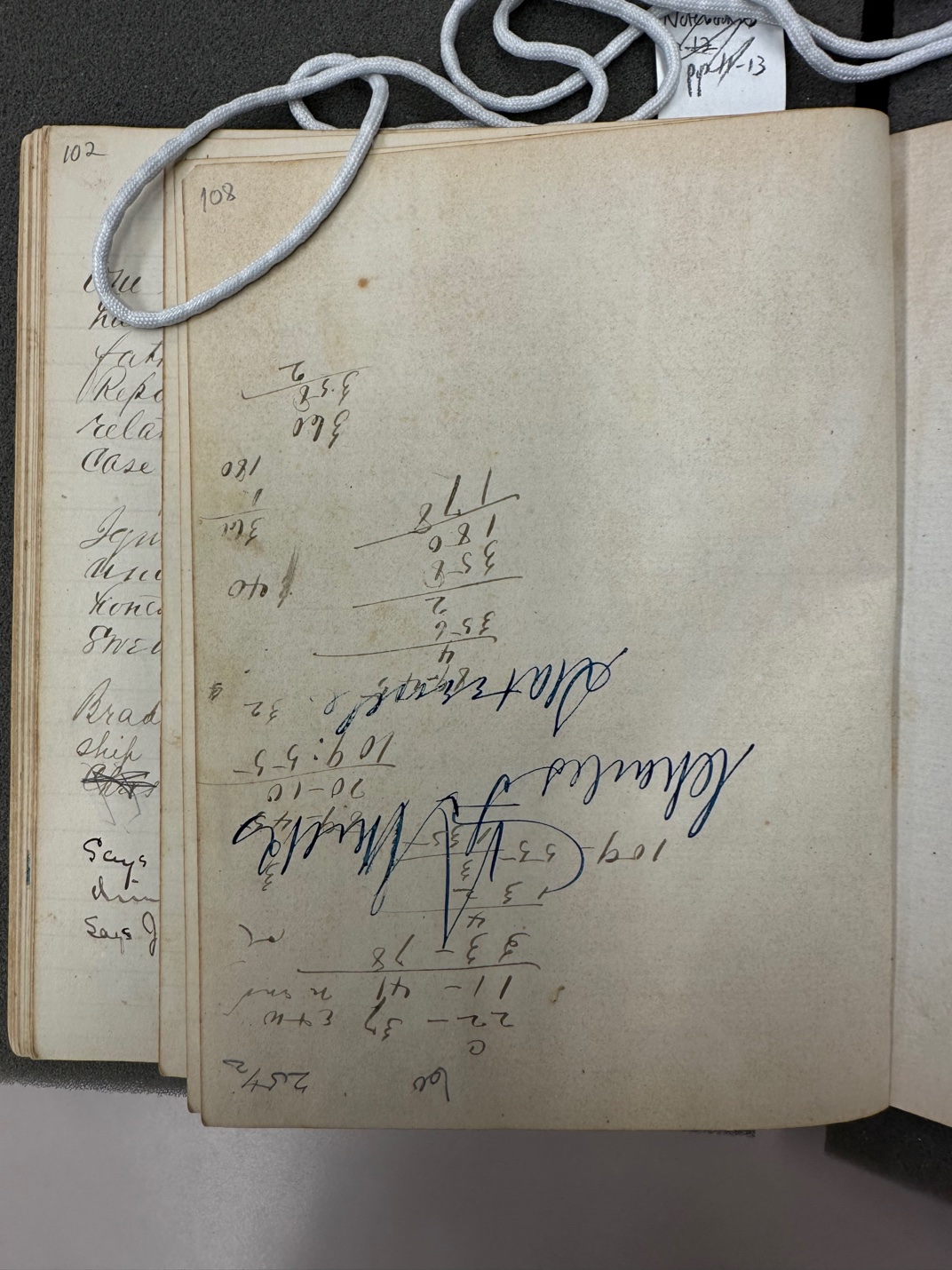
V_0219
108
Charles Mulks Slaterville
Text is written with page rotated 180º. Besides the signature rows of numerical computations appear.
V_0220
Inside of back cover.
V_0221
Outside of back cover.